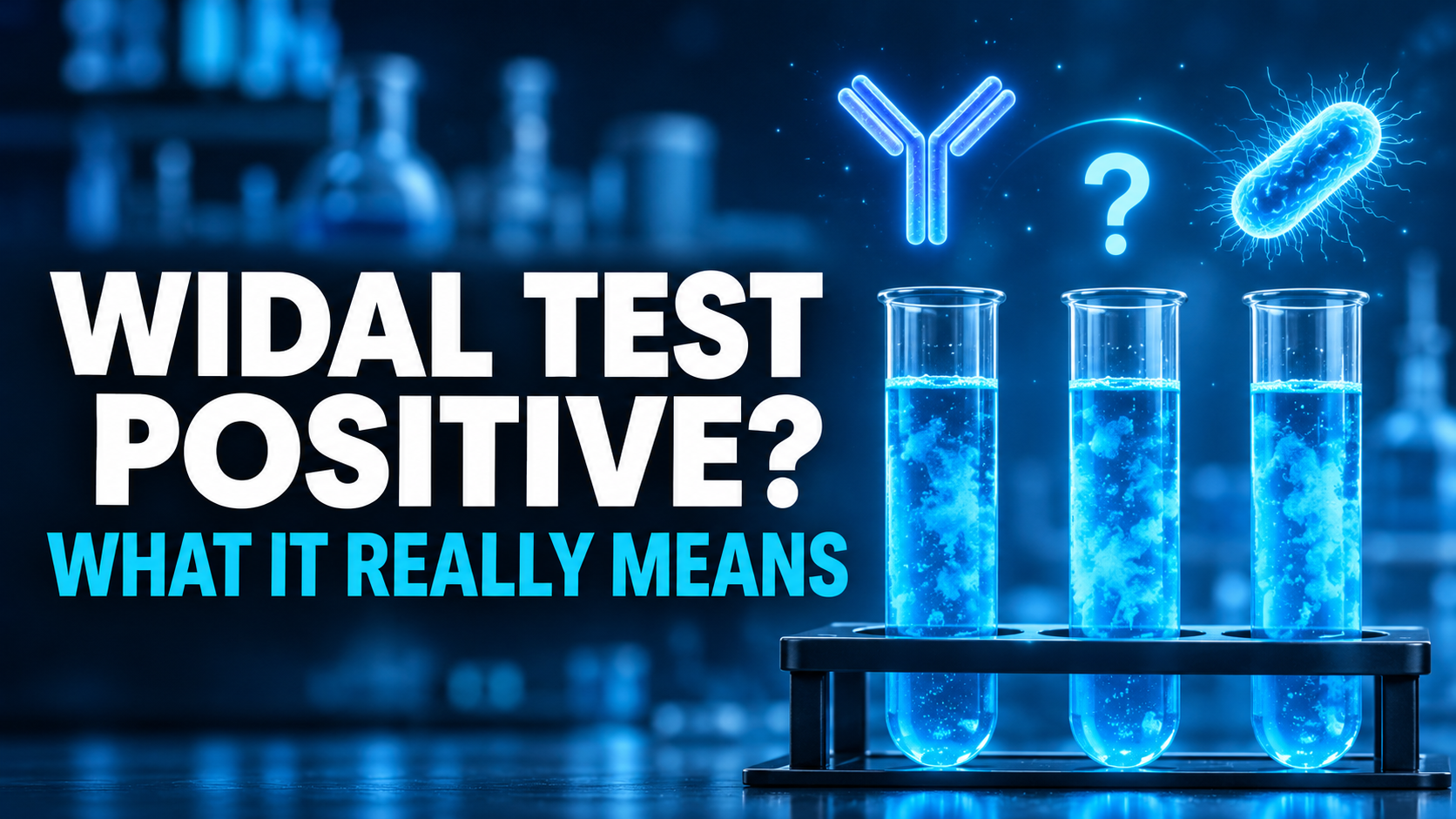
Your doctor orders a Widal test for a long fever, the report says “positive” with numbers like 1:80 or 1:160, and suddenly you are told you have typhoid. Or the opposite: the Widal is negative but the fever continues. In many countries the Widal test is still widely used, yet international guidelines say it should not be used to diagnose typhoid. In this guide you will learn what the numbers mean, why the test gives false results, which tests are better, why this matters in places affected by drug-resistant typhoid, and what to do after a positive report.
What Is the Widal Test?
The Widal test looks for antibodies in your blood against two parts of the typhoid bacterium (Salmonella Typhi): the O antigen and the H antigen. The lab mixes your serum with these antigens in increasing dilutions, and the highest dilution at which clumping (agglutination) still appears is reported as the titre, for example 1:80 or 1:160.
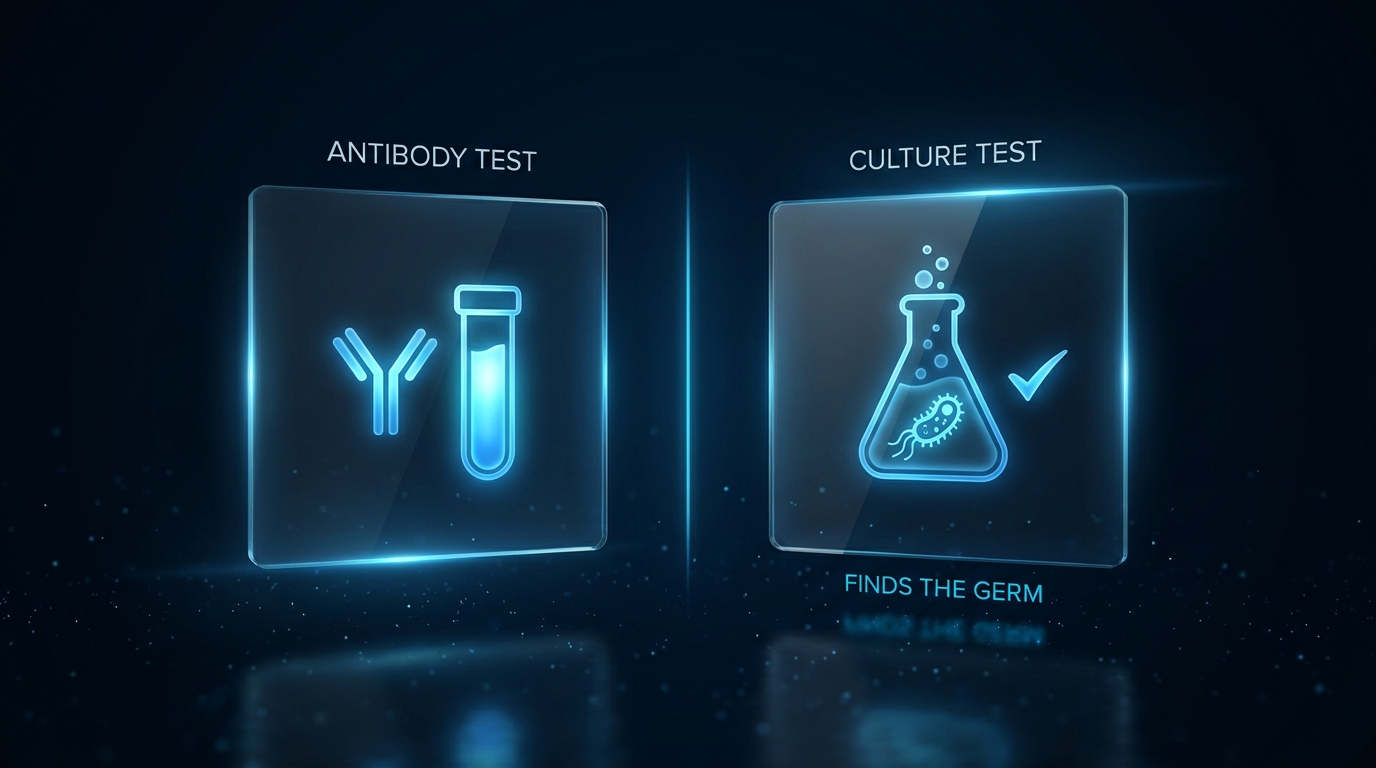
It is an antibody test. It does not find the germ itself. That is the root of most of its problems.

What Do Widal Titres Like 1:80 or 1:160 Mean?
There is no single universal cut-off. Studies have used different ones, and the right cut-off is supposed to be set for each area, based on the antibody levels in healthy people there.
| Study | Cut-off used for a “positive” result |
|---|---|
| An Egyptian study | Titre of 1:160 or more |
| A study of 100 patients (PubMed Central) | 1:80 or more for both O and H |
| A Nepalese study | More than 1:80 for O and more than 1:160 for H |
| A study based on normal individuals | 1:160 or more for O and 1:320 or more for H |
Different labs use different cut-offs, and the “normal range” printed on your report is specific to that lab. Compare your result with the range on your own report.
A research team writing in a PubMed Central paper noted that a proper cut-off for a given area should be set against a reliable gold standard, and that such a cut-off cannot be proposed until a proper gold standard is agreed. In practice, a titre at or above your lab’s cut-off is called “positive”, but this does not by itself prove typhoid.
Does a Positive Widal Test Mean You Have Typhoid?
Not necessarily. The CDC clinical guidance states that serologic tests such as the Widal test are not recommended because of a high rate of false positives. The CDC Yellow Book adds that these tests do not distinguish acute infection from past infection or vaccination and lack specificity.
A BMJ practice pointer on enteric fever says the same thing: serological tests including the Widal test and newer rapid tests are not confirmatory in the acute phase of illness.
Why Can Widal Be Positive Without Typhoid?
- Past infection or vaccination can leave antibodies in the blood.
- Living in an endemic area means many healthy people already have a baseline level of antibodies.
- Other illnesses can cross-react. In one study, a Brucella test recognised the same titres in samples from culture-positive typhoid patients, showing how antibody tests may overlap.
Can Widal Be Negative Even If You Have Typhoid?
Yes, and this is just as important.
- In an Egyptian study, of 25 patients with culture-proven typhoid, only 14 (56%) had a Widal titre of 1:160 or higher.
- In an Indian study of 105 children, Widal was positive in only about 34% of those with culture-confirmed typhoid. Among children with fever lasting less than one week, Widal was positive in 24.2%, compared with 96.9% for Typhidot-M.
- A Nepalese study found that Widal sensitivity and specificity were far lower than those of ELISA: about 0.72 and 0.58 for the anti-H test and 0.80 and 0.51 for the anti-O test, compared with about 0.95 for both with ELISA IgG and IgM.
Antibodies take time to build up. Early in the illness, the test is more likely to be negative or low.
What Is the Best Test for Typhoid?
Blood culture is the preferred method. The CDC says blood culture is the mainstay of diagnosis, and bone marrow culture, with a sensitivity of about 80% in some studies, can remain positive even after antibiotics have been started. Stool and urine cultures are positive less often.
Blood culture also has limits:
- A single culture is positive in only about half of cases, according to the CDC Yellow Book, so multiple cultures may be needed.
- The BMJ pointer gives a blood culture sensitivity of 61%, and says a negative culture does not rule out typhoid. Results take two to three days.
- Antibiotics taken before the test can make the culture negative.
Even so, culture gives an advantage that Widal never can: it grows the germ, which allows antibiotic sensitivity testing. This is why CDC guidance says serologic tests do not provide an isolate for susceptibility testing and should not be used to diagnose typhoid.
Typhidot and Other Rapid Tests
Rapid antibody tests such as Typhidot are common. The CDC Yellow Book states that several commercial rapid tests exist but their sensitivity and specificity are not optimal. The BMJ pointer also says they are not confirmatory in the acute phase. A positive rapid test should be seen as a clue, not a final diagnosis.
Why This Matters in Pakistan: XDR Typhoid
Typhoid in South Asia is changing. According to the CDC Yellow Book, an outbreak of extensively drug-resistant (XDR) typhoid began in Sindh Province, Pakistan, in 2016, and a CDC document reports over 10,000 cases between 2016 and 2019. This strain is resistant to most antibiotics commonly used for typhoid.
A study in Pakistan found that XDR typhoid had spread from Sindh to Punjab and beyond. Its authors report that serological tests were more routinely used than blood culture, although blood culture is needed for a definitive diagnosis, and that inappropriate diagnostic tests and antibiotic practices may lead to missed XDR cases and promote resistance. Of 321 front-line healthcare workers surveyed, only 43.6% had heard of XDR typhoid. A large laboratory network also stopped offering Typhidot and Widal tests after raising awareness among doctors.
The practical message: a Widal report cannot tell which antibiotic will work, but a culture with sensitivity testing can.
Symptoms of Typhoid Fever
According to the CDC, symptoms of typhoid fever include fever, headache, constipation or diarrhoea, weakness (malaise), chills and muscle aches. The illness usually begins gradually. Typhoid and paratyphoid fever cannot be told apart by symptoms alone. Typhoid can also relapse, usually one to three weeks after the first improvement.
Typhoid can become serious. Complicated disease can lead to blood infection with sepsis or shock, and digestive tract complications.
What Should You Do After a Positive Widal Report?
- Do not panic and do not self-treat. A positive Widal alone does not confirm typhoid.
- See a doctor and share your full story: how long the fever has lasted, other symptoms, recent antibiotics, vaccination history and where you live or travelled.
- Ask about a blood culture, ideally before antibiotics are started, and ask for antibiotic sensitivity testing.
- Ask about other tests. The BMJ pointer notes that a complete blood count and blood culture help the diagnosis.
- Take antibiotics only as prescribed, and finish the course. Taking the wrong or incomplete antibiotics can promote resistance and make culture results unreliable.
- Go to the hospital urgently if you have severe abdominal pain, repeated vomiting, black stools or vomiting blood, confusion, a very high fever, or become very weak. For first-response steps, see our first aid guide.
For fever and body pain, remember to use medicines only as directed. You can test your understanding with our paracetamol MCQs. If you want to understand the abbreviations on lab reports, such as CBC or IgM, see our medical abbreviations guide.
How Can You Prevent Typhoid?
- Vaccination: the BMJ pointer notes that the typhoid Vi conjugate vaccine is now recommended by the WHO, and the CDC recommends vaccination for travellers to endemic regions such as South Asia, including Pakistan, India and Bangladesh. Ask your doctor which vaccine is available and suitable for you.
- Safe water and food: drink boiled or properly treated water, eat freshly cooked food, and avoid uncovered street foods and unwashed raw items. (This is standard prevention advice.)
- Hand hygiene: wash hands with soap after using the toilet and before preparing or eating food.
Key Takeaways
- The Widal test measures antibodies, not the typhoid germ, and it cannot reliably tell current infection from past infection or vaccination.
- CDC guidance says Widal and similar serologic tests are not recommended to diagnose typhoid because of false positives.
- Studies show Widal can also miss many real cases, especially early in the illness.
- Blood culture is the preferred test, and it allows antibiotic sensitivity testing, which matters in XDR typhoid areas.
- A positive report means “see your doctor”, not “start antibiotics on your own”.
Conclusion
A positive Widal test is a starting point for a conversation with your doctor, not a diagnosis. In regions where drug-resistant typhoid is spreading, getting a blood culture before antibiotics and following your doctor’s plan can make the difference between quick recovery and complications. Ask questions, avoid self-medication, and do not stop treatment early.
Frequently Asked Questions
What does a positive Widal test mean?
It means antibodies against typhoid antigens were found at or above your lab’s cut-off. It does not prove you have typhoid, because past infection, vaccination and other illnesses can also cause a positive result.
What is the normal range for the Widal test?
There is no single universal range. Studies use cut-offs such as 1:80, 1:160 or 1:320, and each lab has its own reference range. Compare your result with the range on your own report.
Is Widal 1:160 positive for typhoid?
A titre of 1:160 or more is considered positive in many labs and studies, but guidelines say the test is not recommended for diagnosis, and a blood culture is the preferred test.
Can the Widal test be negative in typhoid?
Yes. Studies show many culture-proven cases have a negative or low Widal result, especially in the first week of fever.
Which test is better than Widal for typhoid?
Blood culture is the preferred test, and bone marrow culture can be more sensitive in some cases. Rapid antibody tests are not confirmatory in the acute phase.
Should I take antibiotics if my Widal is positive?
Only if your doctor prescribes them after assessing you. Do not self-medicate, because XDR typhoid is resistant to many common antibiotics.
Is there a vaccine for typhoid?
Yes. The typhoid Vi conjugate vaccine is recommended by the WHO. Ask your doctor about vaccination.
Disclaimer: This article is for educational purposes only and is not a substitute for professional medical advice, diagnosis or treatment. If you have a long-lasting fever, see a doctor. Do not start, stop or change antibiotics without medical advice.
Widal Test and Typhoid Knowledge Quiz
Available options: 1 to 20
References
- CDC. Clinical Guidance for Typhoid Fever and Paratyphoid Fever.
- CDC Yellow Book. Typhoid and Paratyphoid Fever.
- CDC MMWR 2019;68:11-13. Extensively drug-resistant Salmonella Typhi infections associated with travel to Pakistan.
- BMJ practice pointer. Enteric fever (typhoid and paratyphoid fever).
- Pakistan XDR typhoid study: PMC8045622.
- Indian Pediatrics 2010;47:331-333. Comparison of Typhidot-M and Widal test with blood culture.
- Sensitivity of Widal test in culture-proven typhoid (PMC130816).
- Comparison of Widal test and ELISA in typhoid fever. BMC Infect Dis 2015 (s12879-015-1248-6).