A patient with a chest infection looks unwell. The nurse counts the breathing rate, checks the blood pressure and notes that the patient seems a little confused. Within moments, the team has to decide a hard question: could this be sepsis? Over the last thirty years, three scoring tools have been used to help answer it: SIRS, SOFA and qSOFA. They are easy to mix up, and they are not interchangeable. This guide explains what each tool measures, how to calculate the qSOFA score, how to read it, why the 2021 sepsis guideline warns against relying on it alone, and how the pieces fit together, with six worked examples.

Table of Contents
- What sepsis means today
- The qSOFA score
- How to calculate qSOFA
- SIRS criteria
- The SOFA score
- Septic shock
- qSOFA vs SIRS vs SOFA
- Six worked examples
- What the 2021 guideline says
- Limitations
- Common mistakes
- Tips for students and nurses
- Frequently asked questions
- Key takeaways
1. What Sepsis Means Today
In 2016, an international task force published the Sepsis-3 definitions. They describe sepsis as life-threatening organ dysfunction caused by a dysregulated host response to infection. The old stage called “severe sepsis” was dropped as redundant, and the focus moved from inflammation to organ dysfunction. In practice, organ dysfunction is shown by a rise in the SOFA score of 2 points or more, which is associated with an in-hospital mortality above 10%. You can read the original consensus in Sepsis-3 on PubMed.
Sepsis is a medical emergency, and the earlier it is recognized, the better the outlook. That is why quick bedside tools exist.
2. The qSOFA Score
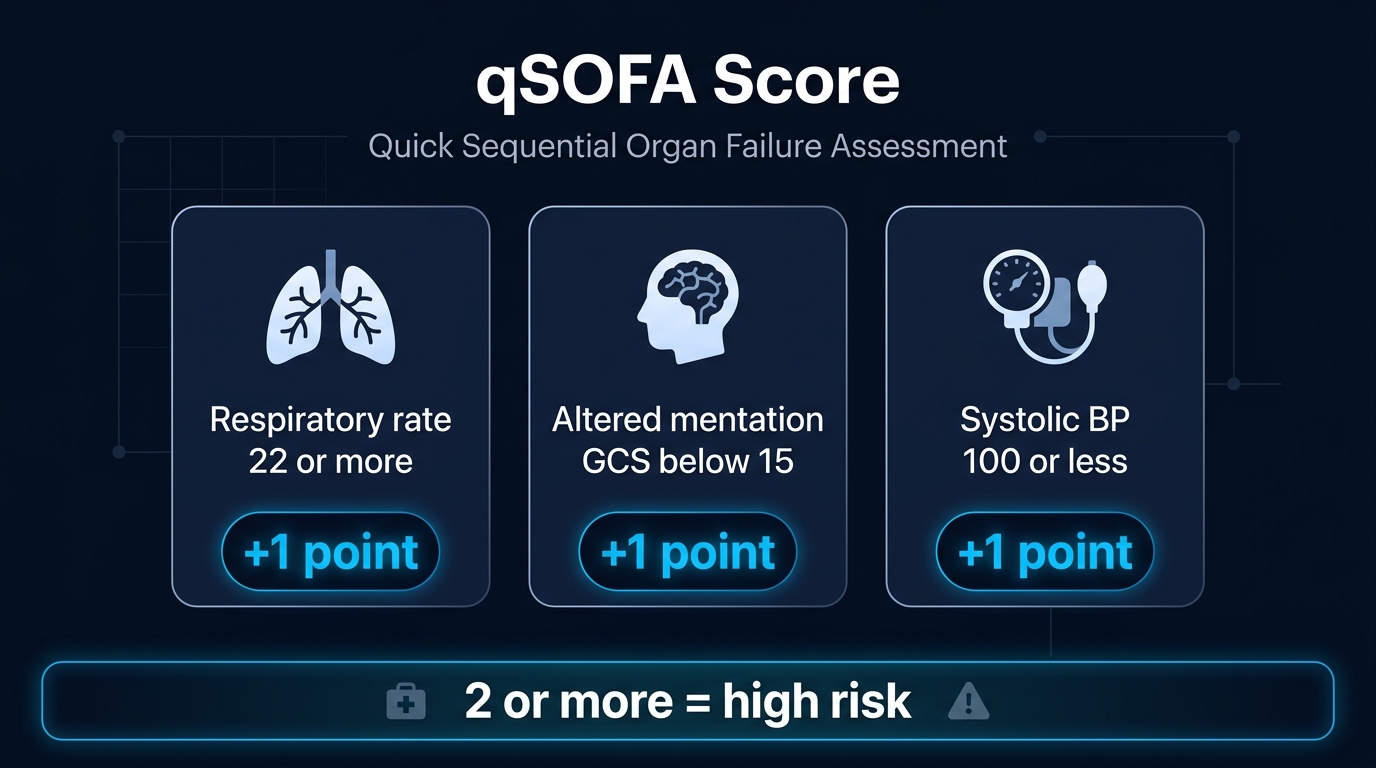
qSOFA stands for quick Sequential Organ Failure Assessment. It was created by the Sepsis-3 group, using data from roughly 75,000 patients, as a simple bedside check for adults with suspected infection outside the ICU (emergency department, wards, ambulance). It needs no blood tests, only three observations:
| Criterion | Point |
|---|---|
| Respiratory rate 22 breaths per minute or more | 1 |
| Altered mentation (Glasgow Coma Scale below 15) | 1 |
| Systolic blood pressure 100 mmHg or less | 1 |
Total: 0 to 3. A score of 2 or more means a higher risk of a poor outcome, such as ICU admission or death, and signals that the patient should be assessed urgently for organ dysfunction and sepsis.
Memory trick: “RAS” (Respiratory rate, Altered mentation, Systolic pressure), or simply “22, 15, 100”: breathing 22 or more, GCS below 15, BP 100 or less.
An important detail from the original design: qSOFA was developed as a risk stratifier, not as a screening tool, as the EMRA overview of Sepsis-3 points out. It is meant for patients in whom infection is already suspected.
3. How to Calculate qSOFA
- Confirm that infection is suspected. The tool is not for patients without a suspected source.
- Count the respiratory rate for a full minute. See our guide to the normal respiratory rate for how to count correctly.
- Check mental state. Any confusion, drowsiness or reduced responsiveness (GCS below 15) scores a point. Our Glasgow Coma Scale tool lets you practise the scoring.
- Measure systolic blood pressure.
- Add the points. Two or more is positive.
- Act on the whole picture, not just the number.

4. SIRS Criteria
The systemic inflammatory response syndrome (SIRS) criteria came from older definitions (1991 and 2001). A patient meets SIRS if two or more of these four are present:
| Criterion | Threshold |
|---|---|
| Temperature | Above 38 °C or below 36 °C |
| Heart rate | Above 90 beats per minute |
| Respiratory rate | Above 20 per minute (or PaCO₂ below 32 mmHg) |
| White cell count | Above 12,000 or below 4,000 per µL (or more than 10% immature bands) |
SIRS is sensitive but not specific. It is positive in many hospitalized patients who do not have infection, such as after surgery, burns, pancreatitis or heavy exercise, so using it alone can lead to over-diagnosis. SIRS is no longer part of the Sepsis-3 definition, though it is still used in some screening protocols. The AAFP review of sepsis discusses how SIRS, qSOFA and SOFA are used in practice.
5. The SOFA Score
The Sequential Organ Failure Assessment (SOFA) score measures how well six organ systems are working. Each is scored from 0 (normal) to 4 (severe failure), so the total ranges from 0 to 24. Sepsis is identified by an increase of 2 or more from the patient’s baseline (assumed to be zero unless the patient has known organ disease).
| System | 0 | 1 | 2 | 3 | 4 |
|---|---|---|---|---|---|
| Respiratory (PaO₂/FiO₂, mmHg) | 400 or more | Below 400 | Below 300 | Below 200 with ventilatory support | Below 100 with ventilatory support |
| Coagulation (platelets, ×10³/µL) | 150 or more | Below 150 | Below 100 | Below 50 | Below 20 |
| Liver (bilirubin, mg/dL) | Below 1.2 | 1.2 to 1.9 | 2.0 to 5.9 | 6.0 to 11.9 | Above 12.0 |
| Cardiovascular | MAP 70 or more | MAP below 70 | Dopamine up to 5 or dobutamine | Dopamine above 5, or epinephrine or norepinephrine up to 0.1 | Dopamine above 15, or epinephrine or norepinephrine above 0.1 |
| Central nervous system (GCS) | 15 | 13 to 14 | 10 to 12 | 6 to 9 | Below 6 |
| Renal (creatinine, mg/dL, or urine output) | Below 1.2 | 1.2 to 1.9 | 2.0 to 3.4 | 3.5 to 4.9 or urine output below 500 mL/day | Above 5.0 or urine output below 200 mL/day |
(Vasopressor doses are in µg/kg/min.) SOFA needs blood tests and sometimes an arterial blood gas, so it is mainly used in hospital and ICU settings. For how to judge kidney output in practice, see our guide to normal urine output.
6. Septic Shock
Septic shock is a subset of sepsis with especially high mortality, where circulation and cell metabolism are seriously disturbed. Sepsis-3 defines it as:
- low blood pressure that needs vasopressors to keep the mean arterial pressure (MAP) at 65 mmHg or higher, and
- serum lactate above 2 mmol/L (18 mg/dL), despite adequate fluid resuscitation.
7. qSOFA vs SIRS vs SOFA
| Feature | qSOFA | SIRS | SOFA |
|---|---|---|---|
| Number of items | 3 | 4 | 6 organ systems |
| Needs blood tests | No | Yes (white cell count) | Yes |
| Where used | Ward, ED, pre-hospital | Screening alerts | ICU and hospital |
| Score range | 0 to 3 | 0 to 4 | 0 to 24 |
| Positive when | 2 or more | 2 or more | Rise of 2 or more |
| Strength | Fast and simple | Sensitive | Defines organ dysfunction |
| Weakness | Misses early sepsis | Not specific | Needs tests, not quick |
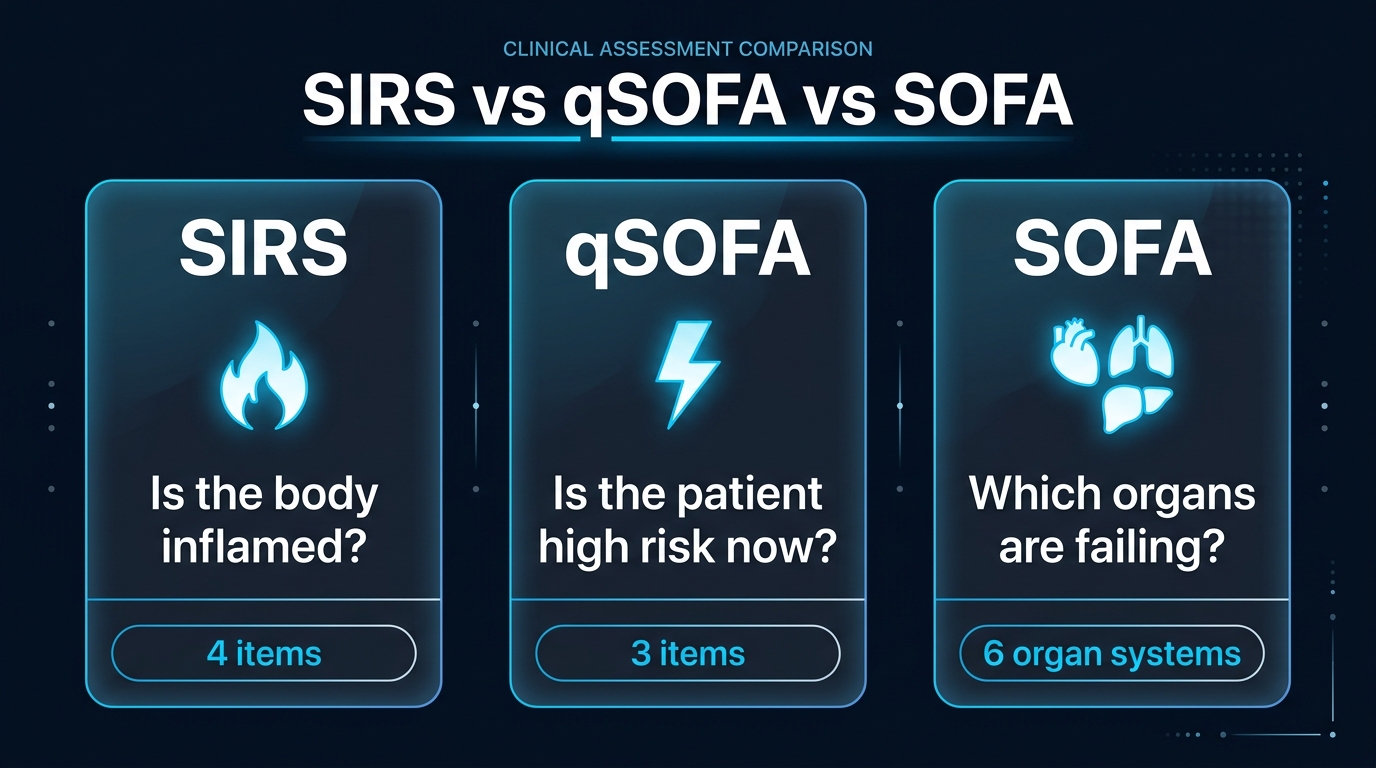
A useful way to think about it: SIRS asks “is the body inflamed?”, qSOFA asks “is this patient at high risk right now?”, and SOFA asks “which organs are failing, and by how much?”
8. Six Worked Examples
Example 1: qSOFA 1, but SIRS 4.
A 68-year-old with pneumonia: respiratory rate 24, GCS 15, systolic BP 110, temperature 38.6 °C, heart rate 112, white cell count 15,000.
qSOFA = 1 (only the respiratory rate). SIRS = 4 of 4.
Meaning: qSOFA is not positive, but the patient is clearly unwell and needs further assessment. Relying on qSOFA alone would give false reassurance.
Example 2: qSOFA 2.
An 80-year-old with a urinary infection is drowsy (GCS 14) with a systolic BP of 92 and a respiratory rate of 18.
qSOFA = 2 (altered mentation and low blood pressure).
Meaning: high-risk. Urgent assessment, lactate and other tests for organ dysfunction are needed.
Example 3: SIRS without infection.
A fit 30-year-old finishes a marathon: heart rate 130, respiratory rate 26, temperature 38.2 °C, white cells 12,500.
SIRS = 4 of 4, yet there is no infection.
Meaning: shows why SIRS is not specific, and why the context matters.
Example 4: A SOFA calculation.
A patient on a ventilator has PaO₂/FiO₂ 180 (3 points), platelets 90 (2), bilirubin 2.5 (2), MAP 62 without vasopressors (1), GCS 13 (1) and creatinine 2.2 (2).
SOFA = 3 + 2 + 2 + 1 + 1 + 2 = 11. With suspected infection and a baseline of 0, the rise of 11 is well above 2, which meets the Sepsis-3 definition of sepsis.
Example 5: Hidden sepsis that qSOFA misses.
A 35-year-old with an abdominal infection has heart rate 120, temperature 39 °C, respiratory rate 20, systolic BP 118 and GCS 15.
qSOFA = 0. SIRS = 2 (temperature and heart rate), and the clinical picture is worrying.
Meaning: qSOFA can miss early sepsis, so a normal qSOFA is not a reason to stop looking.
Example 6: Septic shock and fluids.
An 80 kg adult with sepsis-induced low perfusion is given the suggested starting fluid of 30 mL/kg of crystalloid: 30 × 80 = 2,400 mL over the first 3 hours. Afterwards, the MAP is still 58 and a vasopressor is needed to keep it at 65, with lactate 4.1 mmol/L.
Meaning: this meets the Sepsis-3 criteria for septic shock.
9. What the 2021 Guideline Says
The Surviving Sepsis Campaign (SSC) 2021 guidelines for adults, summarized on the SCCM sepsis guidelines page, contain several messages that matter for this topic:
- Screening: the guideline recommends against using qSOFA, compared with SIRS, NEWS or MEWS, as a single screening tool for sepsis or septic shock. This was a strong recommendation based on moderate-quality evidence. Hospitals are encouraged to use a sepsis screening program for acutely ill, high-risk patients.
- Fluids: for sepsis-induced hypoperfusion or septic shock, the guideline suggests at least 30 mL/kg of IV crystalloid within the first 3 hours. This was downgraded from a strong to a weak recommendation compared with 2016.
- Antibiotics: for possible septic shock or a high likelihood of sepsis, antimicrobials should be given immediately, ideally within 1 hour. For possible sepsis without shock, a rapid assessment of infection is advised within about 3 hours.
- Crystalloids are the first-line fluid, and starches are not recommended.
These are summarized for education. Real treatment follows the current guideline and the hospital’s sepsis protocol.
Why the mixed message? Researchers have debated whether qSOFA is too insensitive for screening, while SIRS can raise too many alarms. This discussion is covered in the review Sepsis-3: how useful is the new definition?. The practical answer: use screening tools as prompts, never as the final word.
10. Limitations
- qSOFA misses early sepsis. A score of 0 or 1 does not exclude sepsis.
- SIRS lacks specificity. Many non-infectious conditions trigger it.
- SOFA needs tests and is slower to complete.
- Confounders: pain, anxiety, drugs, alcohol, chronic hypotension or chronic confusion can change the numbers.
- Special groups: the adult cut-offs do not apply to children, and pregnancy has its own norms.
- Other conditions can mimic the pattern, such as severe hyponatremia or seizures raising respiratory rate and causing altered mentation.
- Scores do not replace clinical judgment.
11. Common Mistakes
- Using qSOFA as the only screen.
- Treating a qSOFA of 0 or 1 as “no sepsis.”
- Confusing the respiratory rate cut-offs: SIRS is above 20, qSOFA is 22 or more.
- Forgetting that qSOFA is only for suspected infection.
- Using adult criteria in children.
- Mixing up the SIRS and qSOFA point systems.
- Delaying antibiotics while waiting for scores or test results.
- Forgetting to recheck observations, because sepsis can evolve quickly.
12. Tips for Students and Nurses
- Memorize “22, 15, 100” for qSOFA and the four SIRS items T-H-R-W (temperature, heart rate, respiratory rate, white cells).
- Remember the order: SIRS (inflamed?) → qSOFA (high risk?) → SOFA (which organs?).
- Count the respiratory rate properly. It is the most frequently skipped vital sign.
- Escalate quickly if the patient is confused, has low blood pressure or is breathing fast.
- Record time of recognition, because time-critical steps depend on it.
- Follow your hospital’s sepsis pathway.
13. Frequently Asked Questions
What is the qSOFA score?
A bedside score of 0 to 3 for adults with suspected infection: respiratory rate 22 or more, altered mentation, and systolic blood pressure 100 mmHg or less.
What qSOFA score is positive?
2 or more.
What does qSOFA stand for?
Quick Sequential (Sepsis-related) Organ Failure Assessment.
What are the SIRS criteria?
Two or more of: temperature above 38 °C or below 36 °C, heart rate above 90, respiratory rate above 20, and white cell count above 12,000 or below 4,000.
What is the difference between qSOFA and SOFA?
qSOFA is a three-item bedside risk screen with no blood tests, while SOFA scores six organ systems and needs lab results.
How is sepsis defined in Sepsis-3?
As life-threatening organ dysfunction caused by a dysregulated host response to infection, shown by a SOFA increase of 2 or more.
What is septic shock?
Sepsis with low blood pressure needing vasopressors to keep MAP at 65 mmHg or more and lactate above 2 mmol/L despite fluids.
Is qSOFA a good screening tool?
The 2021 Surviving Sepsis Campaign recommends against using it as a single screening tool, because it can miss cases.
Can a patient have sepsis with a qSOFA of 0?
Yes, especially early in the illness.
Does qSOFA apply to children?
No. It is for adults, and children use age-specific tools.
qSOFA Score Knowledge Quiz
Available options: 1 to 20
14. Key Takeaways
- Sepsis (Sepsis-3) is life-threatening organ dysfunction from a dysregulated response to infection, shown by a SOFA rise of 2 or more.
- qSOFA = respiratory rate ≥22, altered mentation, systolic BP ≤100. Two or more is positive.
- SIRS is sensitive but not specific, and SOFA measures six organ systems.
- Septic shock needs vasopressors to keep MAP ≥65 and lactate above 2 mmol/L despite fluids.
- The 2021 guideline advises against using qSOFA as a single screening tool.
- Scores are prompts, not verdicts. Treat the patient in front of you, and act early.
Disclaimer: This article is for educational purposes only and is not a substitute for professional medical advice. Sepsis is a medical emergency. If you suspect sepsis in yourself or someone else, seek emergency care immediately.
References
- Singer M, et al. The Third International Consensus Definitions for Sepsis and Septic Shock (Sepsis-3). JAMA. 2016;315(8):801-810.
- Evans L, et al. Surviving Sepsis Campaign: International Guidelines for Management of Sepsis and Septic Shock 2021. Crit Care Med. 2021.
- Vincent JL, et al. The SOFA (Sepsis-related Organ Failure Assessment) score. Intensive Care Med. 1996;22:707-710.