
Ask a hospital team which vital sign gets skipped most often, and the honest answer is breathing rate. It takes no equipment and about a minute, yet studies keep finding that it is the number most likely to be left blank, estimated or copied from the last check. That is a problem, because a change in breathing is often among the first clues that a patient is getting worse. This guide gives you the normal respiratory rate for every age group, a quick-count shortcut table, simple ways to measure it correctly and real-life examples that show how to read the result.
Table of Contents
- Why breathing rate is called the forgotten vital sign
- Normal respiratory rate by age
- Why babies breathe so much faster
- How to count breaths: look, count, confirm
- Mistakes that give wrong numbers
- What pushes the rate up or down
- Fast breathing (tachypnea)
- Slow breathing (bradypnea)
- Warning thresholds
- Three short case examples
- Myths and facts
- Practice MCQs
- Frequently asked questions
- Key takeaways
1. Why Breathing Rate Is Called the Forgotten Vital Sign
Hospital wards routinely record pulse, blood pressure and temperature, but breathing rate is the one that goes missing. Reviews describe it as a “neglected” vital sign even though an abnormal rate can warn of serious events such as cardiac arrest or the need for intensive care. A surprising number of textbooks give it only a passing mention.
For students, this is a useful lesson: the simplest observation at the bedside can be the most informative, and it only works if you count it properly. You can read more in the review on the neglected vital sign.
2. Normal Respiratory Rate by Age
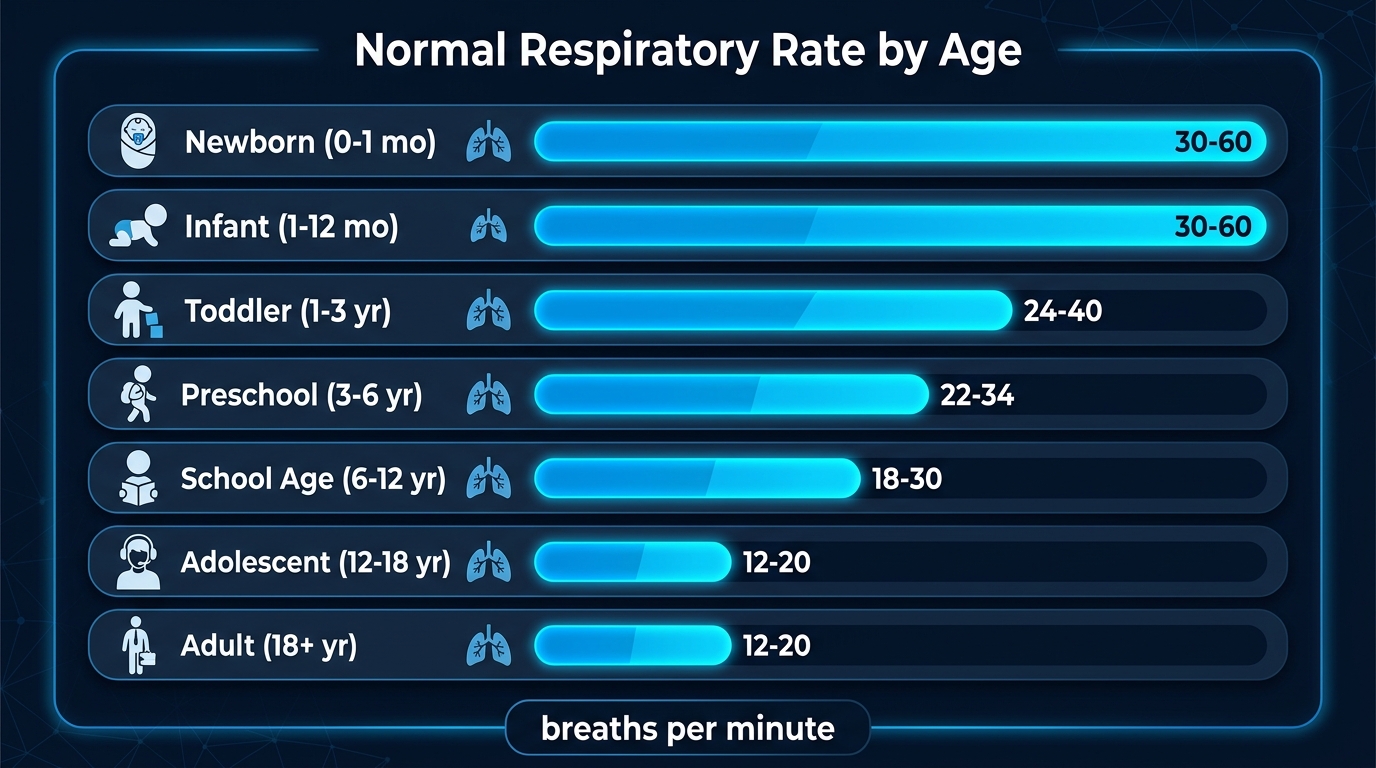
A healthy adult sitting quietly takes roughly 12 to 20 breaths each minute. Children take more, and the younger the child, the faster the pace.
| Age group | Typical breaths per minute | Approx. breaths in 15 seconds |
|---|---|---|
| Newborn (birth to 1 month) | 30 to 60 | 8 to 15 |
| Infant (1 to 12 months) | 30 to 60 | 8 to 15 |
| Toddler (1 to 3 years) | 24 to 40 | 6 to 10 |
| Preschool (3 to 5 years) | 22 to 34 | 6 to 8 |
| School age (6 to 12 years) | 18 to 30 | 5 to 7 |
| Adolescent (13 to 18 years) | 12 to 20 | 3 to 5 |
| Adult | 12 to 20 | 3 to 5 |
A note on differences: Books and hospital charts do not agree on every row. Some list infants at 30 to 50, and some put teenagers at 12 to 16. Treat this chart as a practical guide, and use the version your own unit follows.
The last column is a bedside shortcut: multiply the breaths you count in 15 seconds by 4. It is quick, but it works best on steady, regular breathing. For babies and anyone with an uneven pattern, count for a full minute instead.
3. Why Babies Breathe So Much Faster
Three simple reasons explain the higher numbers in early life:
- Higher fuel use. Per kilogram of body weight, a baby burns far more energy than an adult, so the body needs more oxygen and has more carbon dioxide to clear.
- Small lungs. Each breath moves only a small volume of air, so more breaths are needed to keep up.
- A soft, flexible chest. An infant’s ribs are more horizontal and the chest wall is less able to expand, so speeding up is easier than breathing deeper.

As children grow, metabolism per kilogram settles down, the lungs get bigger, and the rate drifts down to the adult range by the teen years.
4. How to Count Breaths: Look, Count, Confirm
Look. Let the person sit or lie quietly for a few minutes. Watch the chest or upper abdomen, or rest a hand lightly on it. One breath is one rise plus one fall.
Count. Use a timer. Count for a full minute when you can. If breathing is steady, 30 seconds multiplied by 2 is acceptable.
Confirm. Note whether breathing looks easy or hard, whether the rhythm is regular, and whether the number fits the person’s age. If it looks unusual, count again.
Pulse, blood pressure and other checks are usually taken together, and you can try more health checks in our medical tools.
5. Mistakes That Give Wrong Numbers
- Counting for only 10 or 15 seconds on a baby or on irregular breathing.
- Telling the person to “breathe normally.” People change their pattern when they know they are being watched, so many clinicians count while appearing to check the pulse.
- Measuring right after activity, a hot room, crying or a panic.
- Trusting a monitor blindly. Some devices have been shown to report the heart rate as a breathing rate, producing impossible numbers. A quick count by eye can catch this.
- Copying the previous value. Manual entries drift toward “normal,” which hides real change.
- Counting the wrong thing, for example the movement of a crying baby’s whole body instead of the chest.
6. What Pushes the Rate Up or Down
| Tends to raise it | Tends to lower it |
|---|---|
| Exercise | Sleep and deep relaxation |
| Fever | Opioids and sedatives |
| Pain | Raised pressure inside the skull |
| Anxiety or panic | Low body temperature |
| Caffeine and other stimulants | Severe exhaustion of the breathing muscles |
| High altitude | Fitness training (athletes often breathe a little slower at rest) |
| Lung, heart or metabolic illness | Some brainstem problems |
7. Fast Breathing (Tachypnea)
Tachypnea simply means a rate above what is normal for that age. In an adult at rest, that usually means more than 20 breaths per minute.
It helps to sort the causes by body system:
- Lungs and airways: pneumonia, asthma, COPD, a collapsed lung or fluid around the lung.
- Blood vessels and heart: a clot in the lung (pulmonary embolism), heart failure, shock.
- Blood chemistry and infection: sepsis, diabetic ketoacidosis, poisoning by carbon monoxide.
- Everyday triggers: exercise, fever, pain and anxiety.
In newborns, fast breathing shortly after birth can come from fluid still left in the lungs. See the StatPearls review on tachypnea for the full list.
8. Slow Breathing (Bradypnea)
Bradypnea means fewer breaths than expected. In adults, it usually means under 12 per minute. Typical causes are overdose of opioids or sedatives, head injury, very low body temperature and severe illness. Slow breathing with drowsiness, confusion or bluish skin needs urgent medical help.
To practise describing how alert a patient is, try our Glasgow Coma Scale tool.
9. Warning Thresholds
Adults. Early warning scores such as NEWS2 give 0 points for 12 to 20 breaths per minute, 2 points for 21 to 24, and 3 points for 25 or more or for 8 or fewer. The qSOFA sepsis screen counts a rate of 22 or more as one criterion.
Young children. The WHO uses these “fast breathing” lines when screening for pneumonia:
| Age | Fast breathing starts at |
|---|---|
| Under 2 months | 60 or more per minute |
| 2 to 12 months | 50 or more per minute |
| 1 to 5 years | 40 or more per minute |
These tools are for trained staff, and they work alongside the whole clinical picture.
10. Three Short Case Examples
Case 1: The stairs. A 25-year-old walks into clinic after climbing three floors and counts 26 breaths per minute. After five minutes of rest, a recount gives 16. Meaning: the first number was exercise, not illness. Always let the person settle first.
Case 2: The sleepy toddler. A 3-year-old with fever and cough is calm and sleeping, yet the count is 46 per minute. Meaning: this is above the WHO cut-off of 40 for children aged 1 to 5, so the child needs a proper medical assessment even though they look comfortable.
Case 3: The quiet patient. A 68-year-old two days after surgery, on strong pain medicine, is drowsy with a breathing rate of 9. Meaning: slow breathing with sleepiness is a red flag, and the medical team needs to review urgently.

11. Myths and Facts
| Myth | Fact |
|---|---|
| “A normal oxygen reading means breathing is fine.” | Oxygen saturation and breathing rate measure different things, and the rate can climb before the oxygen reading drops. |
| “If a number is written in the chart, it was counted.” | Many entries are estimates, often leaning toward normal. |
| “Only the lungs change breathing rate.” | The heart, blood chemistry, pain, fever and emotions also change it. |
| “Babies breathing 50 times a minute must be sick.” | That is within the normal range for a newborn or infant. |
13. Frequently Asked Questions
What is the normal respiratory rate for an adult?
Between 12 and 20 breaths per minute at rest, with some references narrowing it to 12 to 18.
What is the normal respiratory rate for a newborn?
Usually 30 to 60 breaths per minute, with an uneven rhythm that includes brief pauses.
What is a normal breathing rate for a 10-year-old?
Roughly 18 to 30 breaths per minute, depending on the reference.
What respiratory rate is too high?
In adults, more than 20 is tachypnea, and 25 or more is a serious warning sign. In young children, the WHO lines are 60, 50 and 40 depending on age.
What respiratory rate is too low?
Under 12 is bradypnea in adults, and 8 or fewer is a strong warning sign, especially with drowsiness.
Does sleep change the rate?
Yes, it usually falls a little during sleep.
Can I measure it at home?
Yes. Sit quietly, count each rise and fall of the chest as one breath for a full minute, and avoid telling the person you are counting.
When should I go to the emergency room?
If breathing is abnormal along with blue lips, trouble speaking, chest pain, confusion, or in a child with flaring nostrils, grunting or pulling in of the ribs.
14. Key Takeaways
- The normal respiratory rate for adults is 12 to 20, and it is higher in babies and children.
- Count for a full minute, quietly and at rest, and be extra careful with babies.
- The 15-second count multiplied by 4 is a handy shortcut for steady breathing.
- Do not trust a single number blindly, whether from memory, a chart or a monitor.
- A change in breathing rate is often an early clue, so recording it matters.
- Blue lips, trouble speaking, confusion, or very slow breathing is an emergency.
Disclaimer: This article is for educational purposes only and is not a substitute for professional medical advice. If someone is struggling to breathe, seek emergency care immediately.
References
- Cretikos MA, et al. Respiratory rate: the neglected vital sign. Medical Journal of Australia, 2008.
- StatPearls: Tachypnea. NCBI Bookshelf.
- StatPearls: Abnormal Respirations. NCBI Bookshelf.
- World Health Organization: guidance on fast breathing in childhood pneumonia.