
A child cannot drink after surgery, or is too sick to take fluids by mouth, so they are put on an intravenous drip. The first question the team asks is simple: how fast should it run? For almost seventy years, the answer has come from a piece of arithmetic called the Holliday-Segar formula, usually remembered as the 4-2-1 rule. It takes seconds to calculate from a child’s weight, and it is taught in every pediatric and nursing course. This guide explains where it comes from, how to use it hourly and daily, why the two versions differ slightly, how to add dehydration fluids, and why the choice of fluid matters as much as the rate.

Table of Contents
- What maintenance fluid means
- The 4-2-1 rule (hourly)
- The 100-50-20 rule (daily)
- Where the numbers come from
- Weight chart
- Why the hourly and daily methods differ
- Seven worked examples
- Adding dehydration and ongoing losses
- Which fluid should be used?
- How to check the fluids are right
- Limitations
- Common mistakes
- Tips for students and nurses
- Frequently asked questions
- Key takeaways
1. What Maintenance Fluid Means
Maintenance fluid is the amount of water a patient needs each day to replace normal losses (urine, sweat, breathing and stool) when they cannot drink enough. It is not the same as fluid for dehydration or for bleeding, and it does not replace fluids lost from vomiting, diarrhea or drains. Those are calculated separately and added on. Maintenance IV fluids are meant for patients who are not dehydrated but cannot take adequate fluids by mouth, and they should be stopped as soon as the patient can drink or be fed.
2. The 4-2-1 Rule (Hourly)
| Body weight | Hourly maintenance rate |
|---|---|
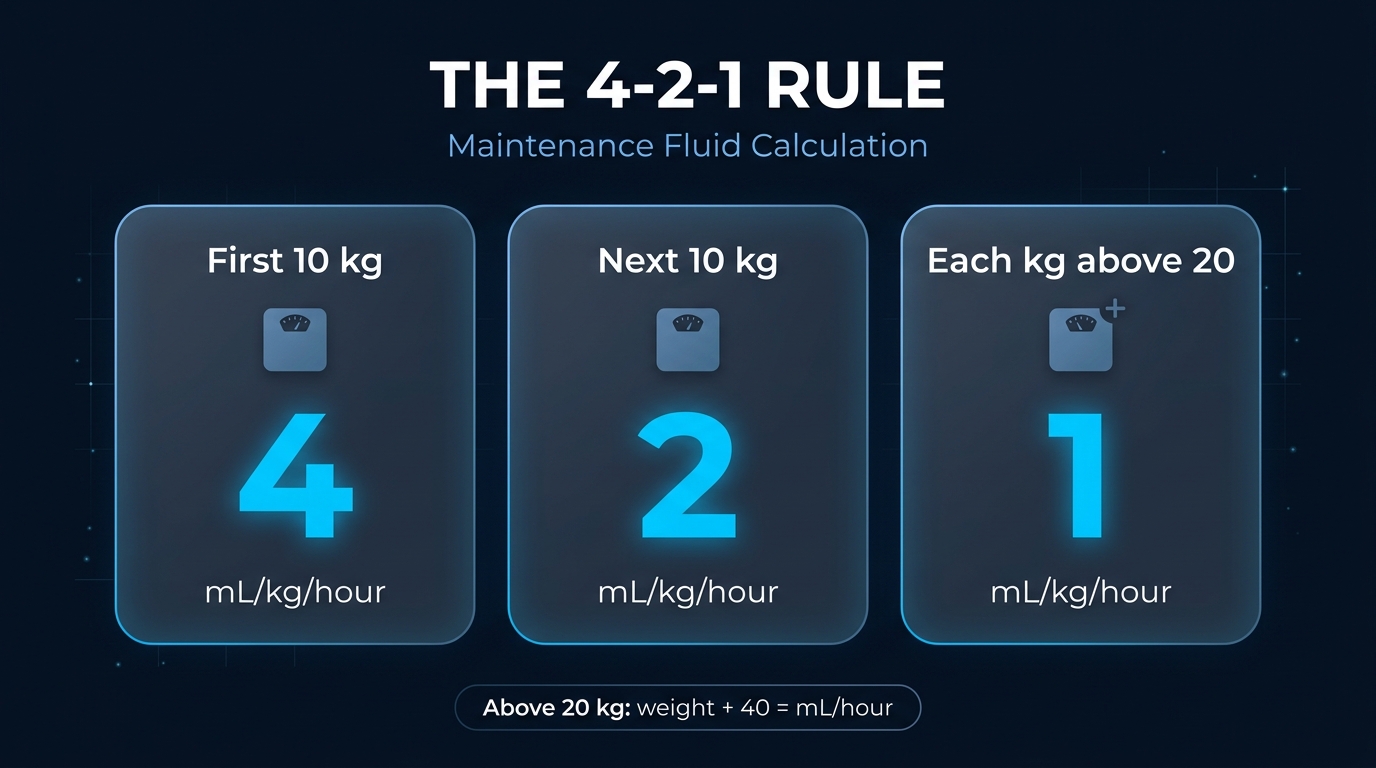
| First 10 kg | 4 mL/kg/hour |
| Next 10 kg (11 to 20 kg) | 2 mL/kg/hour |
| Each kg above 20 kg | 1 mL/kg/hour |
Formula in one line:
mL per hour = 4 × (first 10 kg) + 2 × (next 10 kg) + 1 × (each kg above 20 kg)Shortcut for children above 20 kg: rate (mL/hour) = 40 + 20 + (weight − 20) = weight + 40. For example, a 30 kg child needs 30 + 40 = 70 mL/hour.
3. The 100-50-20 Rule (Daily)
The same rule can be written per day:
| Body weight | Daily maintenance |
|---|---|
| First 10 kg | 100 mL/kg/day |
| Next 10 kg (11 to 20 kg) | 50 mL/kg/day |
| Each kg above 20 kg | 20 mL/kg/day |
For a child above 20 kg: 1,500 mL + 20 mL for each kg above 20.
4. Where the Numbers Come From
Malcolm Holliday and William Segar published their paper, The maintenance need for water in parenteral fluid therapy, in 1957. They linked water needs to energy expenditure, because the body uses water in proportion to the calories it burns:
| Weight | Energy expenditure |
|---|---|
| Up to 10 kg | 100 kcal per kg per day |
| 10 to 20 kg | 1,000 kcal plus 50 kcal per kg above 10 kg |
| Above 20 kg | 1,500 kcal plus 20 kcal per kg above 20 kg |
They estimated that about 110 to 120 mL of water per 100 kcal meets the need, covering urine and insensible losses. The 100-50-20 and 4-2-1 versions are simply rounded forms of this energy-based method. They also emphasized in the original paper that their figures describe the water needs only, which is a point later practice sometimes forgot. You can read a clinician’s account of how the rule began in this history of the 4-2-1 rule.
5. Weight Chart
This original table uses the 4-2-1 (hourly) rule and shows the daily total for comparison.
| Weight (kg) | mL per hour | mL per 24 hours (hourly × 24) | Daily method (100-50-20) |
|---|---|---|---|
| 3 | 12 | 288 | 300 |
| 5 | 20 | 480 | 500 |
| 8 | 32 | 768 | 800 |
| 10 | 40 | 960 | 1,000 |
| 12 | 44 | 1,056 | 1,100 |
| 15 | 50 | 1,200 | 1,250 |
| 20 | 60 | 1,440 | 1,500 |
| 25 | 65 | 1,560 | 1,600 |
| 30 | 70 | 1,680 | 1,700 |
| 40 | 80 | 1,920 | 1,900 |
| 50 | 90 | 2,160 | 2,100 |
6. Why the Hourly and Daily Methods Differ
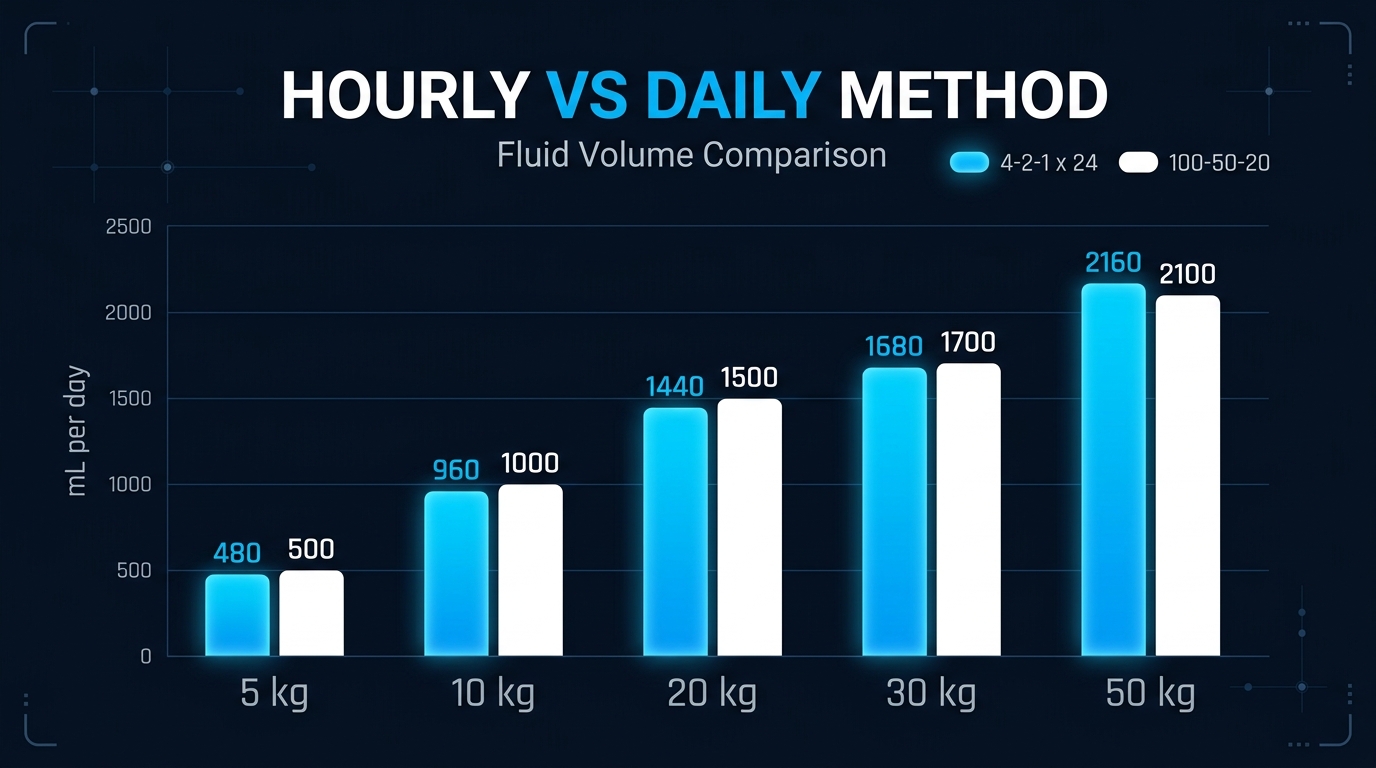
You may have noticed that 4 mL/kg/hour is 96 mL/kg per day, not 100. The 4-2-1 rule rounds each daily figure down to a convenient hourly number, so the two versions do not match exactly:
- For children up to 20 kg, the hourly version gives about 4% less than the daily version.
- Around 30 kg, the difference shrinks to about 1%.
- Above about 35 kg, the hourly version starts to give more than the daily one. For a 70 kg adult it is 2,640 mL per day by the hourly rule versus 2,500 mL per day by the daily rule, a difference of about 5.6%.
In practice, hospitals choose one method and use it consistently. Because the formula was built for children, many protocols cap the rate for large adolescents and adults, often at about 100 mL/hour, rather than letting the formula run to 110 mL/hour or more.
7. Seven Worked Examples
Example 1: Infant, 8 kg.
First 10 kg: 8 × 4 = 32 mL/hour. Daily: 8 × 100 = 800 mL/day.
Example 2: Toddler, 14 kg.
(10 × 4) + (4 × 2) = 40 + 8 = 48 mL/hour. Daily: 1,000 + 200 = 1,200 mL/day.
Example 3: Child, 22 kg.
(10 × 4) + (10 × 2) + (2 × 1) = 40 + 20 + 2 = 62 mL/hour.
By the daily method: (10 × 100) + (10 × 50) + (2 × 20) = 1,540 mL/day, which is about 64 mL/hour. The two answers differ by about 2 mL/hour, which is why teams should agree on one method.
Example 4: Child, 24 kg.
40 + 20 + 4 = 64 mL/hour. By the shortcut: 24 + 40 = 64. Daily method: 1,580 mL/day.
Example 5: Large adolescent or adult, 70 kg.
40 + 20 + 50 = 110 mL/hour (2,640 mL/day). Many protocols cap this at about 100 mL/hour, so the cap usually decides the rate.
Example 6: Adding dehydration.
A 15 kg child is 5% dehydrated.
Maintenance = 40 + 10 = 50 mL/hour.
Deficit = 5 × 15 × 10 = 750 mL. If replaced over 24 hours, that is 750 ÷ 24 = about 31 mL/hour.
Total rate = 50 + 31 = about 81 mL/hour. Some protocols give a bolus first and replace the remaining deficit over a longer period, so follow your local plan.
Example 7: Bolus (not maintenance).
A 10 kg infant needs a bolus of 20 mL/kg of isotonic fluid: 10 × 20 = 200 mL. Boluses are given separately from maintenance and are not included in the 4-2-1 rate.
8. Adding Dehydration and Ongoing Losses
The 4-2-1 rule covers only normal daily needs. A child who is dehydrated or still losing fluid needs extra:
Deficit (mL) = % dehydration × weight (kg) × 10
This formula is described in the Don’t Forget the Bubbles IV fluid prescribing guide, which also shows how to add the deficit to the hourly maintenance rate. It assesses dehydration with items such as tears, mucous membranes, sunken eyes and general appearance.
Ongoing losses (vomiting, diarrhea, drain output, high fever) are measured and replaced separately. Clinical pathways advise calculating replacement for ongoing losses on its own and not raising the maintenance rate above the calculated amount.
This same idea appears in burn care, where children receive maintenance fluid in addition to resuscitation fluid, as covered in our Parkland formula guide.
9. Which Fluid Should Be Used?
The rate is only half the story. For decades, children were often given hypotonic fluid (such as half-normal saline) for maintenance, because the original calculation implied low sodium needs. But hypotonic fluids are linked to hospital-acquired hyponatremia, which can cause brain swelling and seizures.
Large randomized studies found that children given isotonic fluids developed less hyponatremia, and in 2018 the American Academy of Pediatrics published a guideline recommending isotonic fluids for maintenance in most hospitalized children aged 28 days to 18 years, as summarised in the AAP 2018 maintenance fluid guideline.
Common practice, as in these clinical pathways, is to use:
- isotonic fluid (0.9% sodium chloride or a balanced solution),
- dextrose added for children who cannot eat,
- potassium added for most children once urine output is established.
Details vary by hospital, and the UCSF pediatric maintenance IV fluid pathway and the Nationwide Children’s IV fluid therapy pathway show how two large children’s hospitals set it out.
Newborns: Babies younger than 28 days (and premature infants) follow different, age-based fluid schedules, so the 4-2-1 rule is not applied to them.
10. How to Check the Fluids Are Right
- Urine output: children usually aim for about 1 mL/kg/hour. See our guide to normal urine output.
- Daily weights: the most sensitive guide to fluid balance.
- Serum sodium and glucose: checked at intervals in children on IV fluids, especially in the first days.
- Clinical signs: swelling, breathing changes, heart rate and alertness.
- Daily review: stop IV fluids as soon as oral intake is adequate.
11. Limitations
- It is a starting estimate for a healthy child, not a prescription for every patient.
- Some conditions need less fluid, such as kidney failure, heart failure, raised pressure in the brain, or conditions with inappropriate ADH release. Following local protocol is essential.
- It does not replace deficits or ongoing losses.
- It was built for children, and extending it to adults or obese patients needs a cap.
- Over-hydration is harmful, causing hyponatremia and fluid overload.
- Some protocols use body surface area (roughly 1,500 to 1,600 mL per m² per day) for larger children. See our body surface area formula guide if your unit uses that method.
- It does not apply to premature infants and newborns.
12. Common Mistakes
- Using pounds instead of kilograms.
- Adding the rates for the first and second 10 kg incorrectly (for example, applying 2 mL/kg/hour to the whole weight).
- Forgetting that above 20 kg the rate is 1 mL/kg/hour only for the extra kilograms.
- Treating the maintenance rate as the total rate for a dehydrated child.
- Mixing up the hourly and daily versions.
- Giving hypotonic fluids when isotonic ones are standard.
- Letting the drip run on after the child can drink normally.
13. Tips for Students and Nurses
- Learn it as “4, 2, 1 per hour; 100, 50, 20 per day.”
- Remember the shortcut for children above 20 kg: weight + 40.
- Always write the weight and the method next to the rate.
- Calculate maintenance, deficit and ongoing losses as three separate lines, then add them.
- Check the fluid type as well as the rate.
- Report poor urine output, swelling or drowsiness promptly.
- Never change a rate without a prescriber’s order and your hospital’s protocol.
14. Frequently Asked Questions
What is the 4-2-1 rule?
A weight-based rule for hourly maintenance fluids: 4 mL/kg/hour for the first 10 kg, 2 mL/kg/hour for the next 10 kg and 1 mL/kg/hour for each kg above 20 kg.
What is the Holliday-Segar formula?
The original 1957 method linking daily water needs to energy expenditure, simplified into the 4-2-1 and 100-50-20 rules.
What is the daily version of the 4-2-1 rule?
100 mL/kg/day for the first 10 kg, 50 mL/kg/day for the next 10 kg, and 20 mL/kg/day for every kg above 20 kg.
How much maintenance fluid does a 20 kg child need?
60 mL/hour (40 + 20), or about 1,500 mL per day.
Can the 4-2-1 rule be used for adults?
It can estimate a rate, but it is usually capped (often around 100 mL/hour) and used with local adult guidelines.
Which fluid is used for maintenance in children?
Most guidelines recommend isotonic fluid, with dextrose and potassium added as needed.
Is maintenance fluid the same as rehydration fluid?
No. Maintenance covers normal daily needs, while rehydration replaces a deficit.
How do I calculate the fluid deficit?
Deficit in mL = % dehydration × weight in kg × 10.
Does the rule apply to newborns?
No. Babies under 28 days and premature infants follow different schedules.
Why do the hourly and daily results differ?
Because the hourly 4-2-1 numbers are rounded, so the two versions differ by about 4% for children up to 20 kg.
Holliday-Segar 4-2-1 Rule Knowledge Quiz
Available options: 1 to 20
15. Key Takeaways
- 4-2-1 rule: 4 mL/kg/hour for the first 10 kg, 2 for the next 10 kg, and 1 for each kg above 20 kg.
- The daily equivalent is 100-50-20 mL/kg/day, and it differs slightly from the hourly total.
- For children above 20 kg, the hourly rate is simply weight + 40.
- The numbers come from energy expenditure, at about 110 to 120 mL of water per 100 kcal.
- Dehydration (% × kg × 10 mL) and ongoing losses are added separately.
- Isotonic fluids are now standard for most hospitalized children, to lower the risk of hyponatremia.
Disclaimer: This article is for educational purposes only and is not a substitute for professional medical advice. IV fluid orders must be written and checked by qualified clinicians according to the child’s condition and the hospital’s protocol.
References
- Holliday MA, Segar WE. The maintenance need for water in parenteral fluid therapy. Pediatrics. 1957;19(5):823-832.
- Feld LG, et al. Clinical Practice Guideline: Maintenance Intravenous Fluids in Children. Pediatrics. 2018;142(6):e20183083.