

A patient’s blood test shows low bicarbonate and a low pH. The obvious conclusion is metabolic acidosis, but the real question is why. Is the body making too much acid, or losing too much base? One simple subtraction on the same lab report can point you in the right direction. That subtraction is the anion gap. This guide explains the formula, the normal range, how to correct it for albumin, how to read the delta ratio, and where the number can mislead you, with six worked examples along the way.
Table of Contents
- What the anion gap is
- The anion gap formula
- Normal range
- Step-by-step calculation
- High anion gap: causes and mnemonics
- Normal anion gap acidosis
- Low or negative anion gap
- Correcting the anion gap for albumin
- Delta gap and delta ratio
- Six worked examples
- Limitations
- Common mistakes
- Tips for students and nurses
- Frequently asked questions
- Key takeaways
1. What the Anion Gap Is
Blood is electrically neutral: the positive charges (cations) equal the negative charges (anions). But the routine lab panel only measures a few of them. It reports sodium, chloride and bicarbonate, and leaves out many others such as albumin, phosphate, sulfate and organic acids. The “gap” is simply the difference caused by what was not measured. It is not a real gap in charge, only an artefact of testing.
When extra acid is added to the blood, such as lactic acid or ketones, the unmeasured anions rise, the bicarbonate falls, and the gap widens. When bicarbonate is lost instead, the body holds on to chloride and the gap stays normal. This is why the anion gap is the standard first step for sorting metabolic acidosis into two groups. The StatPearls review of the anion gap describes this as its most common application.

2. The Anion Gap Formula
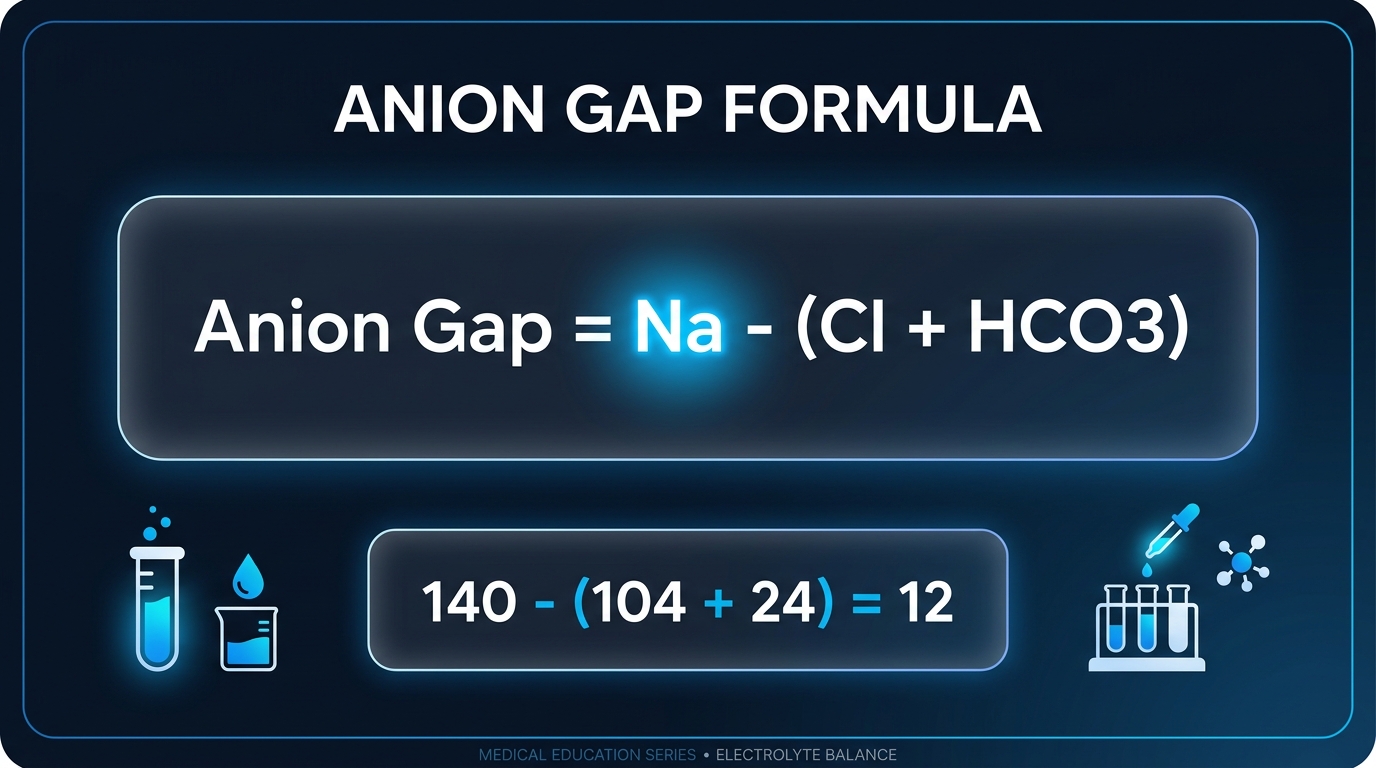
Anion gap = Na⁺ − (Cl⁻ + HCO₃⁻)All values are in mEq/L (or mmol/L, which is the same number for these ions).
Some labs include potassium:
Anion gap (with K⁺) = (Na⁺ + K⁺) − (Cl⁻ + HCO₃⁻)Including potassium raises the normal range by roughly 4, so always check which version your lab uses.
Quick memory trick: “Sodium minus the sum of chloride and bicarbonate.
3. Normal Range
| Source of the range | Typical normal anion gap |
|---|---|
| Older textbooks (without K⁺) | About 12 ± 4, or 8 to 16 mEq/L |
| Many modern analyzers (without K⁺) | About 4 to 12 mEq/L |
| Including potassium | About 12 to 20 mEq/L |
Reference ranges depend on the laboratory and the equipment, and newer analyzers can report low values even in healthy people. Always compare your result with the range printed on the lab report, rather than memorizing one number.
4. Step-by-Step Calculation
- Find sodium, chloride and bicarbonate on the report.
- Add chloride and bicarbonate together.
- Subtract that sum from sodium.
- Compare the result with your lab’s normal range.
- Check the albumin. If it is low, correct the gap (Section 8).
- Decide whether the acidosis is a high or a normal gap type.
5. High Anion Gap: Causes and Mnemonics
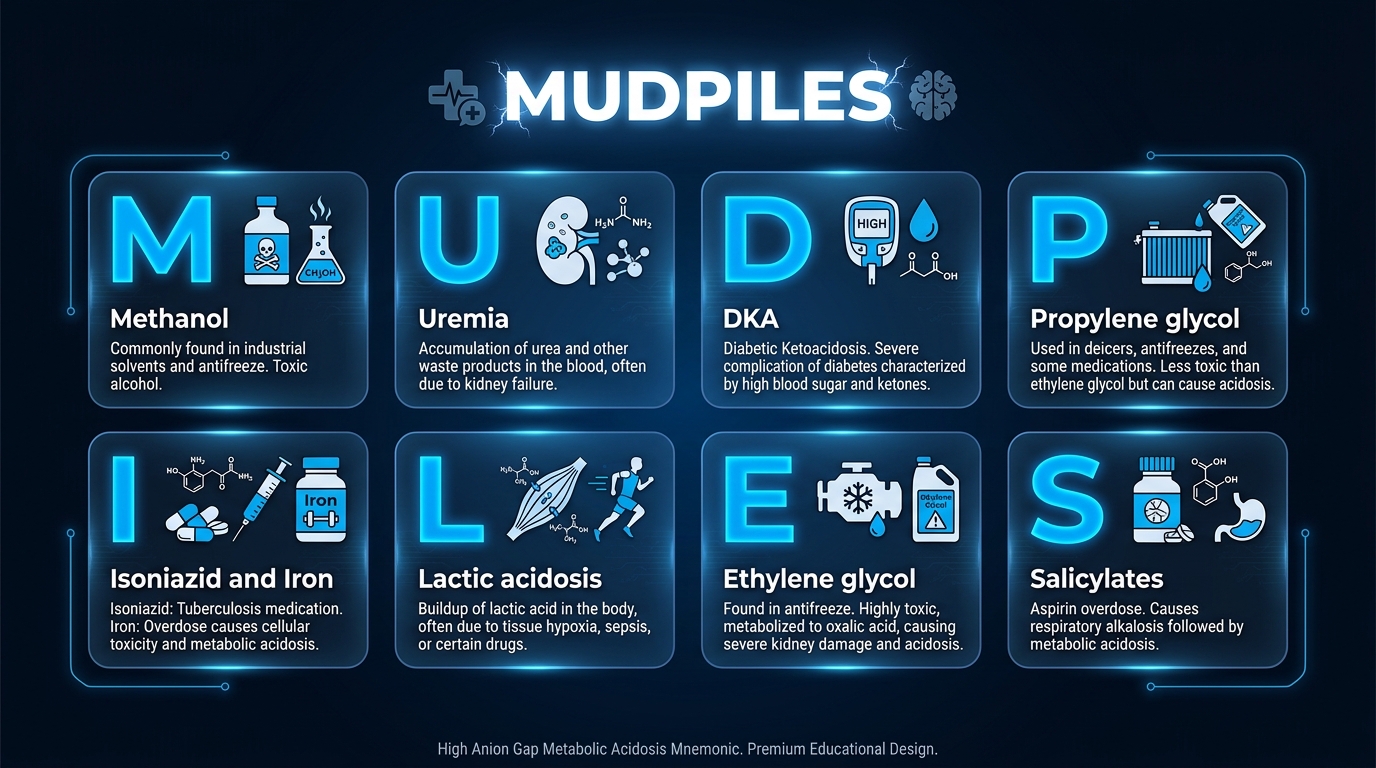
A high gap means unmeasured acids have been added to the blood. The classic memory aid is MUDPILES:
| Letter | Cause |
|---|---|
| M | Methanol (and metformin) |
| U | Uremia (kidney failure) |
| D | Diabetic ketoacidosis |
| P | Paraldehyde or propylene glycol |
| I | Isoniazid or iron |
| L | Lactic acidosis |
| E | Ethylene glycol |
| S | Salicylates (aspirin) |
An extended version, CAT MUDPILES, adds carbon monoxide or cyanide, alcoholic ketoacidosis and toluene. Another memory aid is GOLDMARK, which includes glycols, oxoproline, L- and D-lactate, methanol, aspirin, renal failure and ketoacidosis. The WikEM overview of the anion gap lists these causes in a quick-reference format.
Simple grouping: Many high-gap causes fit into three buckets: ketones (diabetes, alcohol, starvation), lactate (shock, infection, bleeding) and kidney failure, with toxins as the fourth group.
For kidney-related causes, see our guide to the Cockcroft-Gault formula for estimating kidney function.
6. Normal Anion Gap Acidosis
When the gap is normal but bicarbonate is low, the body has usually lost bicarbonate and replaced it with chloride, so this type is also called hyperchloremic acidosis.
| Group | Examples |
|---|---|
| Gut losses | Diarrhea, pancreatic fistula |
| Kidney losses | Renal tubular acidosis |
| Medicines | Acetazolamide, spironolactone |
| Fluids | Large amounts of normal saline |
| Other | Ureteral diversion surgery |
A common mnemonic for this group is HARDUPS.
7. Low or Negative Anion Gap
A low gap is less common, and the most frequent cause is low albumin, because albumin is the main unmeasured anion. Other causes:
- High levels of positively charged proteins, as in multiple myeloma
- Lithium or bromide excess
- Very high calcium or magnesium
- Laboratory error, for example a falsely high chloride
A low gap can also hide a real problem, which is why correcting for albumin matters.
8. Correcting the Anion Gap for Albumin
Albumin carries negative charge. When albumin falls, the gap falls with it, so a patient with low albumin and a “normal” gap may actually have a high gap acidosis.
Correction formula (albumin in g/dL):
Corrected anion gap = measured anion gap + 2.5 × (4.0 − albumin)In SI units, each 10 g/L fall in albumin lowers the gap by roughly 2.3 to 2.5 mmol/L.
Original quick-reference table (assuming a measured gap of 12):
| Albumin (g/dL) | Add | Corrected gap |
|---|---|---|
| 4.0 | 0 | 12.0 |
| 3.0 | 2.5 | 14.5 |
| 2.0 | 5.0 | 17.0 |
| 1.0 | 7.5 | 19.5 |
Albumin matters for calcium too, and the same idea is used in our corrected calcium formula guide. For a deeper look at how albumin affects the number, see this explanation of the advantages and disadvantages of the anion gap.
9. Delta Gap and Delta Ratio
In a high gap acidosis, you can also ask whether there is a second acid-base problem hiding behind the first. The delta values help.
Delta gap = anion gap − 12   (some use 10)
Delta bicarbonate = 24 − bicarbonate
Delta ratio = delta gap / delta bicarbonate| Delta ratio | Suggests |
|---|---|
| Below 0.4 | Pure normal anion gap acidosis |
| 0.4 to 0.8 | Mixed high and normal gap acidosis |
| 0.8 to 2.0 | Pure high anion gap acidosis |
| Above 2.0 | High gap acidosis with a pre-existing metabolic alkalosis |
Different sources draw these lines slightly differently, and some clinicians use “below 1 = mixed.” Treat the bands as a guide. For a detailed explanation, read the updated review of serum anion gap.
10. Six Worked Examples
Example 1: Normal.
Na 140, Cl 104, HCO₃ 24.
Gap = 140 − (104 + 24) = 12. Normal.
Example 2: Diabetic ketoacidosis.
Na 135, Cl 95, HCO₃ 10.
Gap = 135 − 105 = 30. High. Delta gap = 30 − 12 = 18. Delta bicarbonate = 24 − 10 = 14. Delta ratio = 18 / 14 = 1.3, a pure high gap acidosis.
Example 3: Diarrhea.
Na 138, Cl 114, HCO₃ 14.
Gap = 138 − 128 = 10. Normal gap, so this is hyperchloremic acidosis, consistent with bicarbonate loss from the gut.
Example 4: Low albumin hiding a high gap.
Na 138, Cl 102, HCO₃ 18, albumin 2.0 g/dL.
Measured gap = 138 − 120 = 18. Corrected gap = 18 + 2.5 × 2.0 = 23. The true gap is clearly higher than the raw number suggests.
Example 5: Mixed disorder.
Na 140, Cl 108, HCO₃ 12.
Gap = 140 − 120 = 20. Delta gap = 8. Delta bicarbonate = 12. Delta ratio = 8 / 12 = 0.67. This falls in the mixed high and normal gap range, so there is likely more than one process, for example an acid being added and bicarbonate also being lost.
Example 6: High gap with metabolic alkalosis.
Na 142, Cl 90, HCO₃ 20.
Gap = 142 − 110 = 32. Delta gap = 20. Delta bicarbonate = 4. Delta ratio = 5. A ratio this high suggests a pre-existing metabolic alkalosis, for instance a patient who has been vomiting and then developed an acid problem.

11. Limitations
- The normal range varies by laboratory and analyzer.
- Albumin changes the result, so correct it when albumin is abnormal.
- Wrong sodium or chloride values (spurious results) alter the gap.
- Abnormal proteins, such as paraproteins, and high phosphate can shift the number.
- The delta ratio is not perfect. Studies show the relationship between the change in gap and the change in bicarbonate is not always exactly one to one.
- A normal gap does not rule out acidosis, it just points to a different cause.
Despite these caveats, the gap remains a cheap and useful screening tool, as explained in the review on the uses and limitations of the serum anion gap.
12. Common Mistakes
- Using the wrong formula version (with or without potassium).
- Comparing the result with a textbook range instead of the lab’s range.
- Ignoring albumin in sick patients.
- Reading a normal gap as “no acidosis.”
- Calculating the delta ratio with the wrong baseline values.
- Forgetting that blood gas and chemistry results must be from around the same time.
- Treating the number alone without looking at the patient.
13. Tips for Students and Nurses
- Learn the order: gap first, albumin second, delta ratio third.
- Pair the gap with the history. Ketone smell and high glucose suggest DKA, poor perfusion suggests lactate, and diarrhea suggests a normal gap.
- Report signs of acidosis early: fast deep breathing, confusion and drowsiness.
- Write down which formula and range you used.
- Combine lab thinking with other bedside values such as normal urine output and use our medical tools to practice related calculations.
14. Frequently Asked Questions
What is the anion gap formula?
Anion gap = sodium − (chloride + bicarbonate), in mEq/L.
What is a normal anion gap?
It depends on the lab. Many modern labs use about 4 to 12 mEq/L, while older references give 8 to 16.
What causes a high anion gap?
Added acids such as lactate, ketones, toxins like methanol or ethylene glycol, aspirin overdose, and kidney failure.
What causes a normal anion gap acidosis?
Loss of bicarbonate, for example through diarrhea, renal tubular acidosis, certain medicines or large volumes of saline.
What does a low anion gap mean?
Most often low albumin. Other causes include myeloma, lithium or bromide, and lab error.
Why correct the anion gap for albumin?
Low albumin lowers the gap and can hide a high gap acidosis.
How do you correct the anion gap for albumin?
Add 2.5 to the measured gap for every 1 g/dL that albumin is below 4.0.
What is the delta ratio?
The change in the anion gap divided by the change in bicarbonate. It helps spot mixed acid-base disorders.
Can the anion gap be negative?
Yes, though it is uncommon. It can result from lab error, high positively charged proteins or certain drug excesses.
Does a normal anion gap mean no acidosis?
No. It means the acidosis is probably not caused by added unmeasured acids.
Anion Gap Knowledge Quiz
Available options: 1 to 20
15. Key Takeaways
- Anion gap = Na − (Cl + HCO₃), used to sort metabolic acidosis into high and normal gap types.
- Use your lab’s reference range, since it varies.
- High gap causes follow MUDPILES; normal gap causes include diarrhea and renal tubular acidosis.
- Correct for albumin: add 2.5 for each 1 g/dL below 4.0.
- The delta ratio can reveal mixed acid-base disorders.
- It is a screening tool, so always combine it with the patient’s history and other tests.
Disclaimer: This article is for educational purposes only and is not a substitute for professional medical advice. Lab results should be interpreted by a qualified clinician in the context of the whole patient.
References
- Kraut JA, Madias NE. Serum anion gap: its uses and limitations in clinical medicine. Clin J Am Soc Nephrol. 2007;2(1):162-174.
- StatPearls: Anion Gap. NCBI Bookshelf.
- MDCalc: Updated Review of Serum Anion Gap.
- WikEM: Anion Gap.