
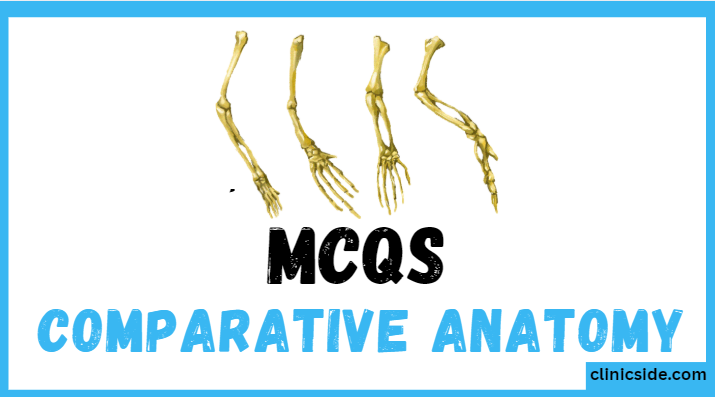
Comparative anatomy is a fundamental branch of biological science that focuses on studying the similarities and differences in the anatomical structures of different organisms. By examining body systems, organs, and skeletal features across species, comparative anatomy helps scientists understand evolutionary relationships, functional adaptations, and common ancestry. This field plays a critical role in zoology, evolutionary biology, paleontology, and medical sciences.
The study of comparative anatomy provides strong evidence for evolution and explains how different organisms adapt structurally to their environments while maintaining underlying similarities.
Quiz
Available options: 1 to 20
Historical Background of Comparative Anatomy
The foundations of comparative anatomy date back to ancient Greek scholars such as Aristotle, who first classified animals based on structural similarities. However, the field gained scientific importance in the 18th and 19th centuries through the work of anatomists like Georges Cuvier and Charles Darwin. Their studies demonstrated that anatomical similarities were not coincidental but reflected shared evolutionary origins.
Modern comparative anatomy integrates genetics, embryology, and molecular biology, making it a powerful interdisciplinary science.
Importance of Comparative Anatomy in Biology
Comparative anatomy is essential for several reasons:
- It provides evidence for evolution
- It helps classify organisms based on structural relationships
- It explains functional adaptations in different species
- It supports medical research using animal models
Through comparative anatomy, scientists can trace how complex structures evolved and diversified over time.

Homologous Structures in Comparative Anatomy
One of the key concepts in comparative anatomy is homologous structures. These are anatomical features that share a common evolutionary origin but may perform different functions in different organisms.
Examples include:
- The forelimbs of humans, whales, bats, and cats
- Similar bone arrangements despite different uses
Homologous structures strongly support the theory of evolution, showing how species diverged from a common ancestor while retaining similar anatomical frameworks.
Analogous Structures and Functional Similarity
In contrast to homologous structures, analogous structures perform similar functions but have different evolutionary origins. Comparative anatomy distinguishes these structures to avoid misleading conclusions about evolutionary relationships.
Examples include:
- Wings of birds and insects
- Fins of fish and flippers of dolphins
Analogous structures highlight how different organisms adapt similarly to environmental pressures, a process known as convergent evolution.
Comparative Anatomy of Skeletal Systems
The skeletal system is one of the most studied areas in comparative anatomy. Vertebrates share a common skeletal plan, yet modifications allow for movement, protection, and specialized functions.
For example:
- Birds have lightweight, hollow bones for flight
- Aquatic mammals possess modified limbs for swimming
- Humans show skeletal adaptations for upright posture
These comparisons demonstrate how structure relates directly to function.
Comparative Anatomy of Organ Systems
Beyond skeletons, comparative anatomy examines internal organ systems such as the digestive, respiratory, and circulatory systems.
- Herbivores have longer digestive tracts for plant digestion
- Fish possess gills, while mammals use lungs
- Birds have highly efficient respiratory systems with air sacs
Such variations reveal how anatomy evolves to meet metabolic and environmental demands.
Embryology and Comparative Anatomy
Embryological studies support comparative anatomy by showing that early developmental stages of vertebrates are remarkably similar. These similarities suggest a shared evolutionary origin and reinforce anatomical comparisons observed in adult organisms.
Role of Comparative Anatomy in Evolutionary Studies
Comparative anatomy provides direct evidence for evolution by demonstrating structural continuity across species. Fossil records combined with anatomical comparisons help scientists reconstruct evolutionary histories and identify transitional forms.
This makes comparative anatomy a cornerstone of evolutionary biology.
Applications of Comparative Anatomy
Comparative anatomy has practical applications in multiple fields:
- Medicine: Animal models help understand human anatomy and diseases
- Veterinary science: Improves diagnosis and treatment across species
- Paleontology: Assists in reconstructing extinct organisms
- Education: Enhances understanding of biological diversity
Conclusion
Comparative anatomy is a vital scientific discipline that bridges structure, function, and evolution. By comparing anatomical features across species, it reveals deep biological connections and explains how life adapts over time. Its contributions extend from academic research to medical science, making comparative anatomy an essential subject for higher-level biological studies.