Every living cell needs energy to perform essential activities such as growth, movement, repair, transport of substances, and reproduction. But where does this energy come from?
The food we eat contains chemical energy, particularly in molecules such as glucose. Cells cannot use all of this stored energy directly. Instead, they break down nutrients through a series of controlled chemical reactions and capture some of the released energy in ATP (adenosine triphosphate).
This process is called cellular respiration.
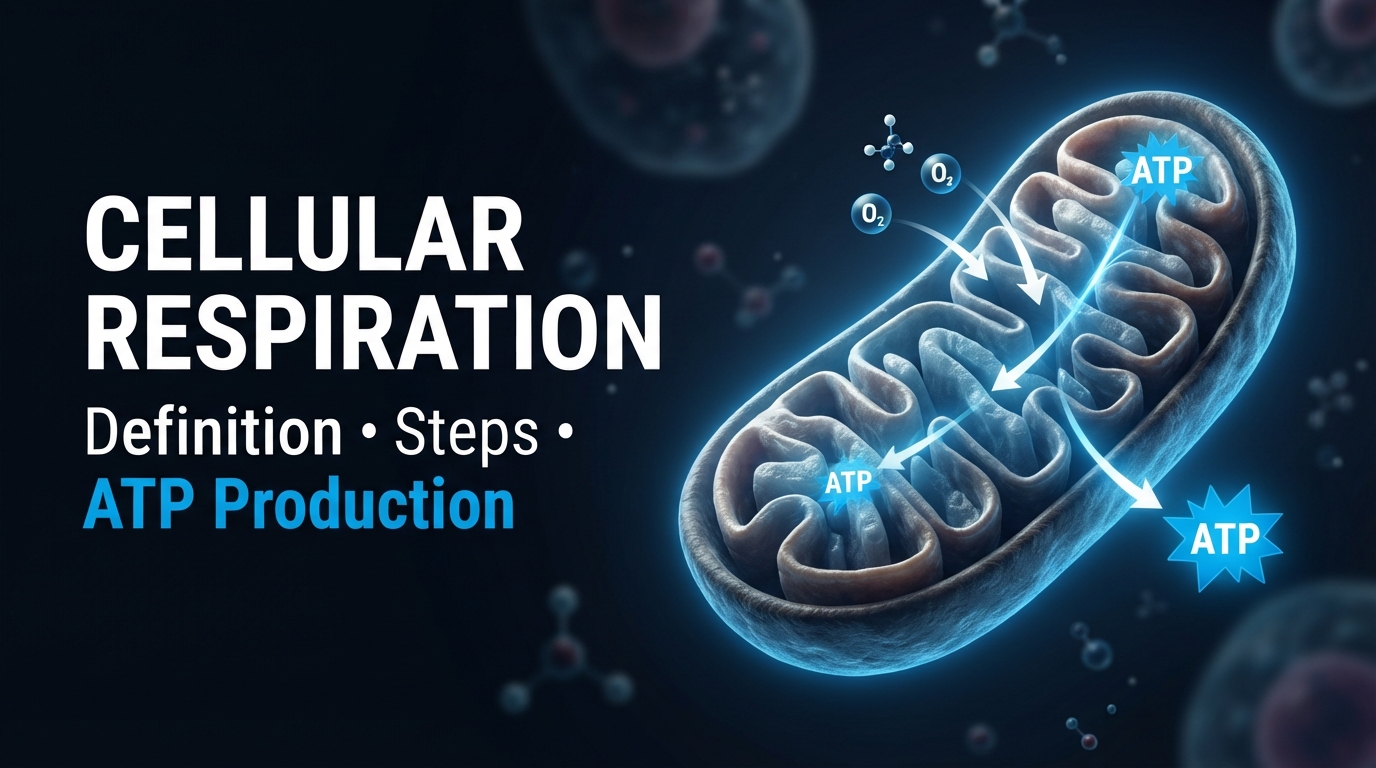
Cellular respiration is one of the most important concepts in biology because it connects food, oxygen, energy, cells, and life processes. In this guide, we will explain cellular respiration in simple terms, discuss its types and major stages, examine the overall equation, and compare aerobic and anaerobic respiration.
What Is Cellular Respiration?
Cellular respiration is a series of metabolic reactions through which cells break down glucose or other energy-rich molecules and release energy for cellular activities.
In aerobic respiration, oxygen is used to help break down glucose completely. The energy released is captured mainly in ATP, while carbon dioxide and water are produced as end products.
A simplified overall equation is:
Glucose + Oxygen → Carbon Dioxide + Water + Energy
In chemical form:
C₆H₁₂O₆ + 6O₂ → 6CO₂ + 6H₂O + Energy
The process does not release all the energy from glucose at once. Instead, energy is released through several controlled steps.
Key idea
Think of glucose as a molecule containing stored chemical energy. Cellular respiration gradually transfers some of that energy into ATP, which cells can use more conveniently.
Why Is Cellular Respiration Important?
Cells constantly need energy. ATP produced during cellular respiration supports many important cellular processes.
1. Growth
Growing cells require energy to build new cellular materials.
2. Active Transport
Cells sometimes move substances across their membranes against a concentration gradient. This process requires energy.
3. Movement
Muscle cells use ATP to support muscle contraction and movement.
4. Cell Division
Energy is required during cell division and the preparation of new cells.
5. Repair and Maintenance
Cells need energy to manufacture proteins, repair structures, and maintain normal functions.
Therefore, cellular respiration is essential because it provides a continuous supply of usable energy.
Where Does Cellular Respiration Occur?
Cellular respiration takes place in more than one part of a cell.
Glycolysis
Glycolysis occurs in the cytoplasm.
It is the first major stage of glucose breakdown.
Later Stages of Aerobic Respiration
In eukaryotic cells, the later stages of aerobic respiration occur mainly inside the mitochondria.
Mitochondria are therefore often described as the major site of aerobic cellular respiration.
However, saying that “all cellular respiration happens inside mitochondria” is not completely accurate because glycolysis takes place in the cytoplasm.
Types of Cellular Respiration
Cellular respiration can broadly be discussed as:
- Aerobic respiration
- Anaerobic respiration
The main difference is whether oxygen is required for the pathway being discussed.
What Is Aerobic Respiration?
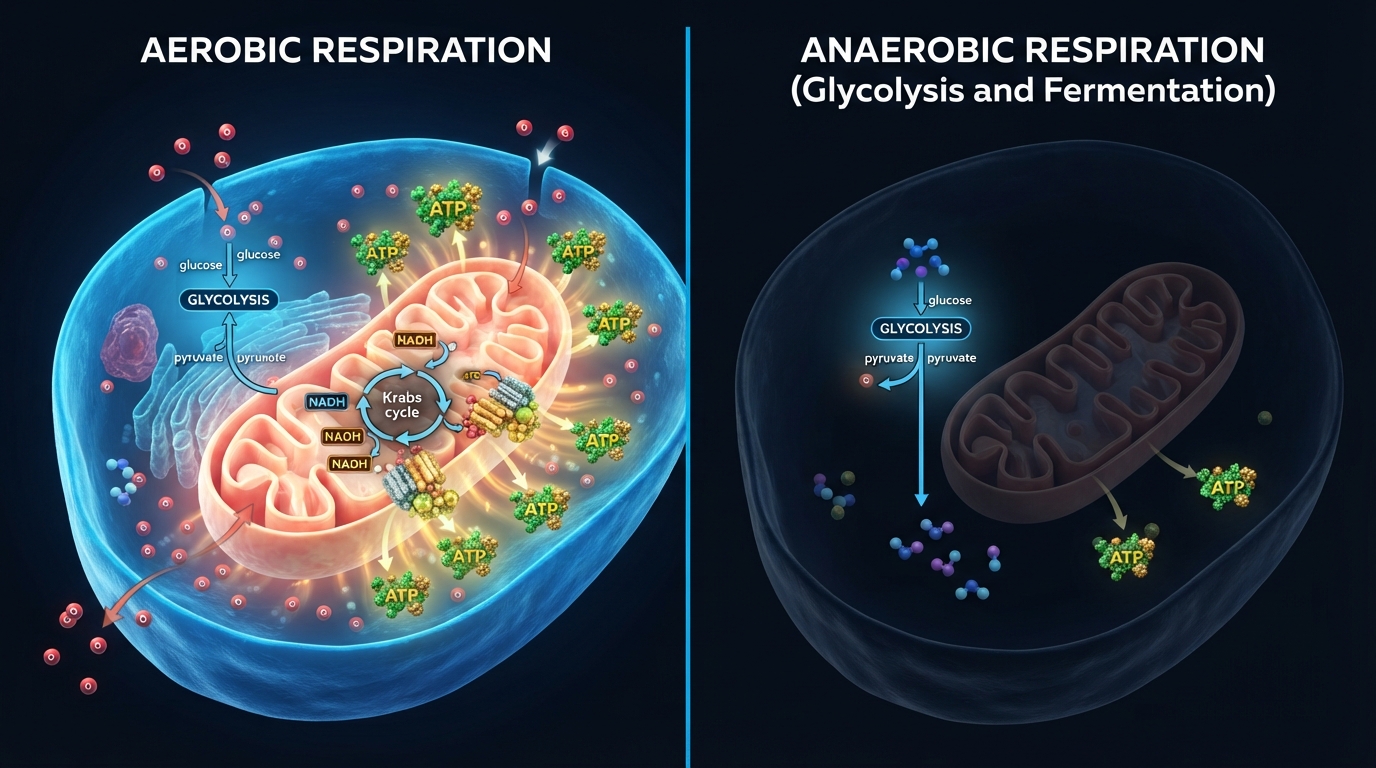
Aerobic respiration is the breakdown of glucose in the presence of oxygen to release energy, producing carbon dioxide and water as major end products.
Aerobic respiration can be summarized as:
Glucose + Oxygen → Carbon Dioxide + Water + Energy
It is associated with the production of a relatively large amount of ATP compared with anaerobic pathways.
Aerobic respiration is common in organisms and cells that have access to oxygen.
What Is Anaerobic Respiration?
Anaerobic respiration refers to energy-releasing pathways that occur without using oxygen in the same way as aerobic respiration.
In school-level biology, anaerobic energy release is commonly illustrated using fermentation.
Two familiar examples are:
In Yeast
Yeast can break down glucose without oxygen and produce ethanol, carbon dioxide, and a small amount of energy.
Simplified equation:
Glucose → Ethanol + Carbon Dioxide + Energy
In Human Muscle Cells
During periods when oxygen supply cannot meet the immediate demand of working muscles, glucose breakdown can lead to the formation of lactic acid (lactate).
This pathway allows ATP production to continue for a limited period, although it is less energy-efficient than complete aerobic oxidation of glucose.
Aerobic vs Anaerobic Respiration
| Feature | Aerobic Respiration | Anaerobic Pathways |
|---|---|---|
| Oxygen | Uses oxygen | Does not require oxygen in the same way |
| Glucose breakdown | More complete | Less complete |
| Major products | Carbon dioxide and water | Products depend on organism/pathway |
| ATP production | Relatively high | Relatively low |
| Example | Respiration in oxygen-using cells | Fermentation in yeast |
Important: Anaerobic pathways vary among organisms. Yeast and human muscle cells do not produce the same end products.
Main Stages of Cellular Respiration
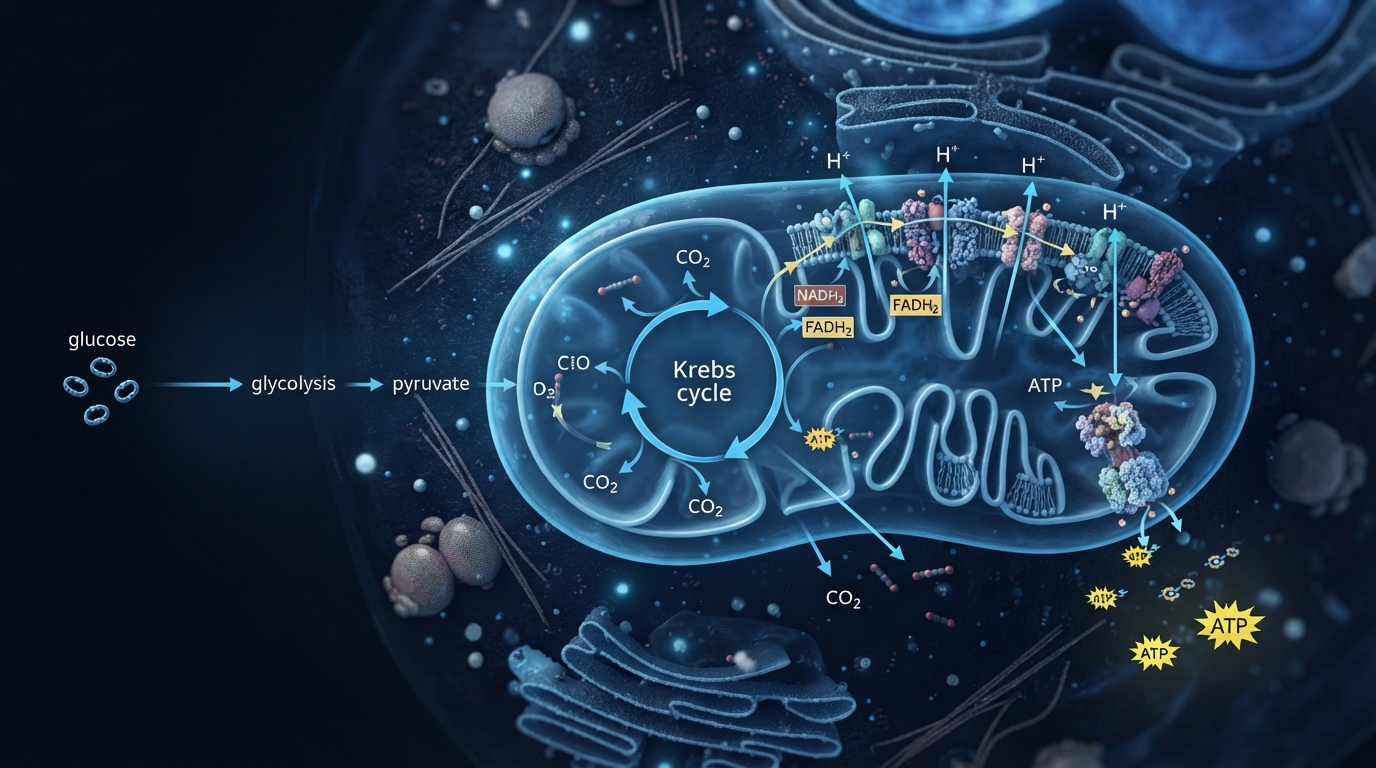
For understanding aerobic respiration, three major stages are commonly introduced:
- Glycolysis
- Krebs cycle
- Electron transport chain
The exact biochemical details can become quite advanced, so the following explanation focuses on the concepts usually required at the Class 9–10 level.
1. Glycolysis
The word glycolysis means the breakdown of glucose.
It is the first stage of cellular respiration and occurs in the cytoplasm.
During glycolysis:
- One glucose molecule is split into smaller molecules.
- A small amount of ATP is produced.
- Electron carriers such as NADH are generated.
- The resulting molecules can enter later stages when oxygen is available.
Glycolysis itself does not require oxygen directly.
Why Is Glycolysis Important?
Glycolysis begins the process of extracting energy from glucose and provides molecules that can be used in subsequent metabolic reactions.
2. Krebs Cycle
The Krebs cycle is also called the citric acid cycle.
In eukaryotic cells, it occurs in the mitochondrial matrix.
Before the cycle proceeds, the products of glycolysis are processed into molecules that can enter the cycle.
During the Krebs cycle:
- Carbon-containing molecules are further broken down.
- Carbon dioxide is released.
- ATP or an equivalent energy-rich molecule is produced.
- Electron carriers such as NADH and FADH₂ are generated.
These electron carriers are especially important because they transfer high-energy electrons to the next stage.
3. Electron Transport Chain
The electron transport chain is the stage where a large proportion of ATP associated with aerobic respiration is generated.
In eukaryotic cells, it is located on the inner mitochondrial membrane.
Electrons carried by NADH and FADH₂ pass through a series of protein complexes. Their energy helps establish a proton gradient across the inner mitochondrial membrane.
This gradient drives an enzyme called ATP synthase, which helps produce ATP.
At the end of the electron transport process, oxygen acts as the final electron acceptor and contributes to the formation of water.
Simple way to remember it
Glycolysis → Krebs Cycle → Electron Transport Chain
You can remember the sequence as:
Break glucose → Process carbon molecules → Generate lots of ATP
What Is ATP?
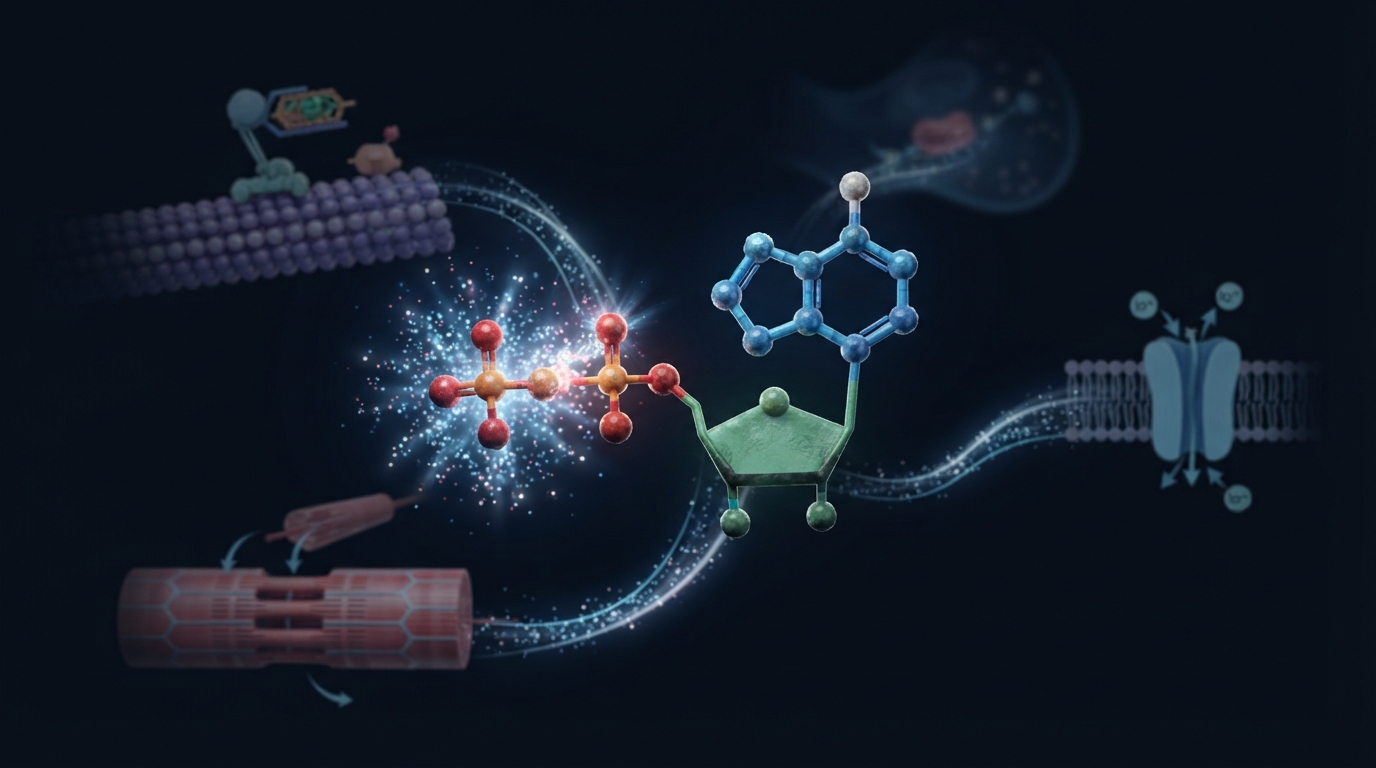
ATP stands for adenosine triphosphate.
It is the major immediate energy-transfer molecule used by cells.
ATP contains:
- Adenine
- Ribose sugar
- Three phosphate groups
Energy released during cellular respiration is used to produce ATP from ADP and inorganic phosphate.
ADP + Pi + Energy → ATP
When ATP is broken down:
ATP → ADP + Pi + Energy
The released energy can then be used by cellular processes.
Why Is ATP Called the Energy Currency of the Cell?
ATP is often called the energy currency of the cell because it transfers usable energy to many cellular reactions.
Cells do not simply store all usable energy as free energy. Instead, they continually produce and use ATP.
For example, ATP can provide energy for:
- Active transport
- Muscle contraction
- Biosynthesis
- Cell division
- Cellular movement
This is why ATP is central to cellular metabolism.
How Much ATP Is Produced?
Older school textbooks sometimes state a fixed theoretical value such as 36 or 38 ATP molecules per glucose molecule.
Modern biology recognizes that the actual ATP yield can vary depending on the organism, cellular conditions, and how electrons from glycolysis are transferred into mitochondria.
For Class 9–10 study, the most important point is:
Aerobic respiration produces much more ATP from one glucose molecule than anaerobic pathways.
Avoid treating a single ATP number as universal.
Cellular Respiration in Humans
Human cells continuously require energy.
Food provides molecules such as glucose that can be metabolized through cellular respiration.
In the presence of sufficient oxygen, aerobic respiration allows cells to extract substantial energy from glucose.
For example, muscle cells require ATP for contraction. During physical activity, the demand for ATP can increase rapidly.
When oxygen delivery cannot immediately satisfy the demand for aerobic metabolism, muscle cells can temporarily rely more on anaerobic energy-producing pathways.
This does not mean that breathing and cellular respiration are the same process.
Cellular Respiration in Plants
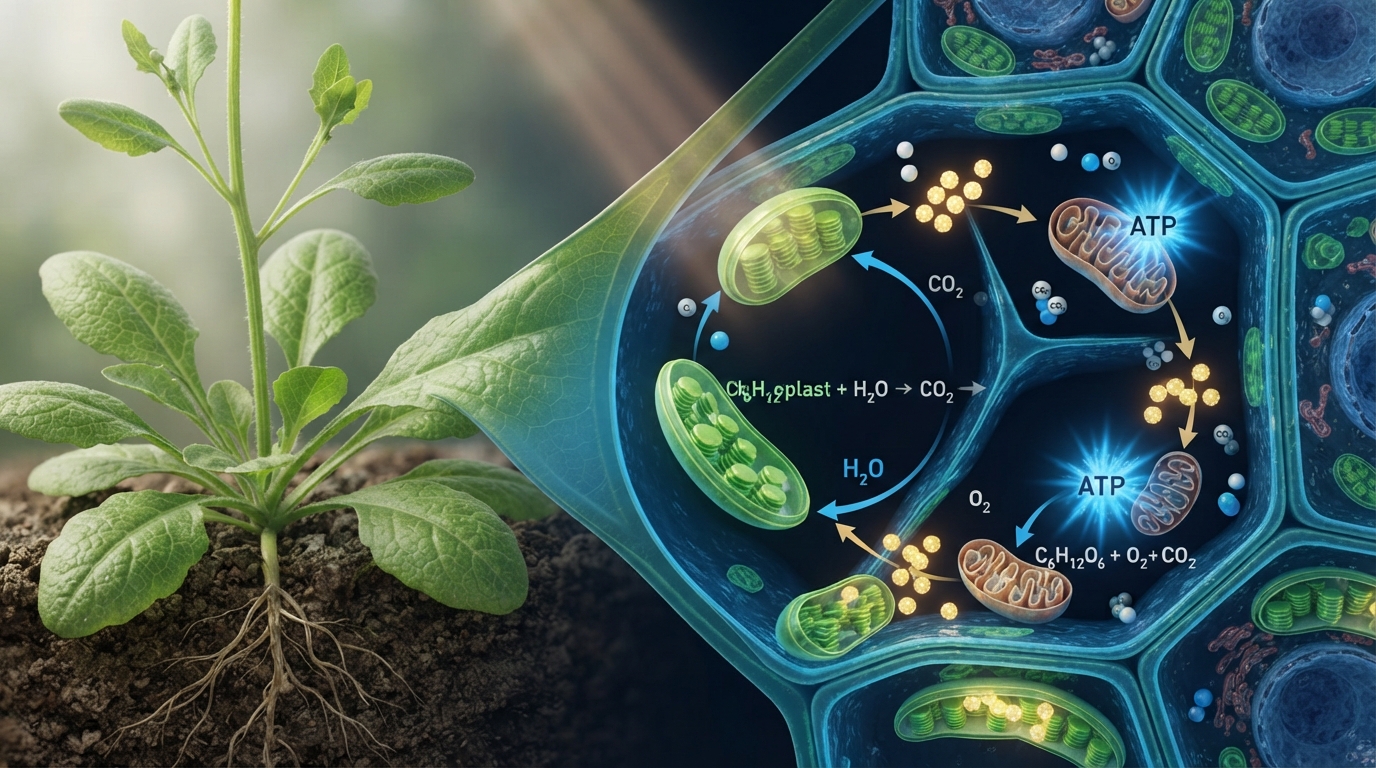
Plants also perform cellular respiration.
Although plants produce glucose through photosynthesis, they still need to convert stored chemical energy into usable cellular energy.
Therefore:
Plants photosynthesize and respire.
Photosynthesis stores energy in organic molecules, while cellular respiration helps release usable energy from those molecules.
Plant cells carry out glycolysis in the cytoplasm and aerobic respiration mainly in mitochondria.
Cellular Respiration vs Photosynthesis
Photosynthesis and cellular respiration are closely connected but are not the same process.
| Feature | Photosynthesis | Cellular Respiration |
|---|---|---|
| Main purpose | Stores energy in organic molecules | Releases usable energy from organic molecules |
| Major reactant | Carbon dioxide and water | Glucose and oxygen in aerobic respiration |
| Major products | Glucose and oxygen | Carbon dioxide and water |
| Energy relationship | Requires light energy | Releases energy from fuel molecules |
| Main location | Chloroplasts in photosynthetic cells | Cytoplasm and mitochondria in eukaryotic cells |
A useful conceptual relationship is:
Photosynthesis builds energy-rich organic molecules, while cellular respiration helps extract usable energy from them.
Is Cellular Respiration the Same as Breathing?
No. Breathing and cellular respiration are different processes.
Breathing
Breathing involves the physical movement of air into and out of the respiratory system.
Cellular Respiration
Cellular respiration refers to chemical reactions inside cells that release energy from nutrients.
Oxygen obtained through breathing can support aerobic cellular respiration, but the two processes should not be confused.
What Happens When Oxygen Is Not Available?
When oxygen is unavailable or insufficient for aerobic metabolism, cells may use alternative pathways to continue producing some ATP.
These pathways are less efficient because glucose is not completely oxidized in the same way as during aerobic respiration.
Examples include:
- Alcoholic fermentation in yeast
- Lactic acid/lactate fermentation in animal muscle cells
These pathways can be useful for short-term energy production, but they do not replace aerobic metabolism for sustained energy requirements.
Factors That Can Affect Cellular Respiration
The rate of cellular respiration can be influenced by several factors.
1. Temperature
Temperature affects the activity of enzymes involved in metabolic reactions. Extremely high temperatures can damage proteins and disrupt cellular processes.
2. Oxygen Availability
Aerobic respiration depends on oxygen availability.
3. Glucose Availability
Cells need suitable fuel molecules to support energy metabolism.
4. Water Availability
Water is important for numerous biochemical reactions and normal cellular function.
5. Cell Type and Metabolic Demand
Different cells have different energy requirements and metabolic characteristics.
Common Misconceptions About Cellular Respiration
Misconception 1: Respiration means only breathing.
Correction: In biology, cellular respiration refers to chemical energy-releasing reactions inside cells.
Misconception 2: Plants do not respire.
Correction: Plants perform cellular respiration just like other living organisms.
Misconception 3: Cellular respiration only happens in mitochondria.
Correction: Glycolysis occurs in the cytoplasm, while later aerobic stages occur in mitochondria in eukaryotic cells.
Misconception 4: Anaerobic respiration produces the same products in every organism.
Correction: Different organisms can use different anaerobic pathways and produce different end products.
Misconception 5: More oxygen always means proportionally more ATP.
Correction: Cellular metabolism is regulated and involves multiple factors; oxygen is important for aerobic respiration but ATP production is not simply proportional to oxygen concentration.
Key Points for Class 9–10 Biology Exams
Remember these important facts:
- Cellular respiration releases usable energy from food molecules.
- Glucose is an important respiratory substrate.
- ATP is the main immediate energy-transfer molecule.
- Glycolysis occurs in the cytoplasm.
- The Krebs cycle occurs in the mitochondrial matrix in eukaryotic cells.
- The electron transport chain is located on the inner mitochondrial membrane.
- Aerobic respiration uses oxygen.
- Anaerobic pathways do not require oxygen in the same way as aerobic respiration.
- Aerobic respiration generally produces much more ATP than anaerobic pathways.
- Plants also perform cellular respiration.
- Breathing and cellular respiration are different processes.
- Carbon dioxide is released during aerobic glucose metabolism.
- Oxygen serves as the final electron acceptor in the aerobic electron transport chain.
Frequently Asked Questions About Cellular Respiration
What is cellular respiration in simple words?
Cellular respiration is the process cells use to release energy from food molecules and transfer much of that energy into ATP.
What is the equation for cellular respiration?
The simplified equation for aerobic cellular respiration is:
C₆H₁₂O₆ + 6O₂ → 6CO₂ + 6H₂O + Energy
What are the three main stages of aerobic cellular respiration?
The three commonly taught stages are glycolysis, the Krebs cycle, and the electron transport chain.
Where does glycolysis occur?
Glycolysis occurs in the cytoplasm.
Where does the Krebs cycle occur?
In eukaryotic cells, the Krebs cycle occurs in the mitochondrial matrix.
Where does the electron transport chain occur?
In eukaryotic cells, the electron transport chain is located on the inner mitochondrial membrane.
What is ATP?
ATP, or adenosine triphosphate, is a molecule that transfers usable energy for cellular activities.
Do plants perform cellular respiration?
Yes. Plant cells perform cellular respiration to obtain usable energy from organic molecules.
What is the difference between aerobic and anaerobic respiration?
Aerobic respiration uses oxygen and generally releases much more energy from glucose, while anaerobic pathways allow cells to produce some ATP without using oxygen in the same way.
Is breathing the same as cellular respiration?
No. Breathing is the movement of air into and out of the respiratory system, while cellular respiration is a series of chemical reactions that release energy inside cells.
Final Takeaway
Cellular respiration is a fundamental process that allows cells to obtain usable energy from nutrient molecules. During aerobic respiration, glucose is gradually processed through glycolysis, the Krebs cycle, and the electron transport chain, with oxygen supporting the final stages.
The energy released is captured in ATP, which powers many cellular activities.
The most important concept to remember is simple:
Food stores chemical energy, cellular respiration releases that energy, and ATP transfers much of it into a form cells can use.
Cellular Respiration Knowledge Quiz
Available options: 1 to 20