
Some medicines are dosed by body weight. Others, especially cancer drugs, are dosed by body surface area (BSA), the total area of skin covering the body, measured in square metres (m²). Kidney function is also reported “per 1.73 m²” so that people of different sizes can be compared. All of this depends on one small calculation from a patient’s height and weight. This guide explains the main BSA formulas, gives you a quick-reference table and six worked examples, and shows where the formulas disagree and why that matters.
Table of Contents
- What body surface area is
- Typical BSA values
- The Mosteller formula
- Other formulas: Du Bois, Haycock and more
- Step-by-step calculation
- Quick-reference table
- Six worked examples
- Why formulas disagree
- Where BSA is used
- Limitations
- Common mistakes
- Tips for students and nurses
- Frequently asked questions
- Key takeaways
1. What Body Surface Area Is
Body surface area is the estimated total skin surface of a person. It is not measured directly in everyday practice. Instead, it is calculated from height and weight with a formula. BSA scales with metabolism, blood volume and the way the body handles many drugs more closely than weight alone does, which is why it is used in dosing and in comparing physiological values between people of different sizes. As the RxList definition of body surface area notes, it is used for drug doses, for IV fluid calculations and to relate kidney function (GFR) to body size.
2. Typical BSA Values
| Group | Average BSA |
|---|---|
| Adult men | About 1.9 m² |
| Adult women | About 1.6 m² |
| Reference “standard” adult | 1.73 m² |
| Child aged 9 | About 1.07 m² |
| Child aged 10 | About 1.14 m² |
| Child aged 12 to 13 | About 1.33 m² |
The 1.73 m² figure is a convention: it is the reference size used to report values such as estimated GFR.
3. The Mosteller Formula
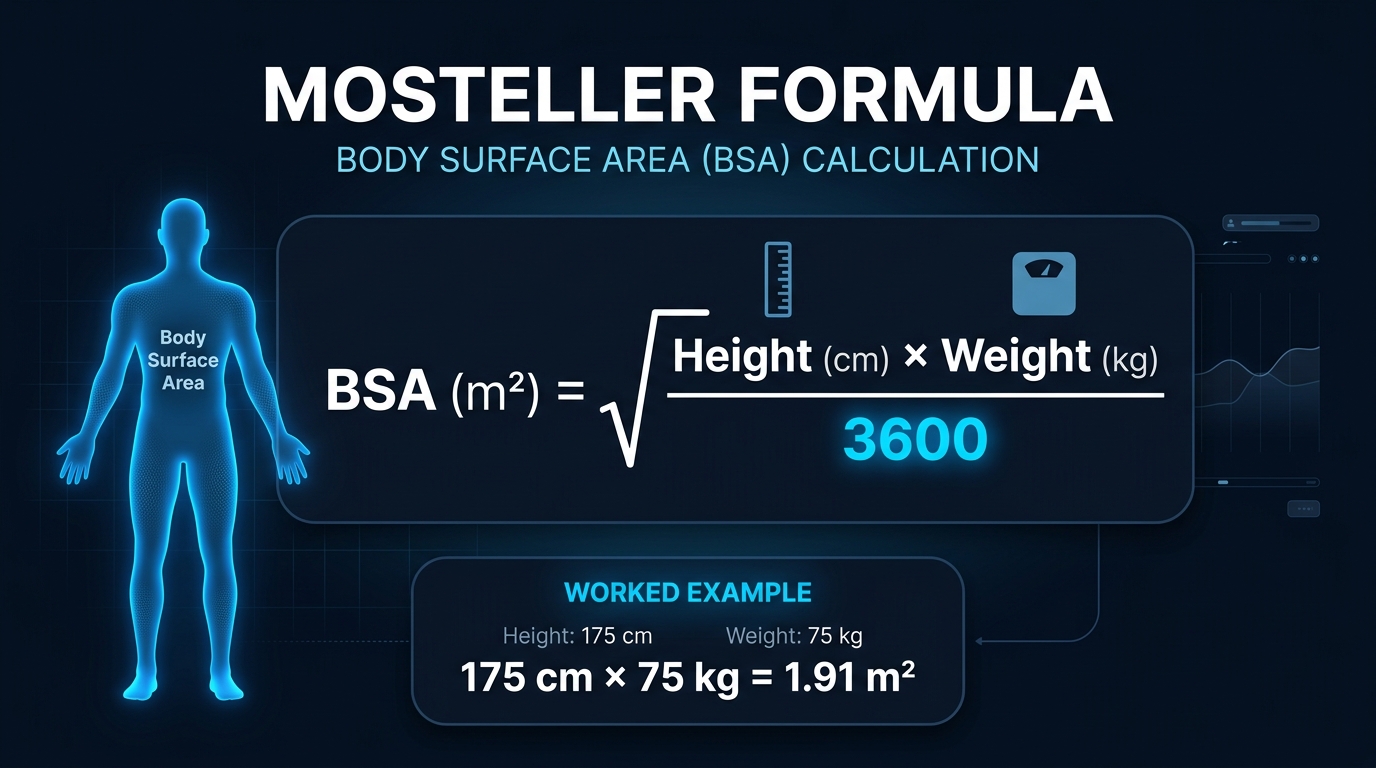
The most commonly used formula today was published by R. D. Mosteller in a 1987 letter to the New England Journal of Medicine. Its popularity comes from its simplicity: it can be done on a basic calculator.
Metric units:
BSA (m²) = √ [ height (cm) × weight (kg) / 3600 ]Imperial units (an equivalent form):
BSA (m²) = √ [ height (in) × weight (lb) / 3131 ]You can read the original in the Mosteller letter on PubMed.
Memory trick: multiply height and weight, divide by 3600, then take the square root.
4. Other Formulas: Du Bois, Haycock and More
Several other equations exist, each fitted to a different group of people at a different time, which is why they do not match exactly.
| Formula | Equation (height in cm, weight in kg) |
|---|---|
| Mosteller | √(H × W / 3600) |
| Du Bois and Du Bois (1916) | 0.007184 × W^0.425 × H^0.725 |
| Haycock (1978) | 0.024265 × W^0.5378 × H^0.3964 |
| Gehan and George | 0.0235 × W^0.51456 × H^0.42246 |
| Boyd | A more complex formula with a weight-dependent exponent |
Which should you use?
- Mosteller is the common default in most hospitals and calculators.
- Du Bois is the classic formula and is still widely used.
- Haycock is often preferred for children, because it was validated in infants, children and adults.
5. Step-by-Step Calculation
- Measure height and weight accurately, in centimetres and kilograms.
- Choose a formula. Use the one required by your protocol or drug label.
- Multiply height by weight (for Mosteller).
- Divide by 3600.
- Take the square root.
- Round sensibly, usually to two decimal places.
- Record the formula next to the result.

6. Quick-Reference Table
This original table uses the Mosteller formula for adults, so you can check your own calculations.
| Height | 50 kg | 60 kg | 70 kg | 80 kg | 90 kg | 100 kg |
|---|---|---|---|---|---|---|
| 150 cm | 1.44 | 1.58 | 1.71 | 1.83 | 1.94 | 2.04 |
| 160 cm | 1.49 | 1.63 | 1.76 | 1.89 | 2.00 | 2.11 |
| 170 cm | 1.54 | 1.68 | 1.82 | 1.94 | 2.06 | 2.17 |
| 180 cm | 1.58 | 1.73 | 1.87 | 2.00 | 2.12 | 2.24 |
| 190 cm | 1.62 | 1.78 | 1.92 | 2.05 | 2.18 | 2.30 |
All values are in m².
7. Six Worked Examples
Example 1: Adult man.
175 cm, 75 kg.
Mosteller: √(175 × 75 / 3600) = √3.646 = 1.91 m².
Example 2: Adult woman.
160 cm, 60 kg.
Mosteller: √(160 × 60 / 3600) = √2.667 = 1.63 m².
Example 3: Comparing formulas in a typical adult.
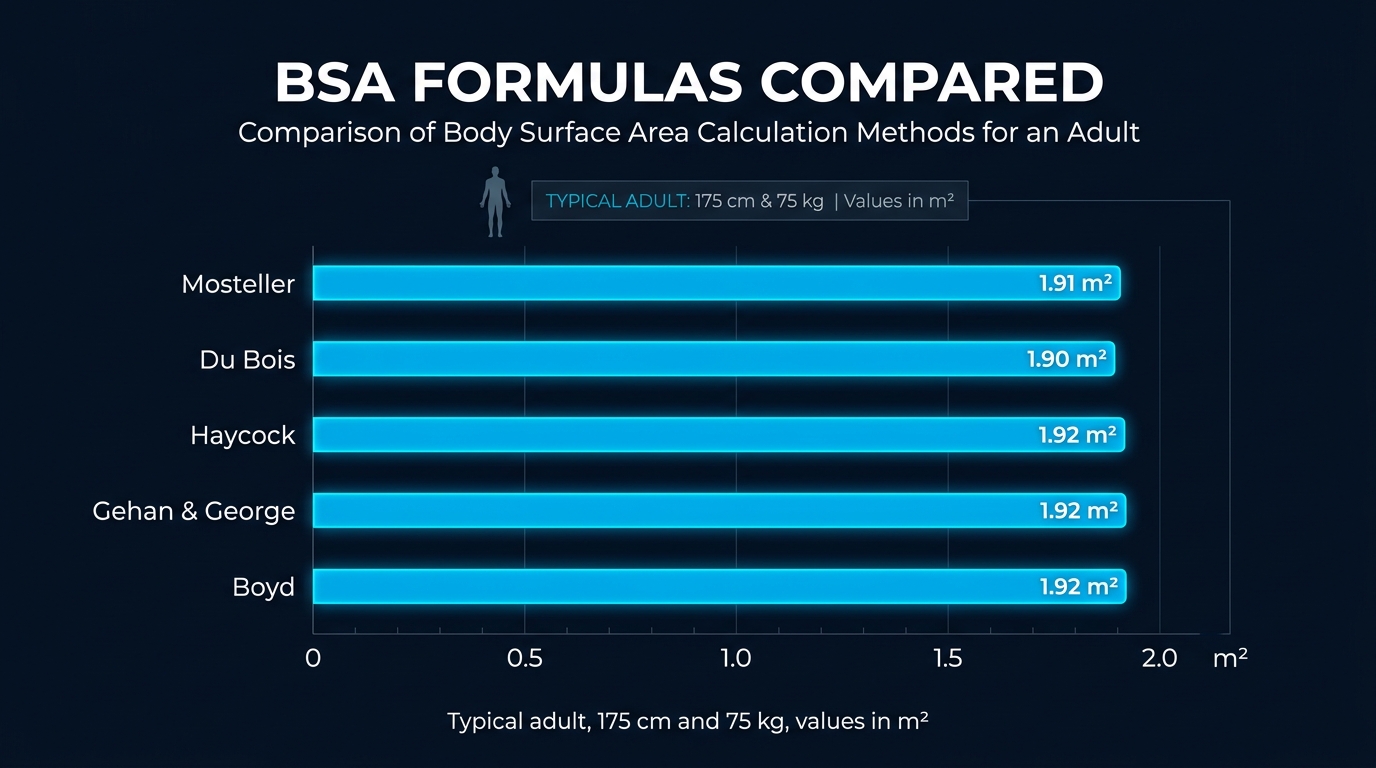
The same man (175 cm, 75 kg) gives:
| Formula | BSA (m²) |
|---|---|
| Mosteller | 1.91 |
| Du Bois | 1.90 |
| Haycock | 1.92 |
| Gehan and George | 1.92 |
| Boyd | 1.92 |
In a typical adult the formulas agree within about 0.02 m², which is why the choice rarely matters.
Example 4: Child.
110 cm, 18 kg.
Mosteller: √(110 × 18 / 3600) = √0.55 = 0.74 m². Haycock gives about the same, 0.74 m². This child’s BSA is roughly 43% of the 1.73 m² adult reference.
Example 5: Chemotherapy dose and BSA capping.
A drug is dosed at 75 mg/m² and the patient’s BSA is 2.3 m².
Full dose = 75 × 2.3 = 172.5 mg. If a clinician “caps” the BSA at 2.0 m², the dose becomes 75 × 2.0 = 150 mg, about 13% lower. Guidance from the American Society of Clinical Oncology recommends using actual body weight for dosing obese patients with cancer rather than capping, because there is no evidence that full weight-based doses increase toxicity. See the ASCO guideline summary on chemotherapy dosing in obesity.

Example 6: Indexing kidney function.
A measured GFR is 90 mL/min in a patient with BSA 2.0 m².
Indexed GFR = 90 × 1.73 / 2.0 = 77.9 mL/min per 1.73 m². Reporting GFR per 1.73 m² lets you compare large and small people fairly. Note that the Cockcroft-Gault equation is not indexed this way, as explained in our Cockcroft-Gault formula guide.
8. Why Formulas Disagree
The formulas were built from different groups of people, so they diverge at the extremes of body size.
- Typical adults: results differ by less than 1%.
- Severe obesity: for an adult of 175 cm and 200 kg, Mosteller gives about 3.12 m², Du Bois about 2.89 m² and Boyd about 3.25 m², a spread of roughly 7%. That difference becomes a real difference in a calculated dose.
- Large studies: in one cancer-clinic comparison, the formulas agreed well overall, but in patients with a BMI above 30 the Du Bois and Mosteller formulas gave lower BSA values than the other three. You can read more in the paper Not all body surface area formulas are the same, but does it matter?
- Overall ambiguity: a wider review, Body surface area formulae: an alarming ambiguity, describes how BSA matters in chemotherapy, transplantation, burn treatment and toxicology, and why the estimate can vary.
9. Where BSA Is Used
| Area | How BSA is used |
|---|---|
| Cancer chemotherapy | Many drugs are dosed in mg/m² |
| Kidney function | GFR is reported per 1.73 m² |
| Burns | %TBSA guides fluid resuscitation (see our Parkland formula guide) |
| Cardiology | Cardiac index is cardiac output divided by BSA |
| Pediatrics | Some doses and fluid calculations use BSA |
| Transplantation and toxicology | Dose and size matching |
10. Limitations
- It is an estimate. The formulas use only height and weight, not body composition.
- Muscle and fat are not distinguished. A muscular athlete and a person with more body fat can have the same BSA.
- Extremes of body size give larger disagreement between formulas.
- Amputations and unusual body shapes are not accounted for.
- Children may need a pediatric formula such as Haycock, since the Mosteller equation was developed mostly for adults.
- Measurement errors in height and weight carry straight into the result.
- It is not a dose by itself. Dosing also depends on organ function, other medicines and local protocols.
11. Common Mistakes
- Mixing cm with pounds or inches with kg.
- Using different formulas when comparing results.
- Forgetting to take the square root in the Mosteller formula.
- Using an old or estimated weight instead of a recent one.
- Capping BSA without a clear protocol, which can underdose obese patients.
- Confusing %TBSA of a burn with BSA in m².
- Rounding too early.
12. Tips for Students and Nurses
- Learn Mosteller by heart: “height times weight, over 3600, then square root.”
- Always write the units and the formula name with the result.
- Double-check height and weight units before you calculate.
- A BSA around 1.7 to 2.0 m² is typical for adults, so a result far outside that range suggests a mistake.
- For related calculations, see our ideal body weight formula guide and try our medical tools.
13. Frequently Asked Questions
What is the Mosteller formula for BSA?
BSA (m²) = square root of [height (cm) × weight (kg) / 3600].
What is the Du Bois formula for BSA?
BSA = 0.007184 × weight^0.425 × height^0.725, with height in cm and weight in kg.
Which BSA formula is the most accurate?
In typical adults they agree closely. Mosteller is the most commonly used, and Haycock is often preferred for children.
What is a normal BSA?
About 1.9 m² for adult men and 1.6 m² for adult women, with 1.73 m² as the standard reference.
Why is BSA used for chemotherapy dosing?
Many drugs are dosed per square metre because BSA relates better to metabolism and drug handling than weight alone.
Should BSA be capped in obese patients?
ASCO guidance recommends using actual body weight for dosing obese adults with cancer, rather than capping BSA, unless there is a specific reason.
Is BSA the same as %TBSA in burns?
No. BSA is the total surface area in m². %TBSA is the percentage of that surface that is burned.
Can I use Mosteller in children?
It can be used, but Haycock is often preferred for children, and local protocols may differ.
What is 1.73 m² used for?
It is the standard adult reference size used to report kidney function values such as estimated GFR.
Why do BSA formulas give different answers?
Each was built from a different group of people, so they diverge at extremes of body size.
Body Surface Area Knowledge Quiz
Available options: 1 to 20
14. Key Takeaways
- BSA is the estimated total skin surface, calculated from height and weight.
- Mosteller: BSA = √(height in cm × weight in kg / 3600).
- Typical adults: about 1.9 m² (men) and 1.6 m² (women), with 1.73 m² as the standard reference.
- Formulas agree closely in normal body sizes but can differ by about 7% in severe obesity.
- BSA is used for chemotherapy dosing, GFR indexing, cardiac index and burn care.
- Always record the formula used, and follow your drug label or hospital protocol.
Disclaimer: This article is for educational purposes only and is not a substitute for professional medical advice. Drug doses must be set by a qualified prescriber or pharmacist according to the product label and local guidelines.
References
- Mosteller RD. Simplified calculation of body-surface area. N Engl J Med. 1987;317(17):1098.
- Du Bois D, Du Bois EF. A formula to estimate the approximate surface area if height and weight be known. Arch Intern Med. 1916;17:863-871.
- Haycock GB, Schwartz GJ, Wisotsky DH. Geometric method for measuring body surface area: a height-weight formula validated in infants, children, and adults. J Pediatr. 1978.
- Griggs JJ, et al. Appropriate chemotherapy dosing for obese adult patients with cancer: ASCO clinical practice guideline. J Clin Oncol. 2012.