
Two patients take the same medicine. One feels the effect fade after a few hours, while the other still has it in the blood a day later. The difference is often the half-life. It is one of the most useful numbers in pharmacology, because it tells you how fast a drug leaves the body, how long it takes to build up to a stable level, and how often it needs to be given. This guide explains the drug half-life formula, the “4 to 5 half-lives” rule, loading and maintenance doses, and six worked examples, with the limits of each shortcut.

Table of Contents
- What half-life means
- The half-life formulas
- Half-lives and how much drug is left
- How long does a drug stay in the body?
- Steady state and accumulation
- Loading dose and maintenance dose
- What changes the half-life
- When half-life is not constant
- Six worked examples
- Common mistakes
- Tips for students and nurses
- Frequently asked questions
- Key takeaways
1. What Half-Life Means
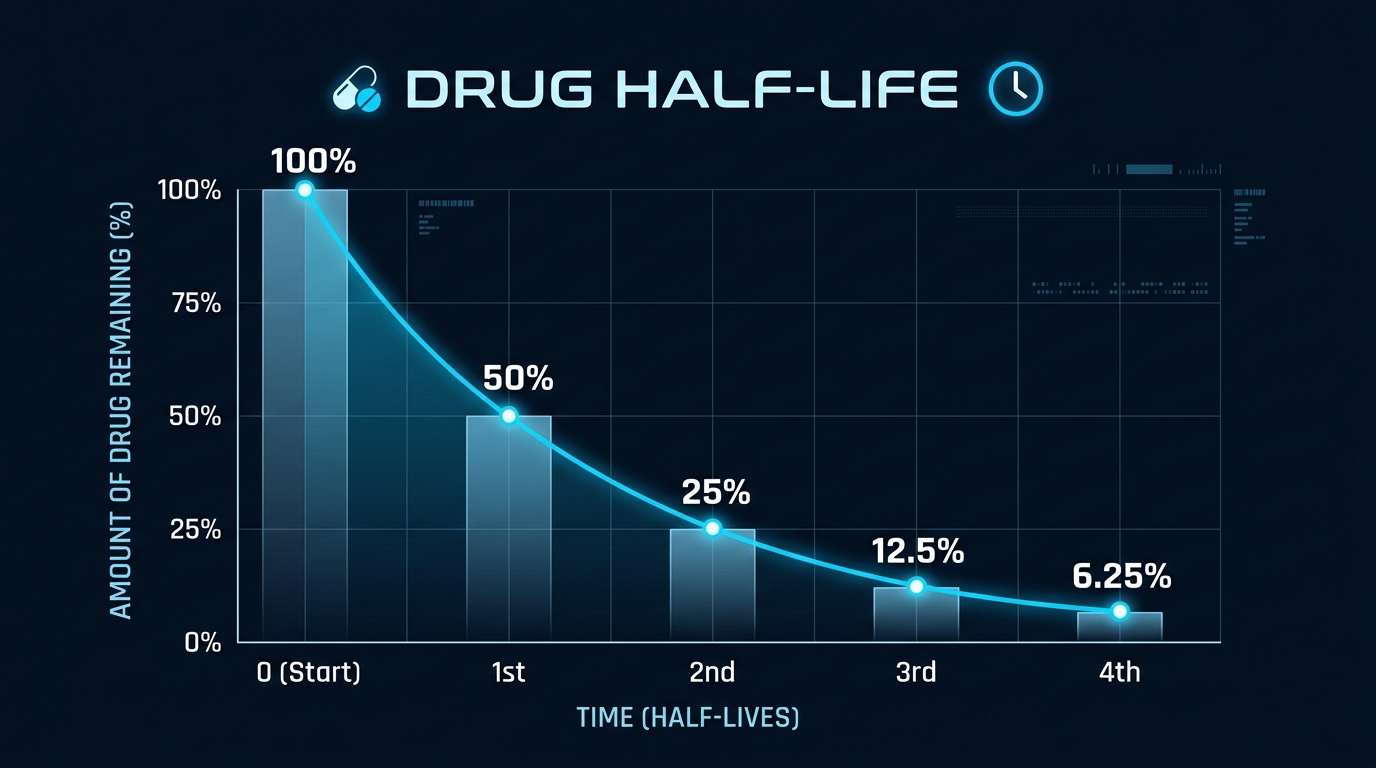
The elimination half-life (written t½) is the time it takes for the concentration of a drug in the body to fall by half. After one half-life, 50% remains. After a second, 25% remains, and so on. For most drugs the time needed to halve the level stays the same, whether the level is high or low, which is why this idea is so handy. The StatPearls review of drug half-life describes it as a key tool for working out excretion rates and steady-state concentrations.
Half-life is not the same as how long a drug works. A drug’s effect depends on its concentration at the site of action, on active breakdown products and on how sensitive the patient is, so the effect can last shorter or longer than the half-life suggests.
2. The Half-Life Formulas
Two forms are used. The first uses the elimination rate constant (k), which is the fraction of drug removed per unit time:
t½ = 0.693 / kThe second uses volume of distribution (Vd) and clearance (CL):
t½ = 0.693 × Vd / CL| Term | Meaning |
|---|---|
| Half-life (t½) | Time for the level to fall by 50% |
| Clearance (CL) | Volume of blood cleared of drug per unit time (L/h) |
| Volume of distribution (Vd) | How widely the drug spreads in the body (L) |
| k | Elimination rate constant (per hour) |
The number 0.693 is the natural logarithm of 2. From these formulas you can see two simple rules: a larger Vd lengthens half-life, and a larger clearance shortens it. More on this in the Pharmaceutical Press guide to half-life.
3. Half-Lives and How Much Drug Is Left
This table applies to drugs that follow first-order elimination (the usual case). It shows the share eliminated after a single dose, and it also shows how close you are to steady state during repeated dosing.
| Number of half-lives | Eliminated (single dose) or reached (steady state) |
|---|---|
| 1 | 50% |
| 2 | 75% |
| 3 | 87.5% |
| 4 | 93.75% |
| 5 | 96.9% |
| 6 | 98.4% |
| 7 | 99.2% |
A useful marker: about 3.3 half-lives are needed for roughly 90% of a dose to be eliminated.
4. How Long Does a Drug Stay in the Body?
For a single dose of a first-order drug, the quick answer is about 5 half-lives to eliminate nearly all of it (around 97%).
Example: A drug with a half-life of 6 hours is almost completely gone after about 30 hours.
But keep three cautions in mind:
- Detectable is not the same as active. Tiny amounts can remain after the effect is over.
- Active metabolites can stay longer than the parent drug and keep acting.
- Patient factors such as age, kidney function and liver function can change the number a lot.
The half-life is a property of the drug in a typical person, not a guarantee for any individual.
5. Steady State and Accumulation
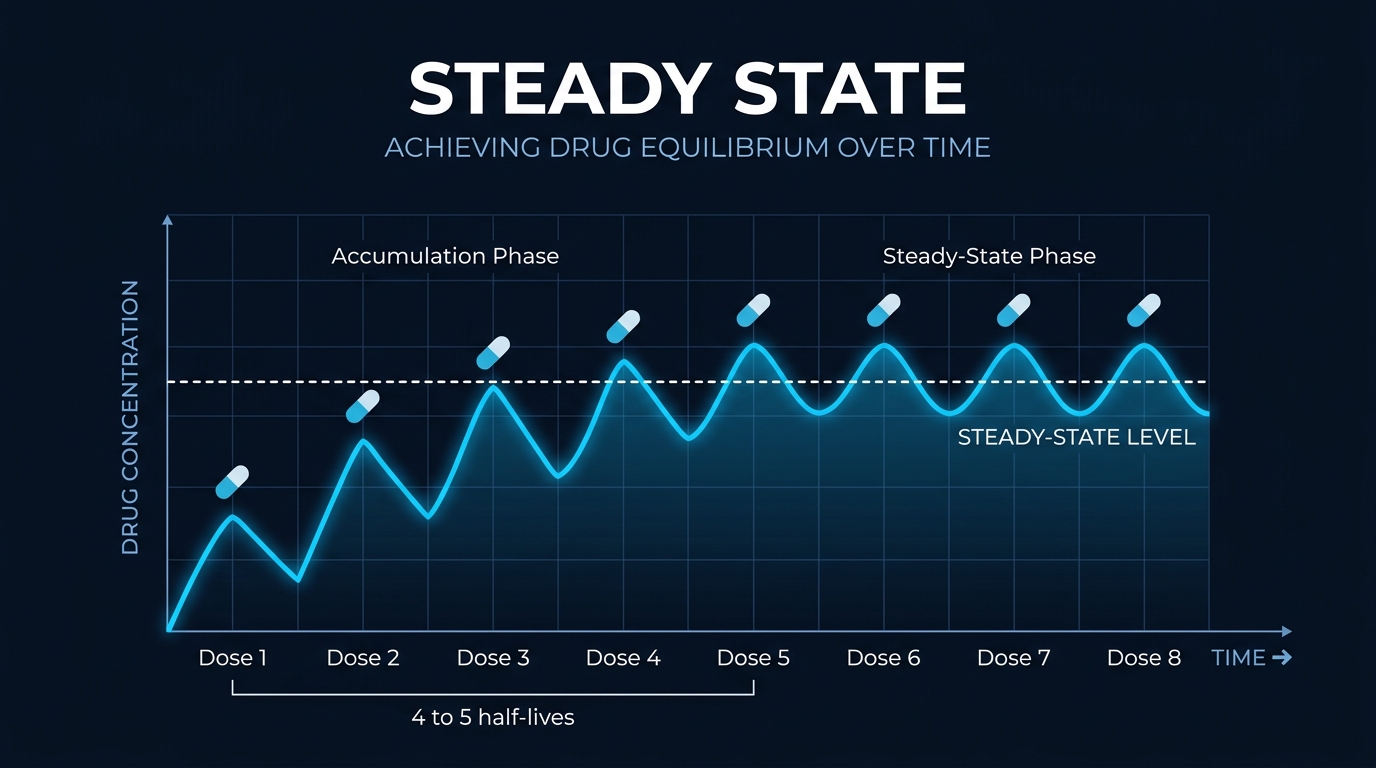
When a drug is given repeatedly, each new dose adds to what is still in the body, so the level climbs and then levels off. The point where the amount going in equals the amount going out is called steady state.
Key rule: Steady state is reached after roughly 4 to 5 half-lives, no matter what the dose is. A bigger dose changes the level at steady state, but not the time needed to get there. Some sources quote 5 to 7 half-lives, and there are exceptions, as described in the StatPearls review of steady-state concentration.
Accumulation factor (how many times higher the steady-state trough is than after the first dose, for first-order drugs):
Accumulation factor = 1 / (1 − 0.5^(τ / t½))where τ (tau) is the dosing interval. This original table shows how it changes:
| Dosing interval vs half-life | Accumulation factor |
|---|---|
| Half as long as t½ (τ = 0.5 × t½) | 3.41 |
| Equal to t½ | 2.00 |
| Twice as long as t½ | 1.33 |
| Three times t½ | 1.14 |
| Four times t½ | 1.07 |
So the shorter the interval compared with the half-life, the more the drug builds up. Accumulation becomes small once the interval is several half-lives long.
6. Loading Dose and Maintenance Dose
Waiting 4 to 5 half-lives for steady state can be too slow for drugs with long half-lives. A loading dose is a larger first dose that “fills” the volume of distribution to the target level straight away. After that, maintenance doses just replace what is cleared.
Loading dose = (Vd × target concentration) / bioavailability (F)

Maintenance dose = (target concentration × CL × dosing interval) / F
These formulas are explained in the StatPearls review of loading dose, which also notes that even drugs with short half-lives may sometimes need a loading dose to act immediately.
Note: Doses based on body size and kidney function matter here too. See our guides to the Cockcroft-Gault formula and the body surface area formula.
7. What Changes the Half-Life
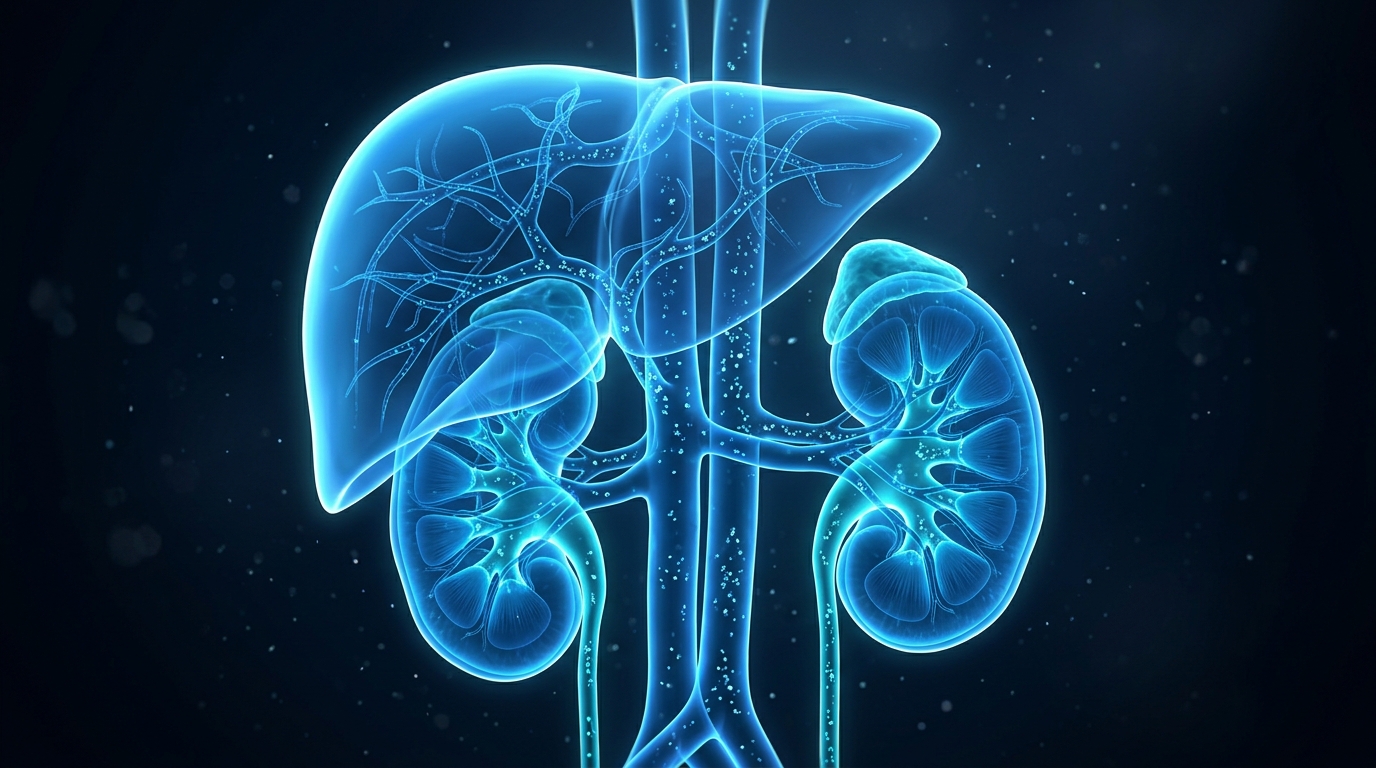
Because half-life depends on both clearance and volume of distribution, anything that changes either one changes the half-life.
| Factor | Effect |
|---|---|
| Kidney impairment | Less clearance of kidney-cleared drugs, so a longer half-life |
| Liver impairment | Less metabolism of liver-cleared drugs, so a longer half-life |
| Age | Newborns and older adults often have slower or changing clearance |
| Body composition | A drug that dissolves in fat can have a larger Vd and a longer half-life in people with more body fat |
| Plasma protein binding | Can alter distribution and clearance |
| Drug interactions | Enzyme inducers shorten half-life, and enzyme inhibitors lengthen it |
| Pregnancy, heart failure, fluid shifts | Can change Vd and clearance |
For more on how age and other factors affect the number, see the MedicineNet explanation of drug half-life.
8. When Half-Life Is Not Constant
The formulas above assume first-order kinetics, where a constant fraction is removed per hour. Some drugs show zero-order (saturable) kinetics, where the body removes a constant amount per hour because the enzymes are overwhelmed. In this case:
- the half-life becomes longer as the dose goes up,
- the “4 to 5 half-lives” rule no longer applies,
- and a small dose increase can cause a large rise in the level.
Examples that can behave this way include alcohol and, at higher doses, phenytoin and aspirin. This is why some of these drugs need blood level monitoring.
9. Six Worked Examples
Example 1: Half-life from the rate constant.
k = 0.1155 per hour.
t½ = 0.693 / 0.1155 = 6.0 hours.
Example 2: Half-life from Vd and clearance.
Vd = 70 L, CL = 7 L/h.
t½ = 0.693 × 70 / 7 = 6.93 hours (k = CL / Vd = 0.1 per hour).
Example 3: Single dose.
A 200 mg dose of a drug with t½ = 6 hours.
After 6 hours: 100 mg. After 12 hours: 50 mg. After 24 hours: 12.5 mg.
Time for 90% to be eliminated is about 3.3 × 6 = about 20 hours, and for almost complete elimination (5 half-lives) it is 30 hours.
Example 4: Time to steady state.
Same drug, t½ = 6 hours.
Steady state needs 4 to 5 half-lives, so 24 to 30 hours. If the drug is given every 6 hours (τ = t½), the accumulation factor is 2.0, meaning the trough at steady state is about twice the level after the first dose.
Example 5: Kidney impairment.
Vd = 70 L, but clearance falls from 7 L/h to 3.5 L/h.
t½ = 0.693 × 70 / 3.5 = 13.9 hours (double the original 6.93 hours).
Steady state now takes 4 to 5 half-lives, which is about 55 to 69 hours instead of 28 to 35 hours. A fixed dose given at the same interval would build up much higher, which is why doses of kidney-cleared drugs are adjusted.
Example 6: Loading and maintenance dose.
Target concentration = 10 mg/L, Vd = 70 L, CL = 7 L/h, F = 1.
Loading dose = 10 × 70 / 1 = 700 mg.
Maintenance rate = 10 × 7 / 1 = 70 mg per hour, which is 420 mg every 6 hours.
Check: a rate of 70 mg/h divided by CL of 7 L/h gives a steady-state level of 10 mg/L, as intended.
These examples use made-up numbers for teaching. Real doses come from the product label and the prescriber.

10. Common Mistakes
- Assuming half-life equals duration of action.
- Saying a drug is “gone” after one half-life.
- Using the 4 to 5 half-lives rule for zero-order drugs.
- Forgetting that a loading dose changes the time to reach the target, not the half-life.
- Mixing up dosing interval and half-life.
- Ignoring active metabolites, which can have their own half-lives.
- Forgetting the units (hours vs minutes) in the formulas.
- Not adjusting for kidney or liver function.
11. Tips for Students and Nurses
- Remember the trio “half-life: 50, 75, 87.5, 93.75, 96.9”.
- Link the formula to meaning: big Vd, long half-life; big clearance, short half-life.
- When you hear “steady state,” think “about 5 half-lives.”
- Before giving a drug to a patient with kidney or liver disease, check whether the dose or interval needs to change.
- Never change a dose on your own because of half-life math. Follow the prescriber and the protocol.
12. Frequently Asked Questions
What is the half-life of a drug?
The time it takes for the drug concentration in the body to fall by half.
What is the half-life formula?
t½ = 0.693 / k, or t½ = 0.693 × Vd / CL.
How many half-lives to eliminate a drug?
About 5 half-lives remove roughly 97% of a dose, and about 3.3 half-lives remove roughly 90%.
How long does a drug stay in your system?
For most drugs, a rough guide is about 5 half-lives. The exact time depends on the drug, the dose and the person, and traces can remain after the effect is over.
How long does it take to reach steady state?
About 4 to 5 half-lives, regardless of the dose.
Does a higher dose change the half-life?
Not for first-order drugs. For zero-order (saturable) drugs, the half-life can lengthen as the dose goes up.
Why do kidney problems lengthen the half-life?
Because clearance falls, and half-life is inversely related to clearance.
What is a loading dose?
A larger first dose that fills the volume of distribution so the drug reaches its target level quickly.
Is half-life the same as duration of action?
No. The duration of action depends on concentration at the target, active metabolites and the patient’s sensitivity.
Do children and older adults have different half-lives?
Often, yes. Metabolism and clearance change with age.
Drug Half-Life Knowledge Quiz
Available options: 1 to 20
13. Key Takeaways
- Half-life is the time for a drug’s concentration to fall by 50%.
- t½ = 0.693 / k = 0.693 × Vd / CL.
- Nearly all of a single dose is gone after about 5 half-lives, and steady state is reached in about 4 to 5 half-lives.
- Loading dose = Vd × target concentration / F, and maintenance dose = target concentration × CL × interval / F.
- Kidney or liver disease can lengthen half-life by lowering clearance.
- Zero-order drugs break the rules, so monitor them carefully.
Disclaimer: This article is for educational purposes only and is not a substitute for professional medical advice. Drug doses must be set by a qualified prescriber or pharmacist according to the product label and local guidelines.
References
- StatPearls: Steady State Concentration. NCBI Bookshelf.
- StatPearls: Loading Dose.
- StatPearls: Half-Life (Physiology and Pharmacology).
- Pharmaceutical Press: What is the half-life of a drug?