
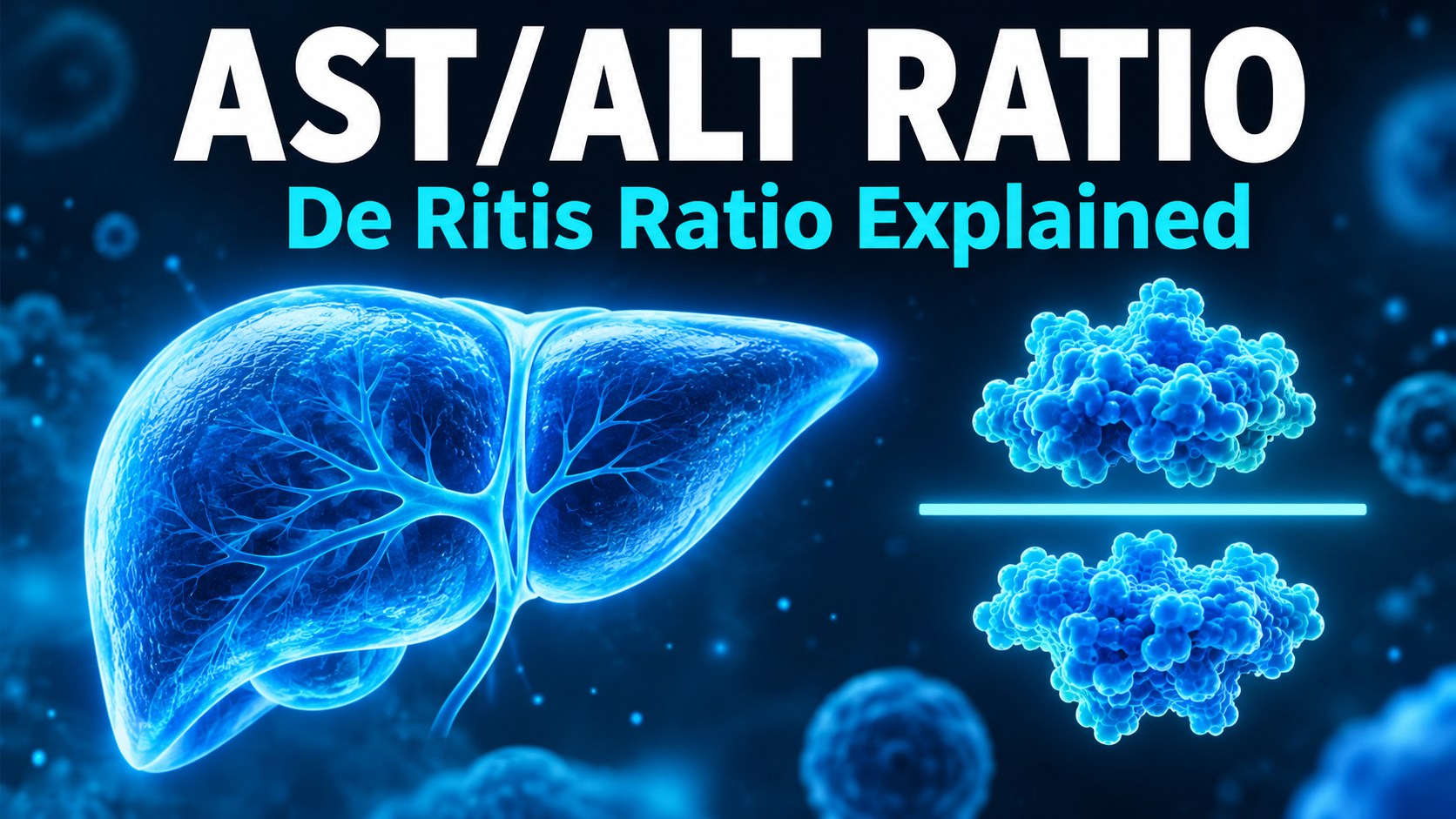
The AST/ALT ratio, also called the De Ritis ratio, compares two liver enzymes from a routine blood test. In a healthy person the two enzymes are roughly equal, so the ratio sits close to 1. A ratio above 2 or below 1 can give doctors a clue about what kind of liver problem may be present, but it never gives a diagnosis on its own. In this guide you will learn the formula, normal values, what a high or low ratio can mean, the factors that can mislead you, and how to read the number safely.
What Is the AST/ALT Ratio?
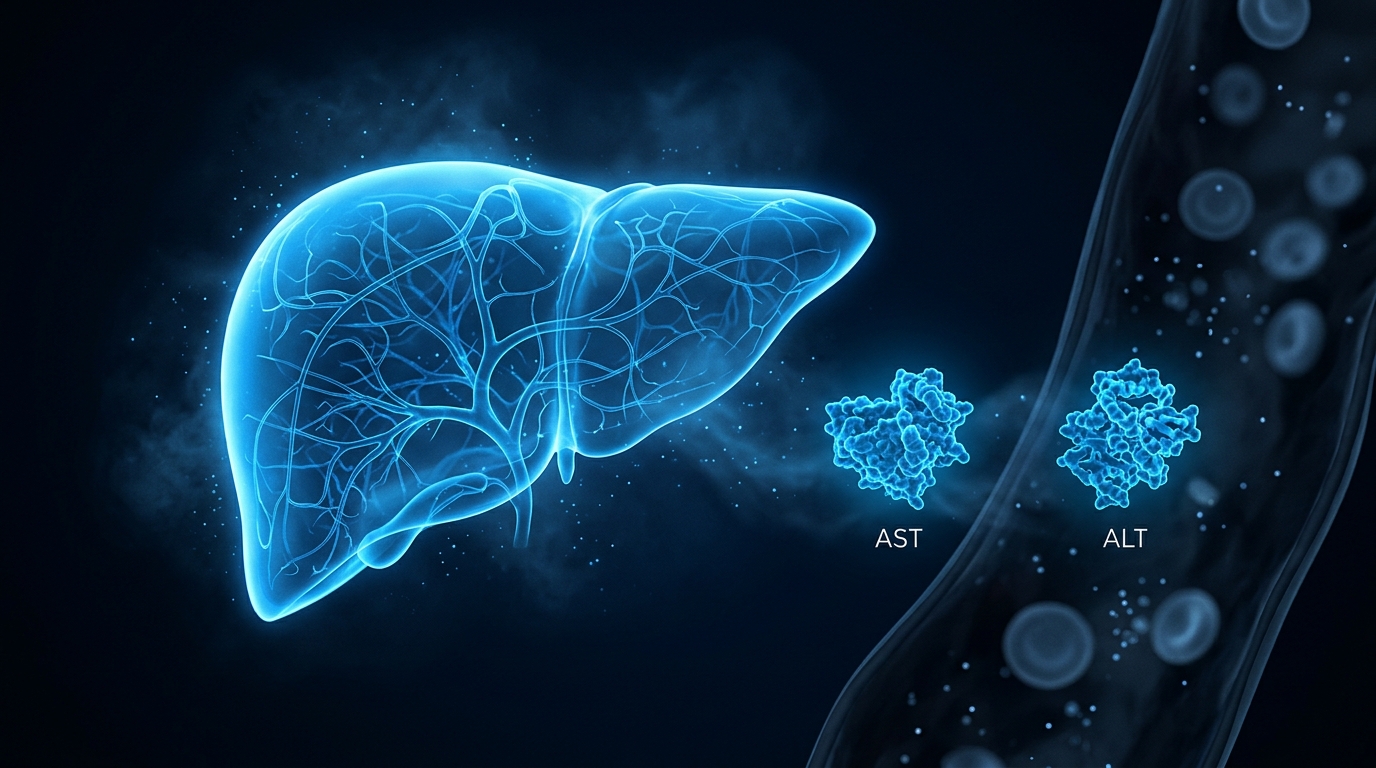
AST (aspartate aminotransferase) and ALT (alanine aminotransferase) are enzymes found mainly in the liver. When liver cells are damaged, these enzymes leak into the blood and their levels rise. The ratio between them was first described by the Italian physician Fernando De Ritis in 1957, and a 2024 review in Cureus notes that it has been used ever since to help tell apart different causes of liver injury.
A review in The Clinical Biochemist Reviews states that, of the many enzyme ratios proposed over the years, the De Ritis ratio is the one that has stood the test of time and is still widely used.
AST/ALT Ratio Formula
AST/ALT Ratio = AST (U/L) ÷ ALT (U/L)
Both values come from the liver function tests on your report. The result has no unit, because the units cancel out. Some websites quote a “normal range” for the ratio in U/L, which is incorrect. Only the enzyme levels themselves are measured in U/L.
You can also use our calculator below.
AST/ALT Ratio Calculator
De Ritis Ratio = AST ÷ ALT
Educational tool only. It does not diagnose any condition. The ratio is most useful when at least one enzyme is raised, and exercise, muscle injury, heart problems and medicines can also change AST and ALT. Please discuss your result with a doctor.
What Is a Normal AST/ALT Ratio?
In healthy individuals AST and ALT are about equal, which gives a ratio of approximately 1. Exact reference ranges for the enzymes themselves vary between laboratories and between men and women, so always compare your values with the range printed on your own report.
| AST/ALT ratio | Pattern often described |
|---|---|
| Around 1 | Typical in healthy people |
| Below 1 | Seen in fatty liver disease (NAFLD/MASLD) and many mild injuries |
| 1 or above | Can appear in chronic liver disease and cirrhosis |
| Above 1.5 to 2 | More suggestive of alcohol-related liver injury |
These bands are a teaching guide and sources use slightly different cut-offs. Your doctor will read the ratio with your symptoms and other tests.

Worked Examples
Example 1: Typical values. AST 30 U/L, ALT 30 U/L. Ratio = 30 ÷ 30 = 1.0.
Example 2: ALT higher than AST. AST 40 U/L, ALT 80 U/L. Ratio = 40 ÷ 80 = 0.5. A ratio below 1 is the pattern most often seen in fatty liver disease, although many other conditions can give the same picture.
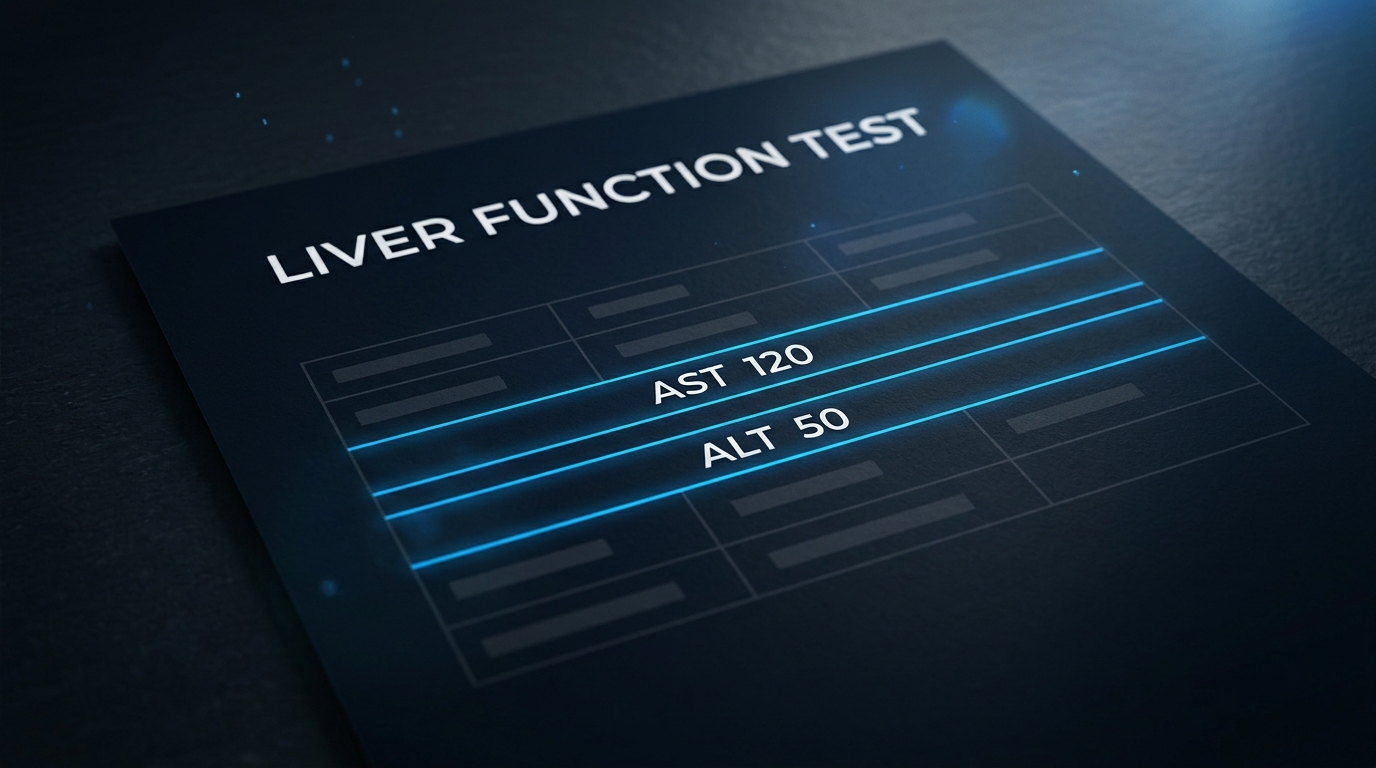
Example 3: AST more than double ALT. AST 120 U/L, ALT 50 U/L. Ratio = 120 ÷ 50 = 2.4. This pattern is associated with alcohol-related liver injury in studies, but it is not proof, and a doctor will want to check other tests such as GGT and the full clinical history.
Example 4: After heavy exercise. AST 150 U/L, ALT 40 U/L. Ratio = 150 ÷ 40 = 3.75. This could reflect muscle rather than liver, which we explain below.
What Does a High AST/ALT Ratio Mean?
Ratio above 2: alcohol-related liver disease
A review of fatty liver and the AST:ALT ratio reports that, in patients with alcohol-related liver disease, the ratio is above 1 in 92% and above 2 in 70%. Scores above 2 are strongly suggestive of alcoholic liver disease, while scores below 1 are more suggestive of non-alcoholic fatty liver disease. Another study notes that a ratio above 1.5 is considered highly suggestive that alcohol is the cause, and that alcoholic hepatitis often shows a ratio above 2 with absolute enzyme levels below 300 IU/L.
Important: the same review states that the ratio does not have enough sensitivity or specificity to definitively separate alcohol-related from non-alcoholic disease. It works as a clinical guide, for example when deciding whether a liver biopsy is needed. A high ratio must never be used to accuse or label anyone.
Why does the ratio rise in alcohol-related disease?
AST is partly stored inside mitochondria, and alcohol damages mitochondria. The ratio also reflects timing, because AST has a shorter half-life (about 18 hours) than ALT (about 36 hours). In addition, deficiency of vitamin B6, which ALT needs to work, can lower ALT in people who drink heavily.
Ratio above 1 in chronic liver disease and cirrhosis
In chronic viral hepatitis, chronic alcoholism and non-alcoholic fatty liver disease, the Clinical Biochemist Reviews article explains that a rising AST/ALT ratio is predictive of long-term complications including fibrosis and cirrhosis. In other words, a fatty liver that starts with a ratio below 1 may drift towards 1 or above as scarring progresses. This is why doctors often combine the ratio with platelet count and scores such as FIB-4.
Other conditions with AST higher than ALT
- Cirrhosis from viral hepatitis or Wilson’s disease: AST can exceed ALT, though the ratio is typically not greater than two.
- Early acute viral hepatitis: the ratio can be high early in the illness and is conventionally below 1 later.
- Muscle injury and strenuous exercise: a study of healthy men showed that muscular exercise can cause highly abnormal liver function tests, because AST (and not only ALT) is also released from muscle.
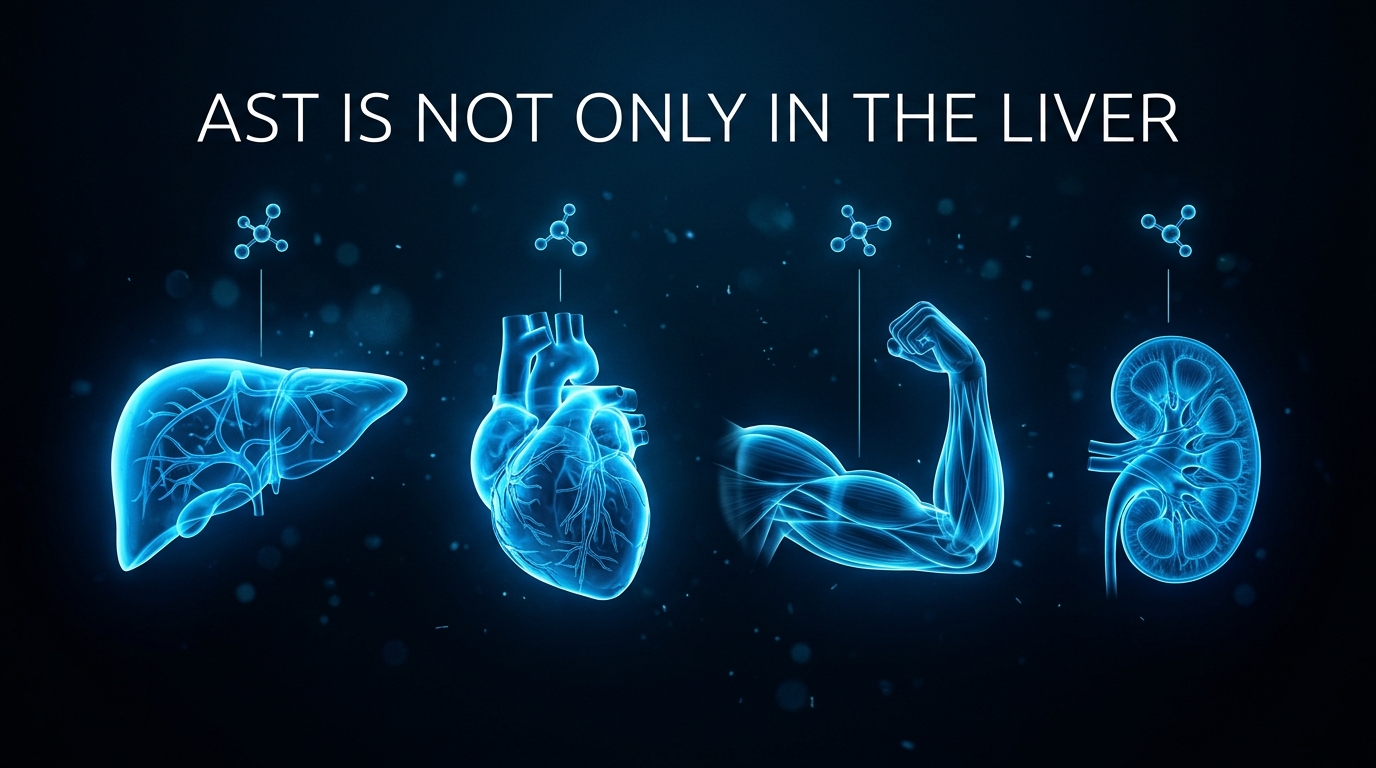
- Heart and kidney tissue: AST is found in higher amounts than ALT in heart and kidney, so a very high ratio can come from outside the liver. The Clinical Biochemist Reviews table lists a ratio of about 2.5 in liver tissue, but 3.8 in kidney and 17 in heart.
What Does a Low AST/ALT Ratio Mean?
A ratio below 1 means ALT is higher than AST. This is the typical pattern in early non-alcoholic fatty liver disease, where ALT is often the enzyme that rises first, as the Cureus review explains. It is also common in many mild forms of liver injury. A low ratio does not mean the liver is healthy, and it does not rule out disease, so the absolute enzyme values still matter.
Factors That Can Change the Ratio
- Timing of the illness: AST clears faster than ALT, so the ratio changes as damage settles or progresses. The Clinical Biochemist Reviews article warns that older rules are too simplistic, noting that acute viral hepatitis can have AST above ALT early on, and alcoholic hepatitis can have ALT above AST several days after drinking stops.
- Exercise and muscle injury: raise AST.
- Vitamin B6 level: affects ALT activity.
- Medicines and toxins: some drugs and toxins injure the liver and change both enzymes.
- Laboratory methods: different analysers have different reference ranges.
When Is the Ratio Most Useful?
The ratio makes most sense when at least one enzyme is raised. If both AST and ALT are well within the normal range, a ratio of 1.2 or 0.8 is rarely meaningful. The Clinical Biochemist Reviews authors suggest that laboratories should ideally report AST, ALT and the De Ritis ratio together whenever ALT is abnormal, since the combination gives useful diagnostic and prognostic information.
Limitations of the AST/ALT Ratio
- Not a diagnostic test: it is a pattern, not a diagnosis.
- Overlap between diseases: several liver and non-liver conditions share the same ratio.
- Cut-offs vary: 1.5, 2 and other thresholds appear in different studies.
- Non-liver sources: muscle, heart and kidney also contain AST.
- Needs context: history, examination, other blood tests and imaging are all required.
When Should You See a Doctor?
See a doctor if your liver enzymes are raised, if the AST/ALT ratio is unusual together with symptoms such as yellow eyes or skin, dark urine, persistent tiredness, abdominal swelling or pain, or unexplained weight loss. Seek urgent care for vomiting blood, black stools or confusion. Do not stop or change any medicine because of this ratio.
Key Takeaways
- AST/ALT ratio = AST ÷ ALT, and it has no unit.
- A ratio of about 1 is typical in healthy people.
- A ratio below 1 is common in fatty liver disease.
- A ratio above 2 is associated with alcohol-related liver injury, but cannot prove it.
- A ratio above 1 in someone with chronic liver disease can signal advancing fibrosis or cirrhosis.
- Exercise, muscle, heart and kidney problems can raise AST and change the ratio.
Conclusion
The AST/ALT ratio is a simple, free number that adds useful context to liver blood tests, but it is only a clue, not a verdict. Read it together with the actual enzyme levels, your symptoms and your doctor’s advice. Use the calculator above to see your own ratio and talk to a qualified clinician about any abnormal result.
Frequently Asked Questions
What is a normal AST/ALT ratio?
In healthy people AST and ALT are about equal, so the ratio is around 1. Reference ranges for the enzymes differ between labs.
What does an AST/ALT ratio above 2 mean?
It is associated with alcohol-related liver injury in studies, but it is not diagnostic. Cirrhosis, muscle injury and other conditions can also raise it, and a doctor will look at GGT and your history.
What does an AST/ALT ratio below 1 mean?
It is the typical pattern in fatty liver disease and several mild liver conditions, but it does not prove a specific diagnosis.
Why is AST higher than ALT after exercise?
AST is also found in muscle, so strenuous exercise or muscle injury can raise AST and push the ratio up.
Does a high AST/ALT ratio mean cirrhosis?
Not by itself. In chronic liver disease a ratio above 1 can point to advancing fibrosis, but doctors confirm this with other tests.
What is the De Ritis ratio?
It is another name for the AST/ALT ratio, named after Fernando De Ritis who described it in 1957.
Does the ratio have a unit?
No. It is a pure number, because both enzymes are measured in U/L.
AST/ALT Ratio Knowledge Quiz
Available options: 1 to 20
Disclaimer: This article is for educational purposes only and is not a substitute for professional medical advice, diagnosis or treatment. Always consult a qualified healthcare provider about your test results.
References
- Shaikh SM, et al. Navigating Disease Management: A Comprehensive Review of the De Ritis Ratio in Clinical Medicine. Cureus. 2024. PMC11319523.
- Botros M, Sikaris KA. The De Ritis Ratio: The Test of Time. Clin Biochem Rev. 2013;34(3):117-130. PMC3866949.
- Liver function tests and the fatty liver AST:ALT ratio review. PMC3609680.
- Torkadi PP, et al. Biochemical Evaluation of Patients of Alcoholic Liver Disease and Non-alcoholic Liver Disease. PMC3903934.
- Pettersson J, et al. Muscular exercise can cause highly pathological liver function tests in healthy men. Br J Clin Pharmacol. 2008. PMC2291230.