
Within a minute of birth, a doctor, midwife or nurse looks at the baby and calls out a number. Then, five minutes later, they do it again. That number is the Apgar score, one of the most recognized quick checks in medicine. Parents often hear “9 and 9” and wonder what it means, and students are expected to recite the chart from memory. This guide explains how the Apgar score works, how to read it, why almost no baby gets a perfect 10, and what the score can and cannot tell you.

Table of Contents
- What the Apgar score is
- Apgar scoring chart
- How to interpret the total
- When the score is taken
- Why most healthy babies get 9, not 10
- Five worked examples
- What happens after a low score
- Limitations: what Apgar cannot tell you
- The expanded Apgar score
- Apgar vs Ballard score
- What parents should know
- Tips for students and nurses
- Frequently asked questions
- Key takeaways
1. What the Apgar Score Is
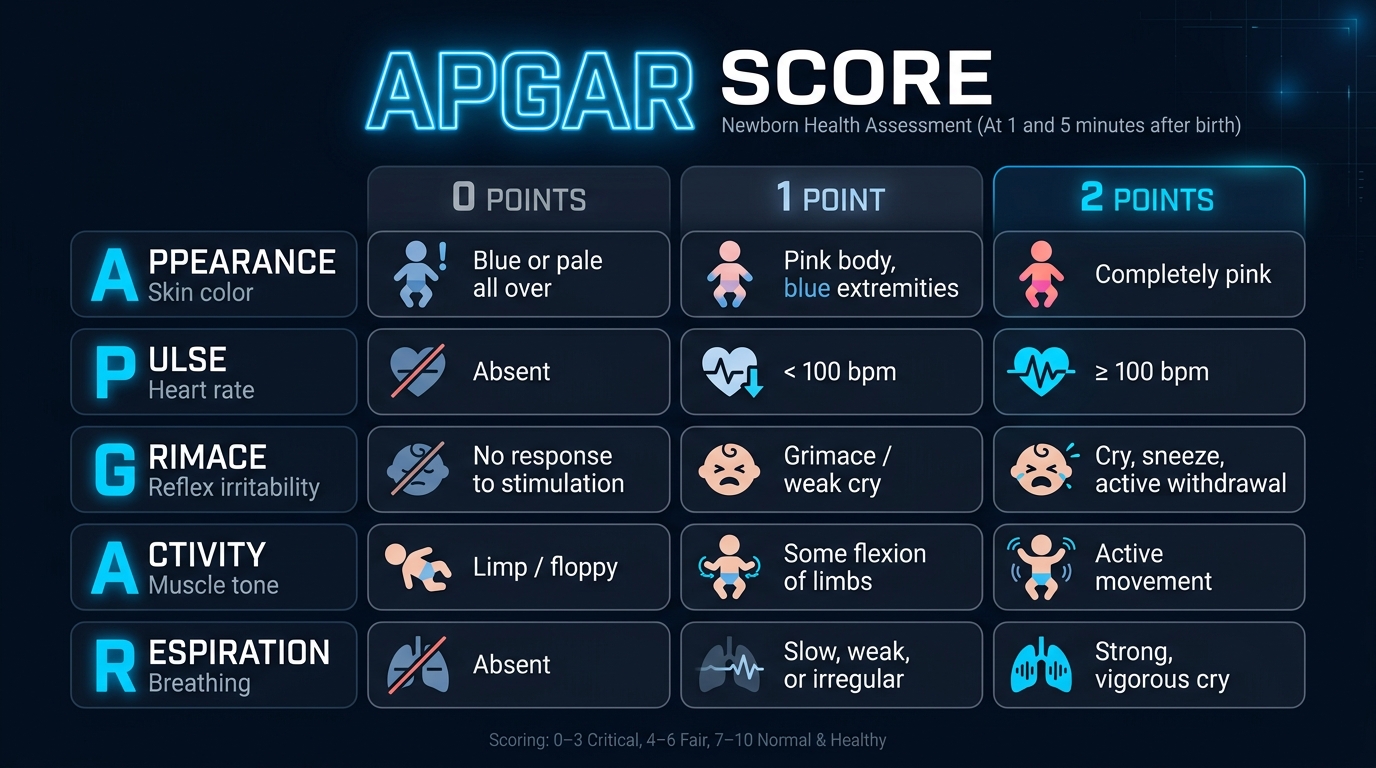
The Apgar score is a fast, repeatable way to sum up a newborn’s condition right after birth. It was devised in 1952 by Dr. Virginia Apgar, an obstetric anesthesiologist, and published in 1953. The surname doubles as a memory aid, because APGAR stands for the five things that are checked: Appearance, Pulse, Grimace, Activity and Respiration. The history of the score and its five components is still described in the same terms today.
Each sign is given 0, 1 or 2 points, and the five are added together to give a total between 0 and 10.
2. Apgar Scoring Chart
| Sign | 0 points | 1 point | 2 points |
|---|---|---|---|
| Appearance (skin color) | Blue or pale all over | Body pink, hands and feet blue | Pink all over |
| Pulse (heart rate) | Absent | Below 100 beats per minute | 100 beats per minute or more |
| Grimace (reflex response) | No response | Grimace or weak cry when stimulated | Cry, cough, sneeze or pulls away |
| Activity (muscle tone) | Limp | Some bending of arms and legs | Active movement, resists straightening |
| Respiration (breathing) | Absent | Slow, weak or irregular | Good, strong cry |
Quick memory rule: for pulse, the line is 100. Below it scores 1, at or above it scores 2. For the skin, “pink” means the skin tone looks healthy and well-oxygenated for that baby.
A detailed list of how each item is scored is also given in this Apgar score summary.
3. How to Interpret the Total
The American Academy of Pediatrics (AAP) and the American College of Obstetricians and Gynecologists (ACOG) group the 5-minute score like this:
| Total score | Meaning |
|---|---|
| 7 to 10 | Reassuring |
| 4 to 6 | Moderately abnormal |
| 0 to 3 | Low |
Other charts use words like “normal,” “may need help” and “needs immediate resuscitation” for the same three bands. In practice, a low score at one minute often improves by five minutes, as the baby adapts to life outside the womb.
4. When the Score Is Taken
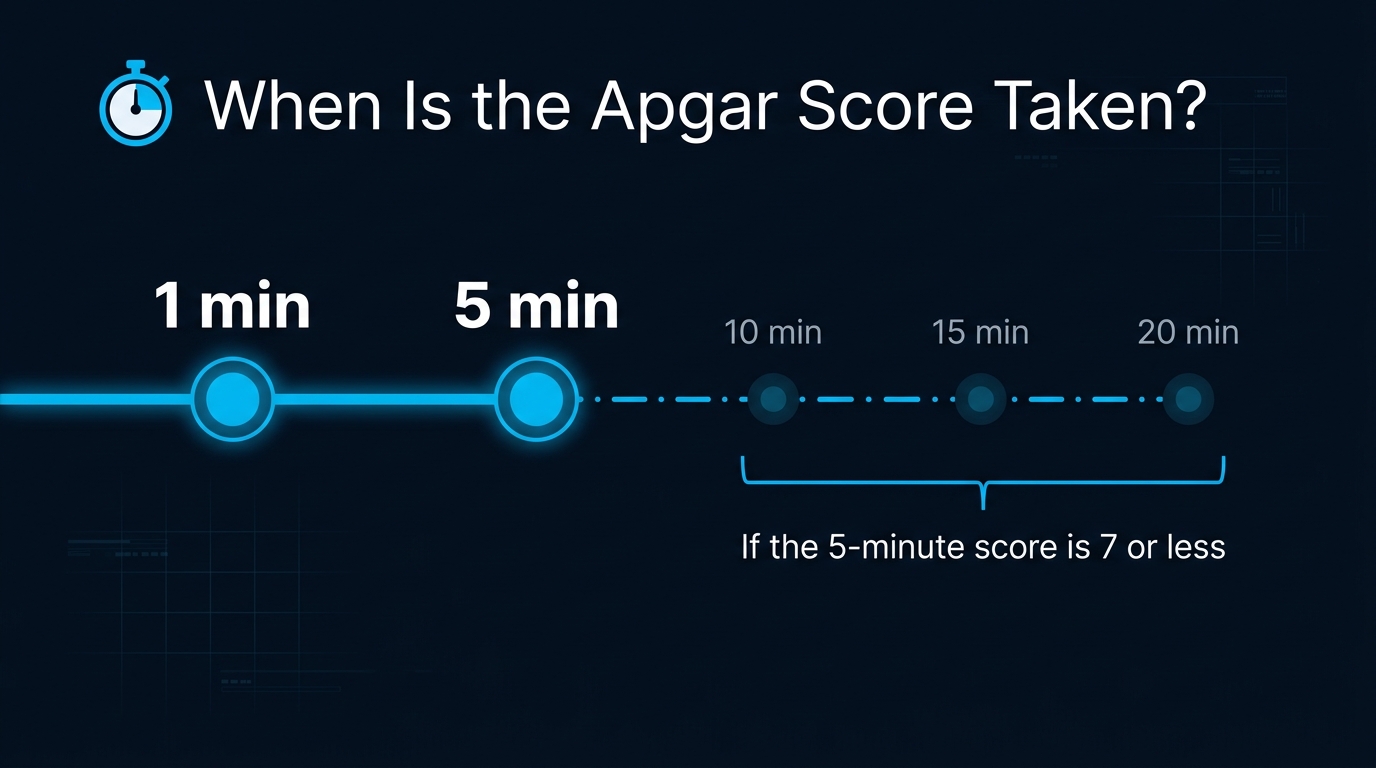
- At 1 minute after birth, which shows how the baby has coped with the birth itself.
- At 5 minutes, which shows how the baby is adapting and responding to any help.
- Every 5 minutes after that, up to 20 minutes, if the 5-minute score is 7 or less.
Important: The score is a record, not a trigger. Care for a baby who needs help starts immediately and does not wait for the 1-minute score to be called out.
5. Why Most Healthy Babies Get 9, Not 10
Look at the “Appearance” row. Many perfectly healthy newborns have pink bodies but bluish hands and feet for the first few minutes, because circulation to the extremities takes time to settle. That scores 1, not 2. So a baby who is otherwise vigorous, breathing well and crying lustily commonly ends up with:
| Sign | Typical healthy baby |
|---|---|
| Appearance | 1 (blue hands and feet) |
| Pulse | 2 |
| Grimace | 2 |
| Activity | 2 |
| Respiration | 2 |
| Total | 9 |
By five minutes, the color often improves and the score may rise to 9 or 10. A 9 is a very good score, not a “missing point.”
6. Five Worked Examples
Example 1: A typical healthy baby.
Pink body with blue hands (1), heart rate 140 (2), cries and pulls away (2), active movement (2), strong cry (2).
Total = 9. Reassuring.
Example 2: A baby who needs a little help.
At 1 minute: blue hands and feet (1), heart rate 120 (2), grimace only (1), some flexion (1), slow irregular breaths (1).
Total = 1 + 2 + 1 + 1 + 1 = 6. Moderately abnormal. At 5 minutes after gentle stimulation and support: pink body (1), heart rate 140 (2), cries (2), active (2), good cry (2). Total = 1 + 2 + 2 + 2 + 2 = 9. The change from 6 to 9 shows a good response.
Example 3: A baby with serious problems.
Pale and blue (0), heart rate 80 (1), no response (0), limp (0), not breathing (0).
Total = 1. This is a low score, and immediate resuscitation is needed. In practice, the team would already be acting before this number was called out.
Example 4: Counting practice.
Blue hands and feet (1), heart rate 90 (1), grimace (1), some flexion (1), weak cry (1).
Total = 5. This is moderately abnormal. If this were the 5-minute score, a blood gas test from the umbilical cord is usually recommended.
Example 5: Reading the pair.
“Apgar 6 and 9” means 6 at one minute and 9 at five minutes. The baby had a slow start but recovered well. A pair like “3 and 4” would be much more concerning, because the score is still low five minutes in.
7. What Happens After a Low Score
The response depends on which sign scored low, not just the total. In outline:
- Low breathing or heart rate: the team supports breathing and checks the heart rate, following newborn resuscitation guidelines.
- Low tone or reflexes: the baby is observed closely and assessed further.
- A 5-minute score of 5 or less: a blood gas from the umbilical cord is recommended, and the placenta may be examined.
- A 5-minute score of 7 or less: the score is repeated every 5 minutes up to 20 minutes.
These steps are for understanding only. Actual care is directed by the delivery and neonatal team.
8. Limitations: What Apgar Cannot Tell You
The 2015 joint policy from the AAP and ACOG is clear that the Apgar score has limits, and it is summarized in this Healio report on the policy and this 2 Minute Medicine summary.
- It does not predict an individual child’s future. A low score correlates with higher risk across large populations, but it cannot tell you how a particular baby will do.
- It should not be used alone to diagnose asphyxia. Other tests, such as the blood gas, are needed.
- It should not decide whether resuscitation is needed. Resuscitation must start before the 1-minute score is assigned.
- It is subjective. Different people can score the same baby slightly differently.
- It is affected by other factors, including how premature the baby is, medicines given to the mother, and resuscitation itself. Premature babies often score lower because of low tone, not because of illness.
- A low score does not mean brain damage. Most infants with low Apgar scores do not develop long-term problems, although a low 5-minute score does carry a higher relative risk across populations.
9. The Expanded Apgar Score
When a baby is being helped with breathing support or other treatment, the number alone can be misleading. A baby who scores 8 because a ventilator is supporting the breathing is not the same as a baby who scores 8 on their own. The expanded Apgar score reporting form records the five components together with the interventions that were happening at the same time, such as oxygen, breathing support, chest compressions or medicines. The AAP and ACOG encourage its use to reduce disagreement between observers and to document what was done, as described in this report on the expanded Apgar protocol.

10. Apgar vs Ballard Score
| Feature | Apgar score | Ballard score |
|---|---|---|
| Purpose | Condition of the newborn right after birth | Gestational age of the newborn |
| Time | 1 and 5 minutes (up to 20) | Usually within the first hours or days |
| Items | 5 signs, 0 to 2 each | 12 signs (neuromuscular and physical) |
| Result | 0 to 10 | −10 to 50, converted to weeks |
They answer different questions. See our guide to the Ballard score for how gestational age is estimated.
11. What Parents Should Know
- A score of 7, 8, 9 or 10 is considered reassuring. An Apgar of 9 is excellent.
- A lower score at 1 minute is common and often improves by 5 minutes.
- The score is not a test of intelligence or of how healthy the child will be later.
- The score is not the same as a diagnosis. If a baby needs extra care, the team will explain what is being done and why.
- If you are worried, ask the doctor or nurse to explain each of the five numbers, not just the total.

12. Tips for Students and Nurses
- Learn the mnemonic as “A, P, G, A, R: five signs, 0 to 2, total 10.”
- Memorize the cut-offs: 7 to 10 reassuring, 4 to 6 moderately abnormal, 0 to 3 low.
- Remember that pulse 100 is the dividing line.
- Do not wait for the Apgar to start resuscitation.
- Record the time of each score, and document interventions on an expanded form.
- For more practice, try our Pediatrics MCQs.
13. Frequently Asked Questions
What is the Apgar score?
A quick check of a newborn’s condition at 1 and 5 minutes after birth, using five signs scored 0 to 2 each.
What does APGAR stand for?
Appearance, Pulse, Grimace, Activity, Respiration.
What is a normal Apgar score?
A score of 7 to 10 is considered reassuring.
Is an Apgar score of 7 good?
Yes, 7 falls in the reassuring range, although 8 to 10 is more common in healthy babies.
Why do most babies not get a 10?
Many healthy babies have blue hands and feet for the first minutes, which scores 1 for appearance.
What is a low Apgar score?
A total of 0 to 3 is considered low, and 4 to 6 is moderately abnormal.
Does a low Apgar score mean brain damage?
No. The score cannot predict an individual child’s outcome, and most babies with low scores do not have lasting problems.
When is the Apgar score done?
At 1 and 5 minutes after birth, and then every 5 minutes up to 20 minutes if the 5-minute score is 7 or less.
Who gives the Apgar score?
A doctor, midwife or nurse present at the birth.
What is the difference between Apgar and Ballard?
Apgar assesses the baby’s condition at birth, while Ballard estimates gestational age.
Apgar Score Knowledge Quiz
Available options: 1 to 20
14. Key Takeaways
- Apgar assesses five signs (Appearance, Pulse, Grimace, Activity, Respiration), each scored 0 to 2, for a total of 0 to 10.
- It is recorded at 1 and 5 minutes, and repeated every 5 minutes up to 20 minutes if low.
- 7 to 10 is reassuring, 4 to 6 moderately abnormal, 0 to 3 low.
- Most healthy babies score 8 or 9 because of blue hands and feet at first.
- It does not predict an individual child’s long-term outcome and should not delay resuscitation.
- The expanded Apgar form records the help being given at the same time.
Disclaimer: This article is for educational purposes only and is not a substitute for professional medical advice. Newborn assessment and resuscitation must be performed by trained clinicians.
References
- Apgar V. A proposal for a new method of evaluation of the newborn infant. Curr Res Anesth Analg. 1953;32:260-267.
- American Academy of Pediatrics Committee on Fetus and Newborn; American College of Obstetricians and Gynecologists Committee on Obstetric Practice. The Apgar Score. Pediatrics. 2015.
- ACOG Committee Opinion No. 644: The Apgar Score. October 2015.