

A patient arrives with burns over a large part of the body. The skin has lost its barrier, fluid is leaking out of the blood vessels into the tissues, and blood pressure is starting to fall. This state is called burn shock, and the first hours decide how well the patient will do. The Parkland formula is the most widely used way to estimate how much intravenous fluid to start with. This guide explains the formula, shows how to estimate the burned area, gives you quick-reference tables and six worked examples, and explains why the number is only a starting point.
Table of Contents
- What the Parkland formula is
- The formula and the schedule
- When to use it, and when not to
- Estimating the burned area (%TBSA)
- Step-by-step calculation
- Quick-reference tables
- Six worked examples
- Urine output: the real target
- Parkland vs modified Brooke, and fluid creep
- Limitations
- Common mistakes
- Tips for students and nurses
- Frequently asked questions
- Key takeaways
1. What the Parkland Formula Is
After a major burn, damaged blood vessels leak plasma into the burned and surrounding tissue, and the patient can become dangerously short of fluid in the bloodstream. Treatment is aggressive intravenous fluid, and the Parkland formula tells the team where to start. It was first proposed in 1968 by Baxter and Shires at Parkland Hospital in Dallas, and it remains the most frequently used burn resuscitation formula. The StatPearls review of the Parkland formula calls it an essential tool for patients with critical burns.
2. The Formula and the Schedule
Total fluid in 24 hours (mL) = 4 mL × body weight (kg) × % TBSA burned- The fluid of choice is lactated Ringer’s solution.
- Half of the total is given in the first 8 hours.
- The other half is given over the next 16 hours.
- The 24 hours start from the time of the burn, not from the time the patient reached hospital.
Shortcut for the hourly rates:
First 8 hours:  total ÷ 16 = mL per hour
Next 16 hours:  total ÷ 32 = mL per hour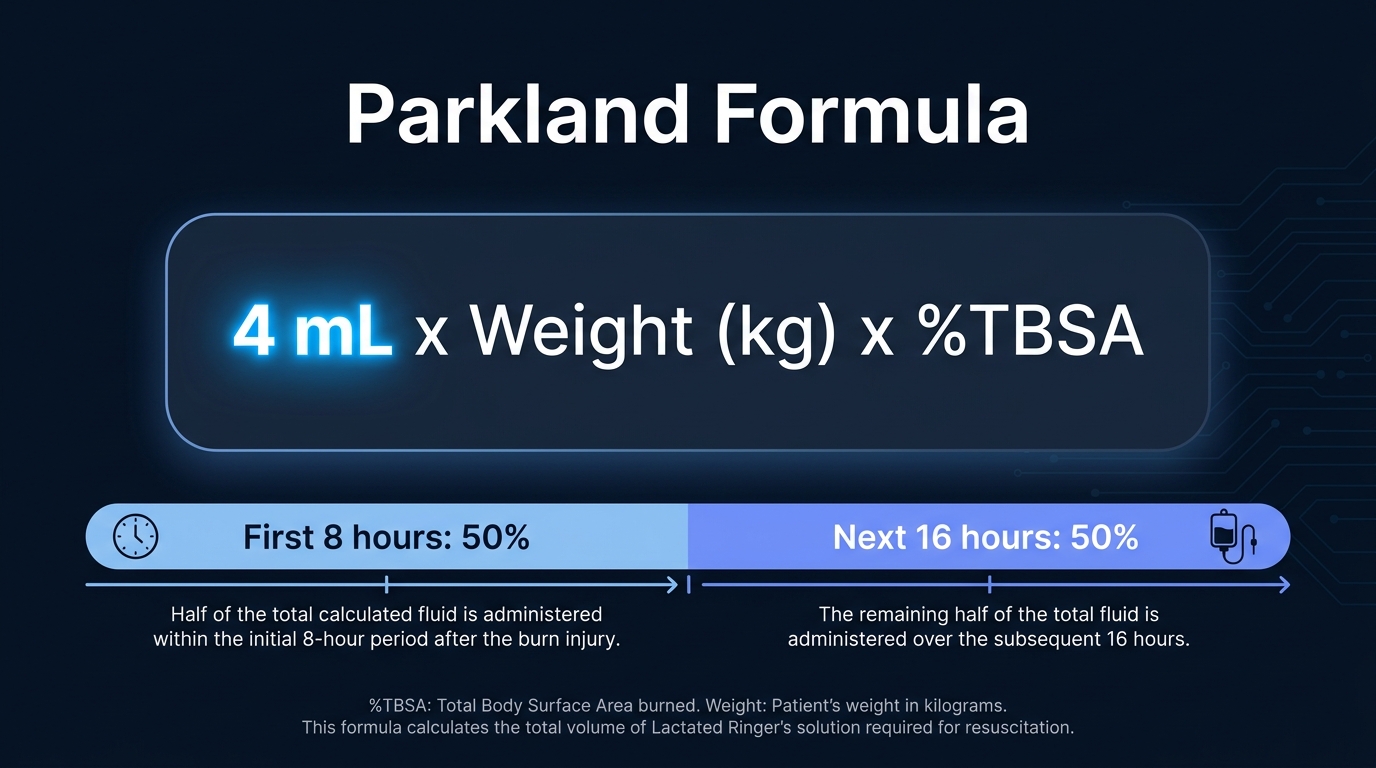
3. When to Use It, and When Not To
Used for: second- and third-degree (partial and full thickness) burns in adults and children, usually when the burn covers about 20% of the body surface or more and the patient needs IV fluids.
Not used for:
- First-degree burns (redness only), because they do not cause large fluid shifts, and these are not counted in the %TBSA.
- Smaller burns where the patient is awake, can drink and can keep up with fluid by mouth.
Remember: if there is a delay between the burn and the start of treatment, the clock still started at the time of the burn.
4. Estimating the Burned Area (%TBSA)
Accuracy here matters, because the whole calculation depends on this one number.
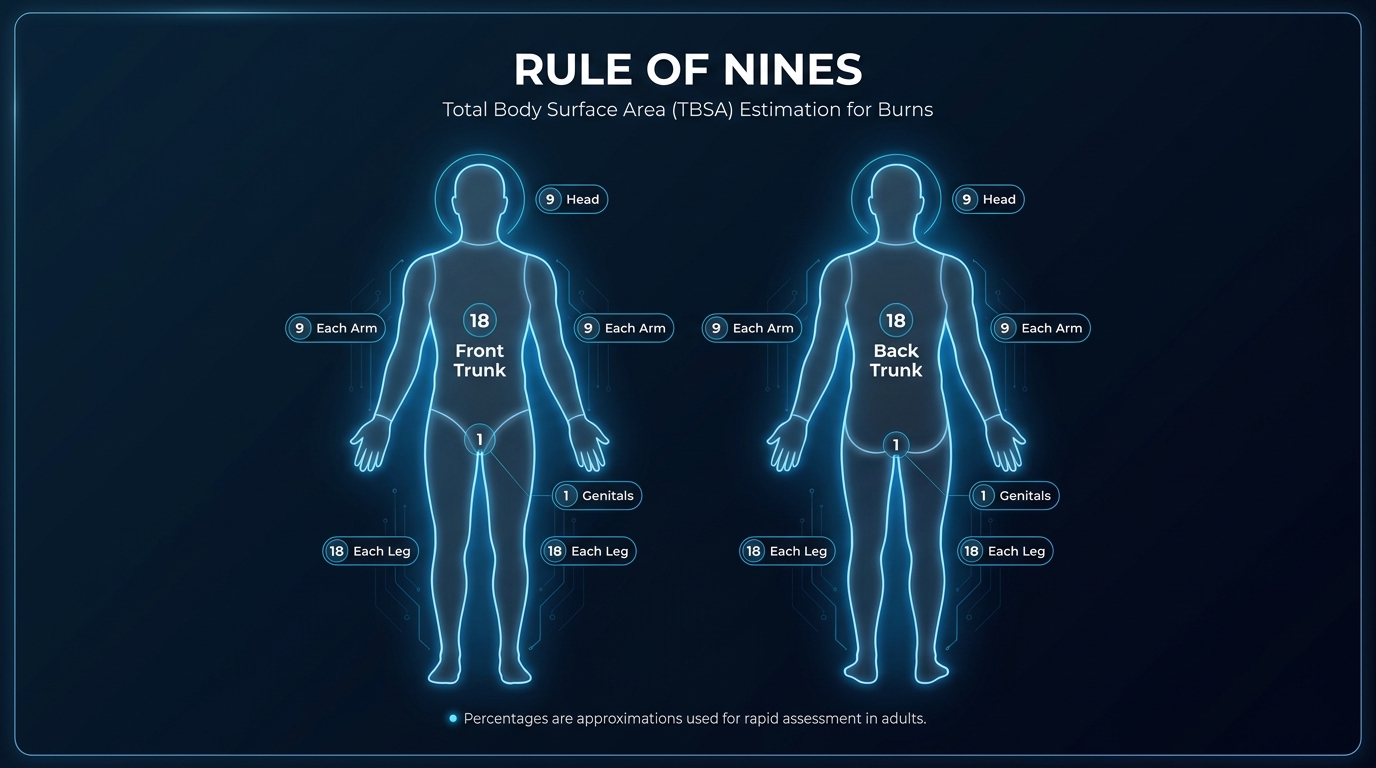
Rule of nines (adults):
| Body area | % TBSA |
|---|---|
| Head and neck | 9 |
| Each arm | 9 |
| Front of the trunk | 18 |
| Back of the trunk | 18 |
| Each leg | 18 |
| Genital area | 1 |
Palm rule: the patient’s own palm (with fingers) is roughly 1% of their body surface. It is handy for patchy or small burns.
Children: a child’s head is larger and the legs are smaller in proportion, so the adult rule of nines overestimates. Burn units use age-adjusted charts such as the Lund-Browder chart for children.
5. Step-by-Step Calculation
- Count only second- and third-degree burns and estimate %TBSA.
- Weigh the patient (or use a recorded weight) in kilograms.
- Multiply: 4 × weight × %TBSA to get the 24-hour volume.
- Divide the total in two. The first half goes into the first 8 hours from the time of injury.
- Subtract fluid already given (for example, by the ambulance team) and adjust the rate for the time that has already passed.
- Start the infusion and watch urine output hourly.
- Adjust the rate to the patient’s response, not just the formula.
6. Quick-Reference Tables
These two original tables save you from calculating every time. They assume adults and the classic 4 mL factor.
Total 24-hour volume (mL):
| %TBSA | 60 kg | 70 kg | 80 kg | 90 kg |
|---|---|---|---|---|
| 20% | 4,800 | 5,600 | 6,400 | 7,200 |
| 30% | 7,200 | 8,400 | 9,600 | 10,800 |
| 40% | 9,600 | 11,200 | 12,800 | 14,400 |
Starting rate for the first 8 hours (mL per hour):
| %TBSA | 60 kg | 70 kg | 80 kg | 90 kg |
|---|---|---|---|---|
| 20% | 300 | 350 | 400 | 450 |
| 30% | 450 | 525 | 600 | 675 |
| 40% | 600 | 700 | 800 | 900 |
For the following 16 hours, the hourly rate is half of the number in the second table.
7. Six Worked Examples
Example 1: Adult with a large burn.
70 kg, 40% TBSA.
Total = 4 × 70 × 40 = 11,200 mL.
First 8 hours: 5,600 mL, which is 700 mL/hour. Next 16 hours: 5,600 mL, which is 350 mL/hour.
Example 2: Moderate burn.
80 kg, 16% TBSA.
Total = 4 × 80 × 16 = 5,120 mL.
First 8 hours: 2,560 mL (320 mL/hour). Next 16 hours: 2,560 mL (160 mL/hour).
Example 3: Late arrival.
60 kg, 30% TBSA, arrives 2 hours after the burn and has had no fluid so far.
Total = 4 × 60 × 30 = 7,200 mL. The first half (3,600 mL) is due within 8 hours of the burn, but 2 hours have already passed, so only 6 hours remain.
Required rate = 3,600 ÷ 6 = 600 mL/hour, compared with 450 mL/hour if treatment had started immediately. The clock never restarts at the hospital door.
Example 4: Using a lower starting factor (modified Brooke, 2 mL).
70 kg, 40% TBSA.
Total = 2 × 70 × 40 = 5,600 mL, which is half of the Parkland figure for the same patient. First 8 hours: 2,800 mL (350 mL/hour). Next 16 hours: 2,800 mL (175 mL/hour).
Example 5: Child (maintenance fluids are added in many protocols).
20 kg, 25% TBSA.
Burn fluid = 4 × 20 × 25 = 2,000 mL: 125 mL/hour for 8 hours and 62.5 mL/hour for 16 hours.
Maintenance (4 mL/kg for the first 10 kg plus 2 mL/kg for the second 10 kg) = 40 + 20 = 60 mL/hour, which is added on top in many protocols.
Urine output target is about 1 mL/kg/hour, or roughly 20 mL/hour, for this child (some sources use 1.0 to 1.5).
Example 6: Adjusting to urine output.
An 80 kg adult needs about 40 mL/hour (0.5 mL/kg/hour). If urine output falls to 20 mL/hour for two hours, the patient is probably under-resuscitated and the infusion rate usually goes up according to the burn unit’s protocol. If output rises to 100 mL/hour (well above 1 mL/kg/hour), the rate is usually reduced to avoid giving too much fluid.
8. Urine Output: The Real Target
The formula gives a starting rate, but the urine output tells you whether it is right. It is considered the most reliable bedside indicator of adequate resuscitation in significant burns, which is why these patients usually have a urinary catheter.
| Patient | Typical hourly urine target |
|---|---|
| Adults | About 0.5 mL/kg/hour (some sources 0.5 to 1) |
| Children under 30 kg | About 1 mL/kg/hour (some sources 1 to 1.5 or 1 to 2) |
A summary table for adults and children is shown in the BMJ ABC of burns, including the extra maintenance fluid for children. For how to calculate and interpret these numbers in other settings, see our guide to normal urine output.
Vital signs, heart rate and mental status are checked together with urine output, and inhalation injury increases fluid needs.
9. Parkland vs Modified Brooke, and Fluid Creep
| Formula | First-24-hour crystalloid |
|---|---|
| Parkland | 4 mL/kg/%TBSA |
| Modified Brooke | 2 mL/kg/%TBSA |
| Brooke (original) | 1.5 mL/kg/%TBSA plus colloid |
Half of the total is given over the first 8 hours in each. The Parkland formula remains the most widely used, but some centres prefer lower starting volumes.
Why the lower numbers? Giving too much fluid has costs. The term fluid creep describes the gradual drift toward larger and larger volumes in burn units, which is linked to swelling, abdominal and limb compartment problems and other complications. Studies also show that the fluid actually given often exceeds the Parkland estimate, as in this study of the Parkland formula in adult thermal burns. Because of this, current guidance increasingly starts at about 2 mL/kg/%TBSA and adjusts according to the response. For a detailed comparison of these formulas, see the Deranged Physiology chapter on fluid resuscitation in burns.
10. Limitations
- It is an estimate. The formula was never meant to be followed blindly, and the rate must be adjusted to the patient.
- %TBSA errors change the answer directly, and they are common, especially with patchy burns.
- Inhalation injury, electrical burns and delayed treatment increase fluid needs.
- Over-resuscitation (fluid creep) can cause harm, just like under-resuscitation.
- Children need different charts and maintenance fluid.
- Obesity, older age and heart or kidney disease change how much fluid is safe.
- It covers only the first 24 hours. After that, fluid needs are reassessed.
11. Common Mistakes
- Counting first-degree burns in the %TBSA.
- Starting the 8-hour clock at hospital arrival instead of the time of injury.
- Using the adult rule of nines in a child.
- Forgetting to subtract fluid already given.
- Following the formula but ignoring urine output.
- Mixing up 4 mL and 2 mL factors in different protocols.
- Using the wrong weight units (pounds instead of kilograms).
12. Tips for Students and Nurses
- Memorize the structure as “4, weight, %TBSA; half in 8 hours.“
- Always write down the time of the burn before anything else.
- Use the shortcut tables above to cross-check your result.
- Hourly urine output charting is part of the resuscitation, so record it accurately and report low or high values quickly.
- Follow your burn unit’s protocol, since the starting factor and targets vary.
- For more practice, try our Surgery MCQs and explore our medical tools.
13. Frequently Asked Questions
What is the Parkland formula?
Total fluid in 24 hours = 4 mL × weight in kg × % total body surface area burned, using lactated Ringer’s solution.
How is the fluid given?
Half in the first 8 hours from the time of the burn, and the other half over the next 16 hours.
Which burns count in the %TBSA?
Only second- and third-degree burns. First-degree burns are not counted.
What fluid is used in the Parkland formula?
Lactated Ringer’s solution.
What is the urine output goal for burn patients?
About 0.5 mL/kg/hour in adults and about 1 mL/kg/hour in children.
What is the difference between Parkland and modified Brooke?
Parkland uses 4 mL/kg/%TBSA, while modified Brooke uses 2 mL/kg/%TBSA.
Does the 8-hour clock start at hospital arrival?
No. It starts at the time of the burn.
What is fluid creep?
The tendency to give more fluid than the formula suggests, which can cause complications.
Can the Parkland formula be used in children?
It is used, but children also get maintenance fluid and a different burn chart.
What if the patient is overweight?
Follow your burn unit’s protocol. The fluid needs depend on the burn and the response, not just on weight.
Parkland Formula Knowledge Quiz
Available options: 1 to 20
14. Key Takeaways
- Parkland formula: 4 mL × weight (kg) × %TBSA of lactated Ringer’s in 24 hours.
- Half in the first 8 hours from the time of injury, half over the next 16.
- Count only second- and third-degree burns, and estimate the area carefully.
- Urine output (about 0.5 mL/kg/hour in adults) is the real target.
- Lower starting factors (2 mL) are increasingly used to avoid fluid creep.
- It is a starting point: adjust to the patient and follow your unit’s protocol.
Disclaimer: This article is for educational purposes only and is not a substitute for professional medical advice. Burn resuscitation must be directed by a qualified clinician following the protocol of the treating burn unit. Large, deep, facial, hand, genital, chemical or electrical burns need emergency care.
References
- Baxter CR, Shires T. Physiological response to crystalloid resuscitation of severe burns. Ann N Y Acad Sci. 1968.
- StatPearls: Parkland Formula. NCBI Bookshelf.
- BMJ: ABC of burns, resuscitation table.
- Saffle JI. The phenomenon of “fluid creep” in acute burn resuscitation. J Burn Care Res. 2007.