Right now, inside your body, thousands of chemical reactions are happening at once — breaking down the roti you had for lunch, copying strands of DNA, pulling oxygen out of your blood and into your cells. None of that would happen fast enough to keep you alive on its own.
The reason it does is a group of molecules most students first meet as a dry textbook chapter but that actually run almost every process in the living world: enzymes. If you’ve ever wondered what are enzymes, exactly, this guide walks through how they actually work, why a fever or a wrong pH can shut one down, and closes with 20 practice MCQs so you can test what stuck.
What Are Enzymes?
An enzyme is a biological catalyst — something that speeds up a chemical reaction inside a living organism while coming out the other side unchanged, ready to do the same job again. Structurally, enzymes are almost entirely proteins: long chains of amino acids that fold, twist, and coil into one very particular three-dimensional shape. Get that folding wrong, and the enzyme simply can’t function — the shape isn’t a side detail, it’s the whole mechanism.
Take away enzymes and the chemistry your body runs on wouldn’t stop, but it would slow to a crawl — reactions that finish in milliseconds could instead take years. Enzymes are essentially what lets biology operate on a human timescale instead of a geological one.
So, What Are Enzymes in Simple Words?
In one line: enzymes are the body’s shortcut-makers — protein molecules that make essential reactions happen fast enough to sustain life, without themselves being used up or changed along the way.
Key Characteristics of Enzymes
A few traits separate enzymes from ordinary chemical catalysts you might use in a lab:
- Catalytic power: one enzyme molecule can process an enormous number of substrate molecules in a very short window of time.
- Specificity: most enzymes only act on one substrate, or a small cluster of closely related ones — often described as a single key fitting a single lock.
- Sensitivity: even small shifts in temperature or pH can throw an enzyme’s performance off badly.
- Reusability: because the enzyme itself doesn’t get consumed, the same molecule keeps working reaction after reaction.
- Reversibility: depending on how much reactant and product is around, many enzymes can drive a reaction in either direction.
Structure of an Enzyme: Active Site, Cofactors, and Coenzymes
Somewhere on the surface of every enzyme is a small pocket or groove called the active site — shaped to accept one specific substrate molecule. When the substrate slots into this pocket, it briefly forms what’s called an enzyme-substrate (ES) complex, and this is exactly where the reaction takes place.
Some enzymes are ready to work as pure protein. Others need a helper molecule before they can function at all:
- Cofactor — typically a metal ion (zinc, iron, and similar) that an enzyme needs in order to work.
- Coenzyme — a smaller organic helper molecule, often built from a vitamin you get through diet, that assists the reaction.
- Apoenzyme — the protein portion alone, before it links up with its cofactor; inactive on its own.
- Holoenzyme — the fully assembled, functional enzyme once the apoenzyme and its cofactor or coenzyme have combined.
How Do Enzymes Work? Lock-and-Key vs Induced-Fit Model
Two competing explanations describe how an enzyme finds and grips its substrate:
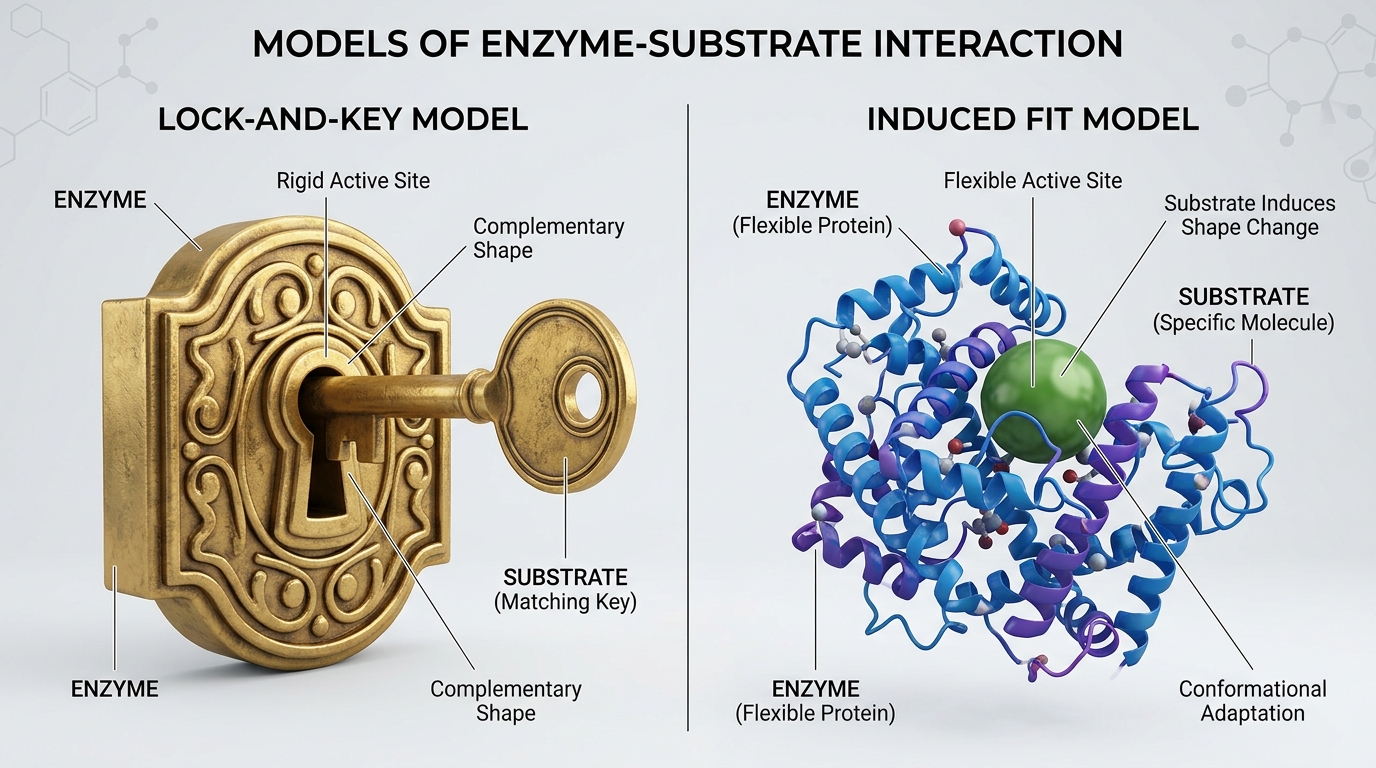
Lock-and-Key Model. The earlier idea. It treats the active site as a fixed, rigid shape — the substrate either fits it or it doesn’t, the same way a specific key opens only its matching lock. It explains specificity neatly, but it can’t account for any give or flexibility in the process.
Induced-Fit Model. The version supported by modern evidence. Here, the active site isn’t locked into one rigid shape — it adjusts slightly as the substrate approaches, closing around it for a snugger, more precise fit. A closer comparison might be a hand adjusting its grip as it wraps around an object, rather than a key sliding into an unchanging slot.
Enzymes and Activation Energy
Every chemical reaction needs a minimum input of energy just to get going — this threshold is called activation energy, and it’s what’s required to break the existing bonds in a substrate before any new bonds can form.
Enzymes don’t add extra energy to push a reaction forward. Instead, they lower how much activation energy is needed in the first place, mainly by:
- holding substrate molecules in exactly the orientation a reaction requires
- placing slight strain on the substrate’s bonds so they break more easily
- creating a local environment at the active site — through charge or micro-pH effects — that favors the reaction
With a lower energy barrier to clear, the reaction moves forward dramatically faster — often millions of times faster than it would without any enzyme involved.
For readers who want to go one level deeper into the biochemistry side of this, Khan Academy’s guide to enzyme structure and function is a solid next stop.
Factors Affecting Enzyme Activity
This is the section exam papers lean on the hardest — and it also happens to explain a lot of everyday things, from why fevers are dangerous to why food lasts longer in a fridge.
1. Temperature
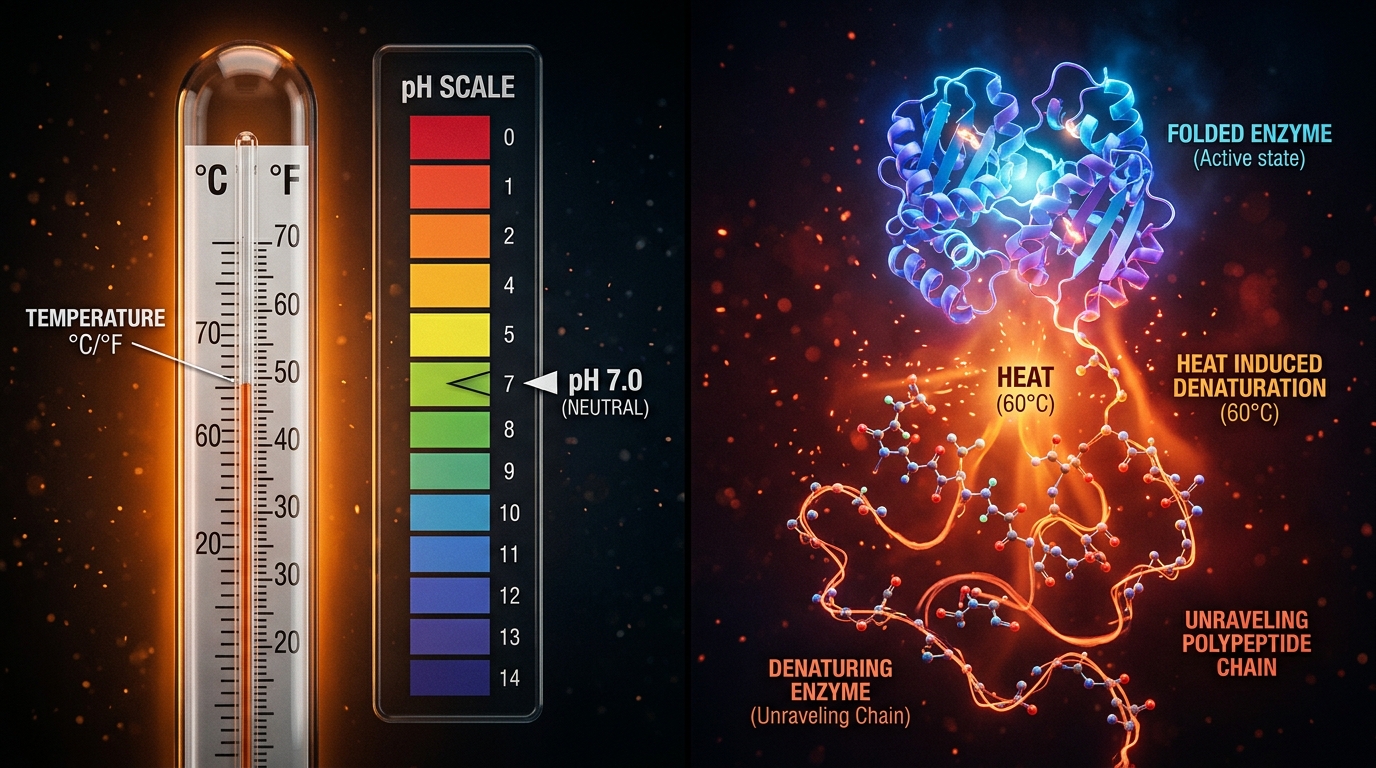
Warming things up gives molecules more energy and gets them colliding more often, so enzyme activity climbs as temperature rises — up to a point. That peak is called the optimum temperature, roughly 37°C for most enzymes in the human body, which isn’t a coincidence — it’s why your body temperature sits where it does.
Push the temperature higher than that, and the weak bonds holding the enzyme’s folded shape together start breaking down. The active site loses its precise form, the substrate no longer fits, and the enzyme becomes denatured — usually for good. It’s the same basic thing that happens to the clear part of an egg once it hits a hot pan: heat permanently rearranges the protein’s structure.
2. pH
Every enzyme has its own optimum pH — the acidity level where it performs best. Pepsin, working in the stomach, is most effective around pH 2, in a strongly acidic environment. Trypsin, on the other hand, works further along in the small intestine and prefers a mildly alkaline setting, around pH 8. Move too far away from an enzyme’s optimum pH in either direction and — exactly like extreme temperature — its shape distorts, and activity drops off or disappears.
3. Substrate Concentration
More substrate generally means a faster reaction, simply because there’s a greater chance of substrate molecules meeting free active sites. But this only holds up to a limit: once every active site available is occupied at the same moment — a state known as saturation — adding more substrate has no further effect, because the number of enzyme molecules, not substrate, is now what’s holding the reaction back.
4. Enzyme Concentration
As long as substrate is plentiful, adding more enzyme raises the reaction rate roughly in proportion, since more active sites are now available to work at the same time.
5. Inhibitors
Certain molecules slow or stop enzyme action altogether. Competitive inhibitors are shaped closely enough to the real substrate that they can occupy the active site themselves, physically crowding out the actual substrate — and because it’s a matter of competition for space, raising the substrate concentration can reverse the effect. Non-competitive inhibitors attach somewhere else on the enzyme entirely, distorting its overall shape and disrupting the active site indirectly — a problem that extra substrate can’t fix.
Types and Everyday Examples of Enzymes
Digestive Enzymes in the Human Body
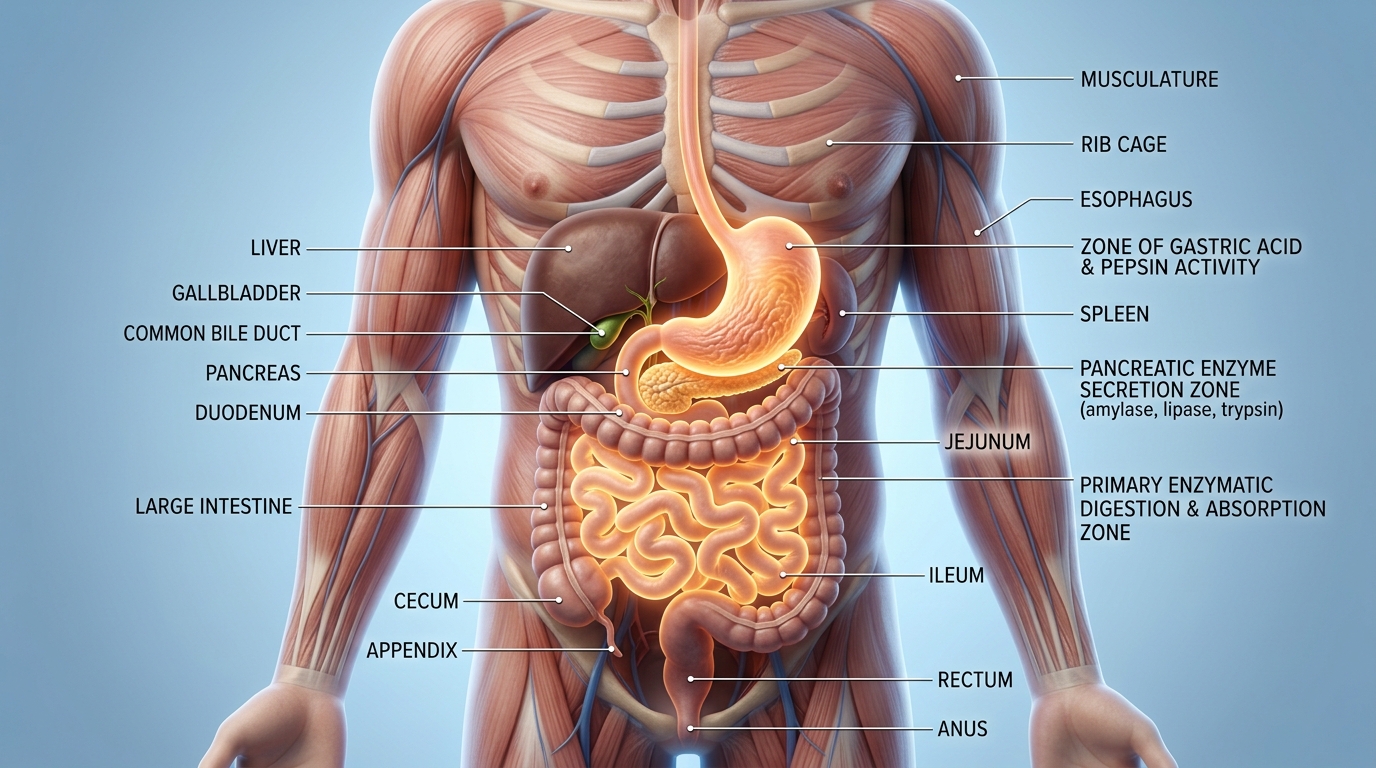
- Amylase (found in saliva and pancreatic juice) — breaks starch down into simpler sugars
- Pepsin (active in the stomach) — begins breaking proteins into smaller peptide fragments
- Trypsin (active in the small intestine) — carries protein digestion further
- Lipase (released from the pancreas) — splits fats into fatty acids and glycerol
- Catalase (present in nearly every living cell) — neutralizes hydrogen peroxide, a toxic metabolic byproduct, converting it into harmless water and oxygen
Enzymes Beyond the Body: Industry and Daily Life
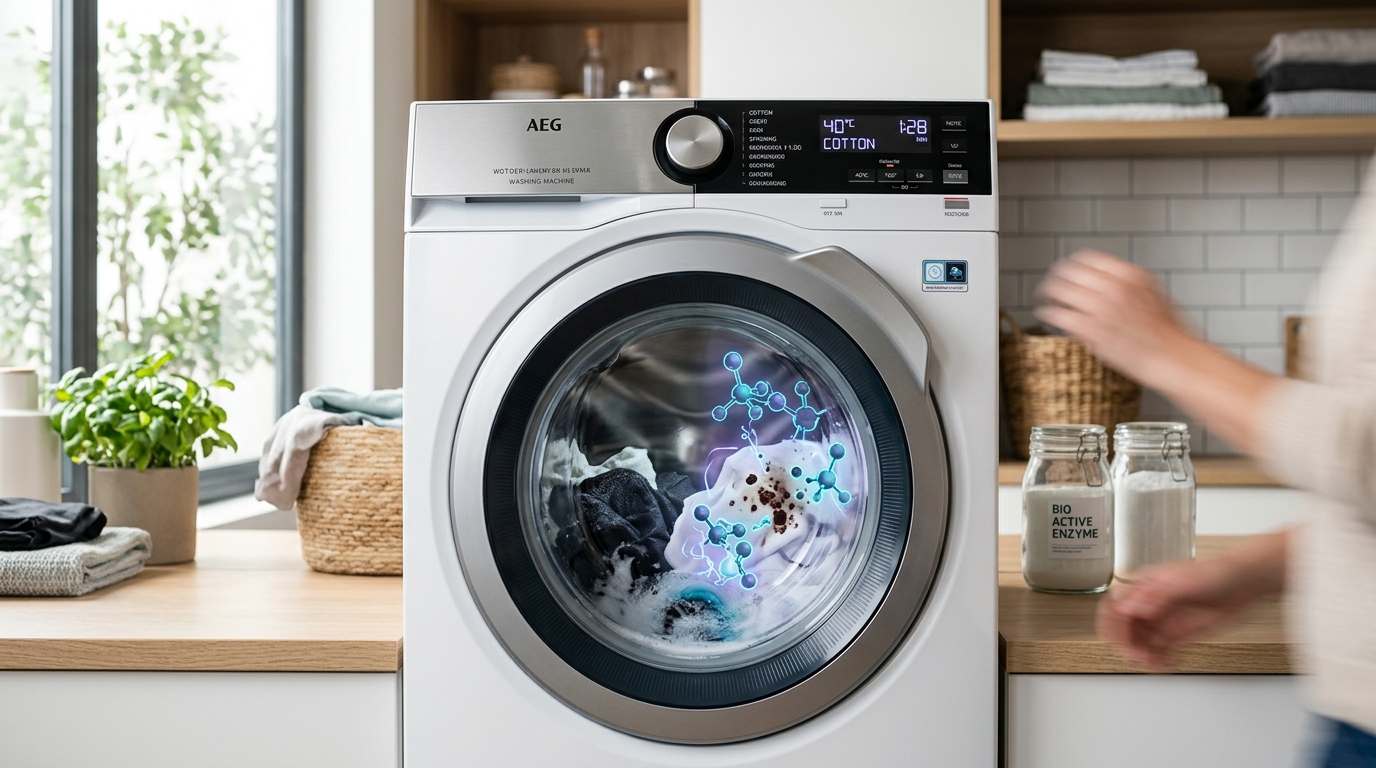
Enzymes show up well outside a biology classroom too. Biological washing detergents rely on protease and lipase enzymes to lift protein- and fat-based stains even in cooler water.
Cheese-making, brewing, and baking all lean on enzymatic reactions at various stages. In medicine, enzyme-based tests are routinely used to flag conditions ranging from diabetes to liver damage.
Enzymes don’t sit in isolation from the rest of the Biology syllabus, either. The same enzyme-driven chemistry sits quietly behind how cells divide during mitosis, how meiosis drives genetic diversity, and how plants reproduce through vegetative methods — three chapters that make a lot more sense once you understand what are enzymes and how they keep each of those processes running on schedule.
Why Enzymes Matter Beyond the Exam
Enzyme behavior explains more of daily life than most students expect. A high fever is dangerous partly because it can push temperature-sensitive enzymes past their optimum range and begin to denature them. Refrigeration slows down food spoilage largely by slowing the enzymes at work inside bacteria and inside the food itself. And a number of medicines — several classes of antibiotics among them — are designed specifically to target and block one particular enzyme.
Quick Recap: What Are Enzymes, In One Table
| Concept | Key Point |
|---|---|
| Enzyme | A biological catalyst, mostly protein, that speeds up reactions without being consumed |
| Active site | The pocket where substrate binds to form the enzyme-substrate complex |
| Lock-and-key | Older model — treats the active site as fixed |
| Induced-fit | Modern model — active site adjusts shape around the substrate |
| Activation energy | Minimum energy needed to start a reaction; enzymes reduce it |
| Optimum temperature | Around 37°C for most human enzymes; higher temperatures denature them |
| Optimum pH | Varies by enzyme (pepsin ~2, trypsin ~8) |
| Saturation | The point where every active site is occupied; extra substrate has no added effect |
Frequently Asked Questions (FAQs)
Here are the questions students most often ask once they’ve got the basics of what are enzymes sorted out.
Are all enzymes proteins?
The overwhelming majority are, yes — though a small group called ribozymes is built from RNA instead and can still catalyze reactions on its own.
What happens to an enzyme when it’s exposed to very high temperature?
Its folded structure unravels and the active site loses its precise shape. This is called denaturation, and once it happens, the enzyme typically can’t go back to working order.
How is an enzyme different from an ordinary chemical catalyst?
Both speed up a reaction without being used up in the process, but an enzyme is usually locked onto one specific substrate and is far more easily thrown off by temperature or pH changes than a standard lab catalyst.
Can a denatured enzyme start working again?
Generally no — denaturation is a lasting structural change. A brief, mild slowdown from cold conditions is different, though, and tends to correct itself once normal conditions return.
Why does an enzyme only work with one particular substrate?
Its active site is built — and, per the induced-fit model, able to flex slightly — to accommodate only a certain substrate or a small group of closely related ones, similar to how only a matching piece fits into a specific gap.
What’s the difference between a competitive and a non-competitive inhibitor?
A competitive inhibitor physically sits in the active site and blocks the substrate from binding, so raising substrate concentration can push it out. A non-competitive inhibitor attaches somewhere else on the enzyme entirely, distorting its shape from a distance — and more substrate can’t undo that effect.
Enzymes Knowledge Quiz
Available options: 1 to 20