
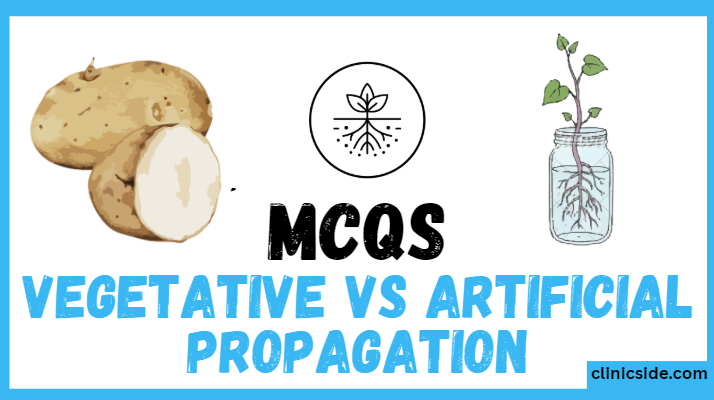
Plants reproduce through both sexual and asexual methods to ensure survival and continuity. Among asexual methods, vegetative propagation vs artificial propagation is one of the most important comparisons in plant biology. These methods allow plants to reproduce without seeds and produce offspring that are genetically identical to the parent plant. Understanding vegetative propagation vs artificial propagation is essential for students, agriculturists, and horticulturists.
Quiz
Available options: 1 to 20
Vegetative Propagation
Vegetative propagation is a natural method of asexual reproduction in plants where new individuals develop from vegetative parts such as roots, stems, or leaves of the parent plant. No fertilization or seed formation occurs in this process.
Types of Vegetative Propagation
Vegetative propagation is mainly classified into natural vegetative propagation and special vegetative structures.
1. Vegetative Propagation by Roots
Some plants develop adventitious buds on their roots, which grow into new plants.
🔸 Examples:
- Sweet potato
- Dahlia
🔸 Explanation:
Roots store food and possess buds that can develop into shoots when conditions are favorable. This type of vegetative propagation ensures rapid multiplication.
2. Vegetative Propagation by Stems
Stems are the most common organs involved in vegetative propagation.
🔸 Underground Stem Modifications
- Tuber: Potato
- Rhizome: Ginger
- Bulb: Onion
- Corm: Colocasia
These stems store nutrients and contain nodes with buds that grow into new plants.
🔸 Sub-Aerial Stem Modifications
- Runner: Grass, Strawberry
- Stolon: Jasmine
- Offset: Water hyacinth
- Sucker: Mint, Banana
These stems spread horizontally and produce new plants at nodes.
3. Vegetative Propagation by Leaves
Some plants produce buds on leaf margins.
🔸 Examples:
- Bryophyllum
- Begonia
🔸 Explanation:
Adventitious buds develop into plantlets that detach and grow independently.
Artificial Propagation
Artificial propagation is a human-controlled method of vegetative reproduction where plant parts are deliberately used to grow new plants. This method is widely applied in agriculture and horticulture to improve yield and quality.
When studying vegetative propagation vs artificial propagation, artificial propagation represents technological advancement in plant reproduction.
Types of Artificial Propagation
Artificial propagation is classified into cutting, layering, grafting, budding, and tissue culture.
1. Cutting
🔹 Explanation:
A part of a plant (stem, leaf, or root) is cut and planted in soil to grow a new plant.
🔹 Examples:
- Rose
- Sugarcane
- Bougainvillea
🔹 Importance:
Simple, cost-effective, and commonly used by gardeners.
2. Layering
🔹 Explanation:
A branch is bent to the ground and covered with soil. Roots develop while attached to the parent plant.
🔹 Types:
- Simple layering
- Air layering
🔹 Examples:
- Jasmine
- Strawberry
3. Grafting
🔹 Explanation:
The stem of one plant (scion) is joined to the rooted plant (stock). Both grow as a single plant.
🔹 Examples:
- Mango
- Citrus
🔹 Significance:
Combines desirable traits such as strong roots and high-quality fruits.
4. Budding
🔹 Explanation:
A single bud from one plant is inserted into another plant.
🔹 Examples:
- Rose
- Peach
5. Tissue Culture (Micropropagation)
🔹 Explanation:
Small plant tissues are grown in sterile nutrient media under laboratory conditions.
🔹 Examples:
- Banana
- Orchid
🔹 Importance:
Produces disease-free plants on a large scale.
Vegetative Propagation vs Artificial Propagation (Detailed Comparison)
| Feature | Vegetative Propagation | Artificial Propagation |
|---|---|---|
| Nature | Natural | Man-made |
| Human Role | Not involved | Fully involved |
| Speed | Moderate | Very fast |
| Control | Limited | High |
| Genetic Variation | Absent | Absent |
| Use in Agriculture | Limited | Extensive |
This comparison clearly explains vegetative propagation vs artificial propagation for examination purposes.
Advantages of Vegetative Propagation
- Rapid reproduction
- Preserves parental traits
- Early maturity
- Suitable for seedless plants
Advantages of Artificial Propagation
- High-quality crop production
- Disease-free plants
- Uniform growth
- Large-scale multiplication
Disadvantages of Vegetative Propagation
- No genetic variation
- Disease spread risk
- Environmental vulnerability
Disadvantages of Artificial Propagation
- Requires skill and equipment
- Costly (especially tissue culture)
- Artificial conditions needed
Biological and Agricultural Importance
The concept of vegetative propagation vs artificial propagation is vital in modern agriculture, plant breeding, and conservation biology. Artificial propagation ensures food security, while vegetative propagation helps maintain plant populations in nature.
Conclusion
In conclusion, vegetative propagation vs artificial propagation explains two important asexual reproduction methods in plants. Vegetative propagation occurs naturally through roots, stems, and leaves, whereas artificial propagation is human-assisted and widely used for crop improvement. Both methods play a crucial role in plant survival and agricultural development.


Usually I do not read article on blogs, however I would like to say that this write-up very compelled me to take a look at and do so! Your writing taste has been amazed me. Thanks, quite nice post.