


The Bishop score, also called the pelvic score or cervix score, is a pre-labor scoring system that helps predict whether induction of labor will be required. It was developed by Dr. Edward Bishop and first published in August 1964. If you are a medical student, a nurse, or an expecting mother trying to understand your exam results, this guide explains it step by step. WikipediaWikipedia
What Is the Bishop Score?
It is a way for a healthcare provider to judge how ready the cervix is for labor. It checks for changes in the cervix and how low the baby’s head sits in the pelvis, then gives one total number. The score is worked out from a vaginal examination. Cleveland Clinic
The Five Components
- Dilation: how open the cervix is, in centimeters
- Effacement: how thin the cervix has become, as a percentage
- Station: how far down the baby’s head is relative to the pelvic bones
- Consistency: whether the cervix feels firm, medium, or soft
- Position: whether the cervix points backward (posterior), is midway, or faces forward (anterior)
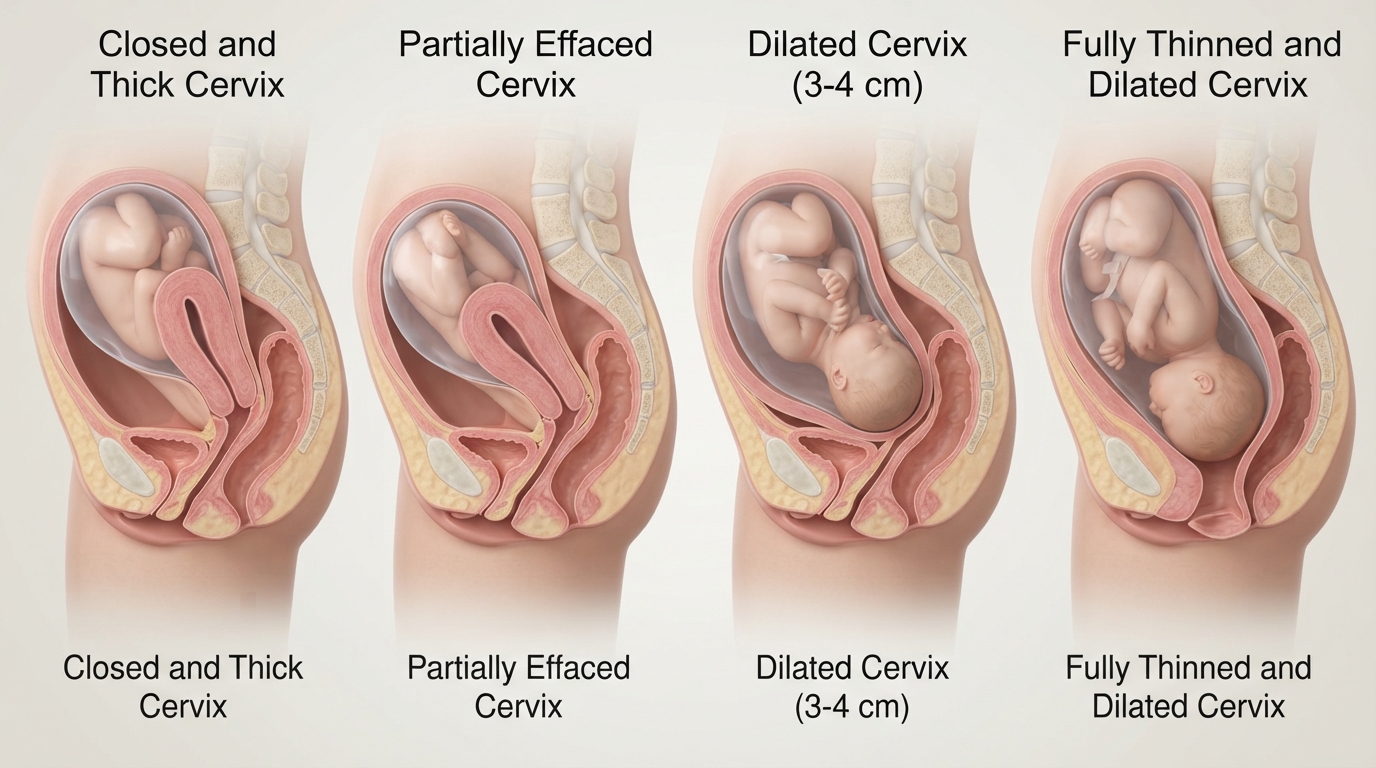
Bishop Score Chart
| Component | 0 points | 1 point | 2 points | 3 points |
|---|---|---|---|---|
| Dilation (cm) | Closed | 1–2 | 3–4 | 5 or more |
| Effacement (%) | 0–30 | 40–50 | 60–70 | 80 or more |
| Station | -3 | -2 | -1 or 0 | +1 or +2 |
| Consistency | Firm | Medium | Soft | – |
| Position | Posterior | Mid | Anterior | – |
Add the five values together. The total ranges from 0 to 13.
Worked Example
A woman at 40 weeks has: dilation 2 cm (1), effacement 50% (1), station -1 (2), consistency soft (2), position anterior (2).
Total = 1 + 1 + 2 + 2 + 2 = 8

How to Interpret the Score
- 8 or more (favorable): the chances of a vaginal delivery are good and the cervix is called favorable or “ripe” for induction. Perinatology
- 6 or less (unfavorable): the chances of a vaginal delivery are lower and the cervix is called unfavorable or “unripe”. Perinatology
- Scores under 6 usually mean the provider may use a cervical ripening method, either pharmacologic or physical, such as a Foley bulb. clinicaltrials
Cut-offs differ slightly between textbooks and hospitals (some use 5, some 6), so always follow your local protocol.
When Is It Checked?
Providers typically calculate it around 40 weeks, since induction is usually not considered before the due date. In practice, induction may also be needed earlier for medical reasons such as high blood pressure or poor fetal growth, and in those cases labor is induced whatever the score. Cleveland Clinic

Simplified and Modified Bishop Score
The simplified version uses only dilation, effacement, and station. Research found that a simplified score of 5 predicted vaginal delivery about as well as an original score above 8. Modified versions also consider factors such as pre-eclampsia, previous vaginal deliveries, postdates, first pregnancy, and PPROM. PerinatologyMedscape Reference
Limitations
The Bishop score is subjective because it depends on the examiner’s judgment. A 2025 systematic review notes that its predictive power is limited in mixed populations, and that adding ultrasound measurements such as cervical length can improve prediction. Another review points out that induction methods today differ from those used in Bishop’s era, and that even with a low score, induction still resulted in fewer cesareans than waiting in one study. So a low score does not mean induction is a bad idea; it only guides the method.

Bishop Score vs. Due Date Calculation
Your due date decides when induction is discussed, and the Bishop score shows how ready the cervix is. To understand how due dates are calculated, read our guide on the Mittendorf-Williams Rule vs. Naegele’s Rule and try our EDD calculator.
FAQs
What is a good Bishop score? 8 or above.
Can the score change? Yes, it can change within hours or days as the cervix ripens.
Can I calculate it myself? No. It needs a trained clinician’s internal exam.
Is a low score dangerous? No. It only means the cervix needs more preparation before or during induction.
Disclaimer: This article is for education only and is not a substitute for medical advice.
Sources: Cleveland Clinic, Perinatology.com, Wikipedia, NCBI/PMC systematic review (2025).
Bishop Score Quiz
Available options: 1 to 20