

Being told at your 20-week scan that your placenta is “low-lying” can feel frightening, especially when you are not sure what it means for your baby or your delivery. The reassuring news is that this is a common finding and, in most pregnancies, the placenta ends up in a safe position by the next scan. In this guide you will learn what a low-lying placenta is, how often it moves, which scans you can expect, what warning signs matter, and how delivery is planned if it does not move.
What Is a Low-Lying Placenta?
The placenta is the organ that connects you and your baby. In most pregnancies it attaches high up on the wall of the uterus. In some women it attaches lower down and may reach, or cover, the cervix (the neck of the womb).
According to RCOG patient information, a placenta that attaches low in the uterus is called:
- Low-lying placenta, when the placenta is less than 20 mm from the cervix
- Placenta praevia (spelled “previa” in the US), when the placenta completely covers the cervix
This low position is often first noticed on the routine 20-week ultrasound scan, when the baby’s anatomy is checked.
Low-Lying Placenta vs Placenta Praevia: What Is the Difference?
| Term | What the scan shows |
|---|---|
| Normal placenta | Placenta well away from the cervix |
| Low-lying placenta | Placental edge less than 20 mm from the cervix, but not covering it |
| Placenta praevia (major) | Placenta completely covers the cervix |
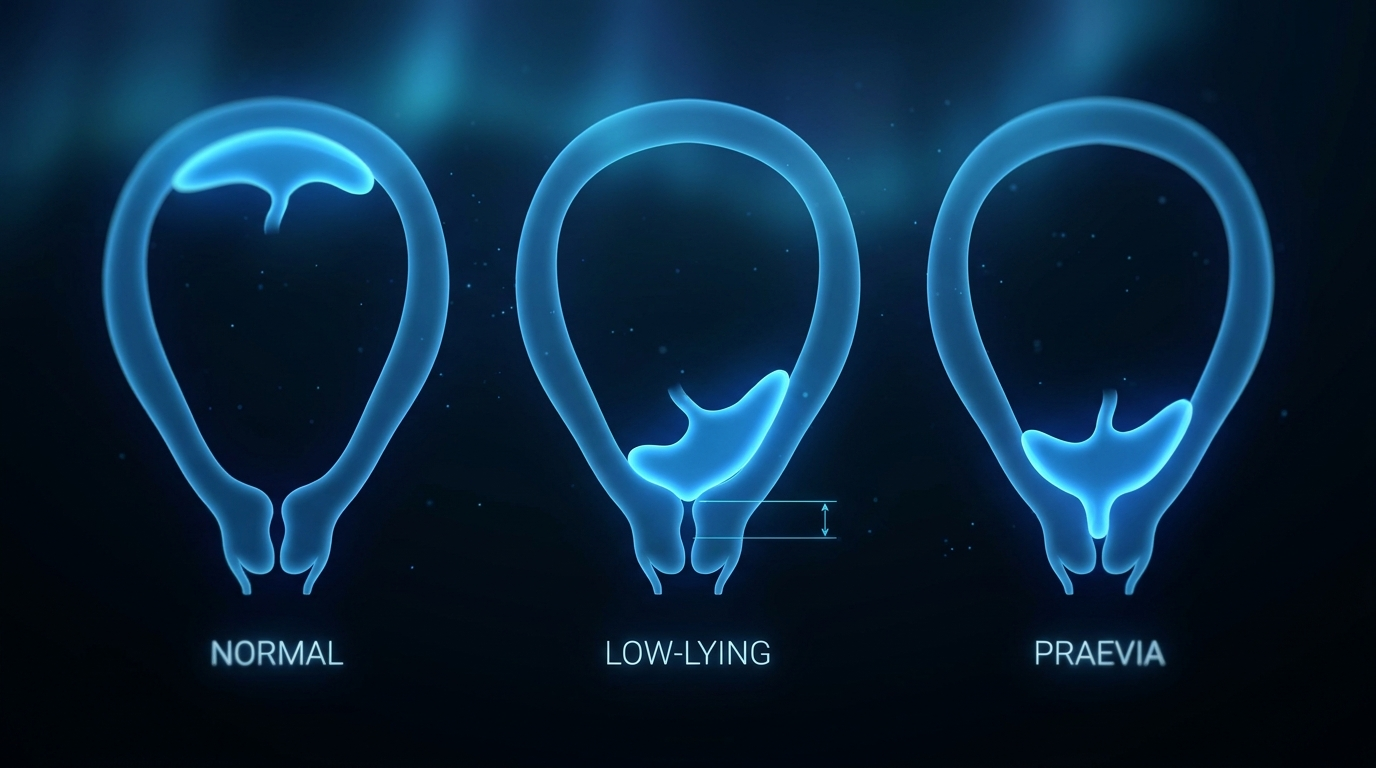
The names can be confusing, because RCOG also describes placenta praevia as a low-lying placenta after 20 weeks of pregnancy. In practice, a low-lying placenta at the 20-week scan is “suspected” and is re-checked later, because many of these placentas move.
Will a Low-Lying Placenta Move?
In most cases, yes. RCOG says that in most women the placenta moves upwards and out of the way as the uterus grows, and that 9 out of 10 women with a low-lying placenta at the 20-week scan will no longer have a low-lying placenta at the follow-up scan. Overall, only about 1 in 200 women will have placenta praevia at the end of pregnancy.
In plain terms: the placenta does not literally crawl upwards. As the lower part of the uterus stretches and grows during the second and third trimester, the placenta ends up further from the cervix.
Does the Type of Low-Lying Placenta Matter?
Yes. A small study from Nepal of 230 women who had a scan before 20 weeks found that only about 10.5% of lateral low-lying placentas persisted, while all of the placentas that completely covered the cervix persisted. This is a small, older study, so use it only as a hint: the closer the placenta is to covering the cervix, the less likely it is to move.
When Is the Placenta Less Likely to Move?
RCOG notes that if you have previously had a baby by caesarean, the placenta is less likely to move upwards. Placenta praevia is also more common if you have had one or more previous caesareans, had fertility treatment or smoke.
Which Scans Will You Have After a Low-Lying Placenta at 20 Weeks?
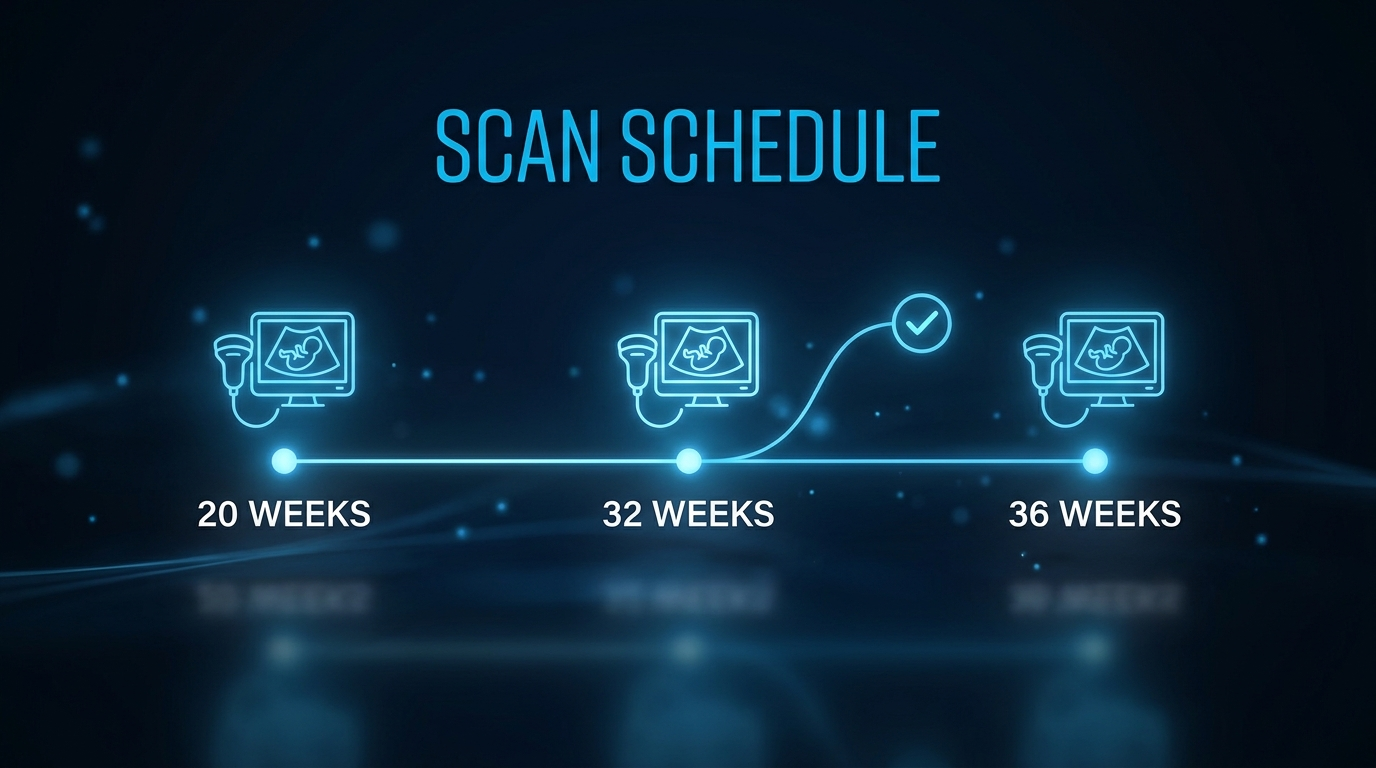
The schedule described in RCOG patient information and in NHS hospital leaflets is:
- 20-week scan: low-lying placenta noticed.
- 32-week scan: a follow-up scan to see whether the placenta is still low. A transvaginal scan may be used, which is safe for you and your baby. Your cervical length may also be measured to predict the risk of early labour and bleeding.
- 36-week scan: if the placenta is still low-lying at 32 weeks, another scan is offered at 36 weeks. You then see an obstetrician, who will plan the safest way to give birth.
If the placenta has moved away, you will usually return to routine pregnancy care.
Symptoms and Warning Signs of a Low-Lying Placenta
Many women with a low-lying placenta have no symptoms at all. When symptoms occur, the main one is vaginal bleeding. RCOG explains that bleeding from placenta praevia is usually painless and may happen after sex. The NCT adds that any vaginal bleeding in the second half of pregnancy might be a sign of placenta praevia.
When to Contact Your Hospital Straight Away
If you know you have a low-lying placenta, RCOG advises contacting the hospital straight away if you have:
- any vaginal bleeding
- contractions
- pain

Even if you have had no symptoms, there is a small risk of sudden, heavy bleeding, which may need an emergency caesarean. Do not wait to see if it settles. Go to your maternity unit or the nearest emergency department.
Placenta praevia may also be suspected later in pregnancy if the baby is lying in an unusual position, such as bottom first (breech) or across the womb (transverse).
What Can You Do With a Low-Lying Placenta?
Daily Activities
A Sussex NHS leaflet says you should continue your daily activities as normal, unless your care team advises otherwise. Follow the advice you personally have been given, because your doctor knows your scan details.
Sex and Travel
Leeds Teaching Hospitals explains that penetrative sex may cause bleeding because the placenta is close to the cervix, and that many women choose to avoid intercourse. Another NHS guideline advises women with placenta praevia to avoid intercourse, limit travel and go to hospital immediately if bleeding starts. Ask your doctor what applies to your own scan, because advice depends on how close the placenta is to the cervix and whether you have had any bleeding.
Avoiding Anaemia
RCOG advises trying to avoid anaemia by eating a healthy diet and taking iron supplements if your team recommends them. Your haemoglobin is checked at regular intervals. You can use our pregnancy weight gain tracker to keep an eye on your overall pregnancy progress, but remember that it does not replace your antenatal checks.
What If the Placenta Does Not Move?
If the placenta is still low or covers the cervix later in pregnancy, it is managed as placenta praevia. According to RCOG:
- Earlier birth risk: you are at higher risk of having your baby before 37 weeks. You may be offered steroid injections between 34 and 36 weeks to help your baby’s lungs mature, and in early labour a medicine (tocolysis) may be used to try to stop contractions so steroids can be given.
- Hospital care: additional care, including whether you need to stay in hospital, depends on your individual circumstances.
- Blood transfusion: you are more likely to need one, and blood should be available during a planned caesarean.
How Will You Give Birth With a Low-Lying Placenta?
RCOG explains that the plan is based on the 36-week scan:
- If the edge of the placenta is less than 20 mm from the entrance of the cervix, a caesarean is the safest way to give birth.
- If the placenta is further than 20 mm from the cervix, you can choose a vaginal birth.
Unless you have heavy or recurrent bleeding, a planned caesarean usually takes place between 36 and 37 weeks. If you have had vaginal bleeding during the pregnancy, it may take place earlier.
For a caesarean, a senior obstetrician and anaesthetist should be present, and you should give birth in a hospital with facilities to deal with heavy bleeding, especially if you have had previous caesareans. RCOG states that bleeding may be heavier than average, and that if it cannot be controlled in other ways, a hysterectomy may sometimes be needed. Your team will discuss these risks with you in advance.
Related Conditions: Placenta Accreta and Vasa Praevia
RCOG also covers two rarer conditions:
- Placenta accreta is when the placenta grows into the muscle of the womb. It affects between 1 in 300 and 1 in 2000 pregnancies and is more common in women with placenta praevia who have had previous caesareans, other uterine surgery, are over 35 or had fertility treatment, especially IVF.
- Vasa praevia is very rare, affecting between 1 in 1200 and 1 in 5000 pregnancies. It involves unprotected baby blood vessels near the cervix, and a planned caesarean at around 34 to 36 weeks is offered if it is found before labour.
If your doctor mentions either term, ask them to explain what it means for your plan. To learn how pregnancy details are recorded, see our guide on history taking in obstetrics.
Key Takeaways
- A low-lying placenta (less than 20 mm from the cervix) is a common 20-week scan finding.
- About 9 out of 10 resolve by the follow-up scan; only about 1 in 200 pregnancies have placenta praevia at the end.
- Expect scans at 32 weeks and, if still low, at 36 weeks.
- Contact your hospital straight away for bleeding, contractions or pain.
- A caesarean is usually planned at 36 to 37 weeks if the placenta is within 20 mm of the cervix at 36 weeks.
- Follow your own team’s advice on sex, travel and activity.
Conclusion
A low-lying placenta at 20 weeks usually turns out well, and the extra scans are there to make sure you and your baby stay safe. Know the warning signs, keep your hospital’s contact number handy, and ask your doctor to explain your scan report in plain language. If the placenta stays low, you will still have a clear plan for a safe birth.
Frequently Asked Questions
Can a low-lying placenta move?
Yes. About 9 out of 10 women with a low-lying placenta at the 20-week scan will no longer have it at the follow-up scan, because the uterus grows and carries the placenta further from the cervix.
When does a low-lying placenta usually move?
It is rechecked at 32 weeks. Many have moved by then, and if it is still low a final scan is done at 36 weeks.
What are the symptoms of a low-lying placenta?
Often none. When symptoms occur, the main one is painless vaginal bleeding, sometimes after sex. Call your hospital for any bleeding, contractions or pain.
Is a low-lying placenta the same as placenta previa?
Not exactly. Low-lying means the placenta is within 20 mm of the cervix. Placenta praevia (previa) means it covers the cervix. A low-lying placenta at 20 weeks is rechecked because many move.
Can I have a normal delivery with a low-lying placenta?
If the placenta edge is more than 20 mm from the cervix at 36 weeks, you can choose a vaginal birth. If it is less than 20 mm, a caesarean is the safest option.
Can I have sex or travel with a low-lying placenta?
Your doctor may advise avoiding sex and limiting travel, especially if the placenta is close to the cervix or you have had bleeding. Ask for advice that suits your scan.
What increases the risk of a low-lying placenta?
Previous caesarean births, fertility treatment and smoking.
Low-Lying Placenta at 20 Weeks Knowledge Quiz
Available options: 1 to 20
Disclaimer: This article is for educational purposes only and is not a substitute for professional medical advice, diagnosis or treatment. If you have vaginal bleeding, contractions or pain in pregnancy, contact your maternity unit or go to the nearest emergency department immediately.
References
- Royal College of Obstetricians and Gynaecologists. Placenta praevia, placenta accreta and vasa praevia: Information for you. September 2018 (based on RCOG Green-top Guidelines 27a and 27b).
- University Hospitals Sussex NHS Foundation Trust. Low-lying placenta at 20 week scan: patient information.
- NCT. What is a low-lying placenta? (citing RCOG, 2018).
- Leeds Teaching Hospitals NHS Trust. Low-lying placenta and placenta praevia: patient information.
- Importance of placental localisation in early pregnancy. Nepal J Obstet Gynaecol. 2007;2(2):16-19.