
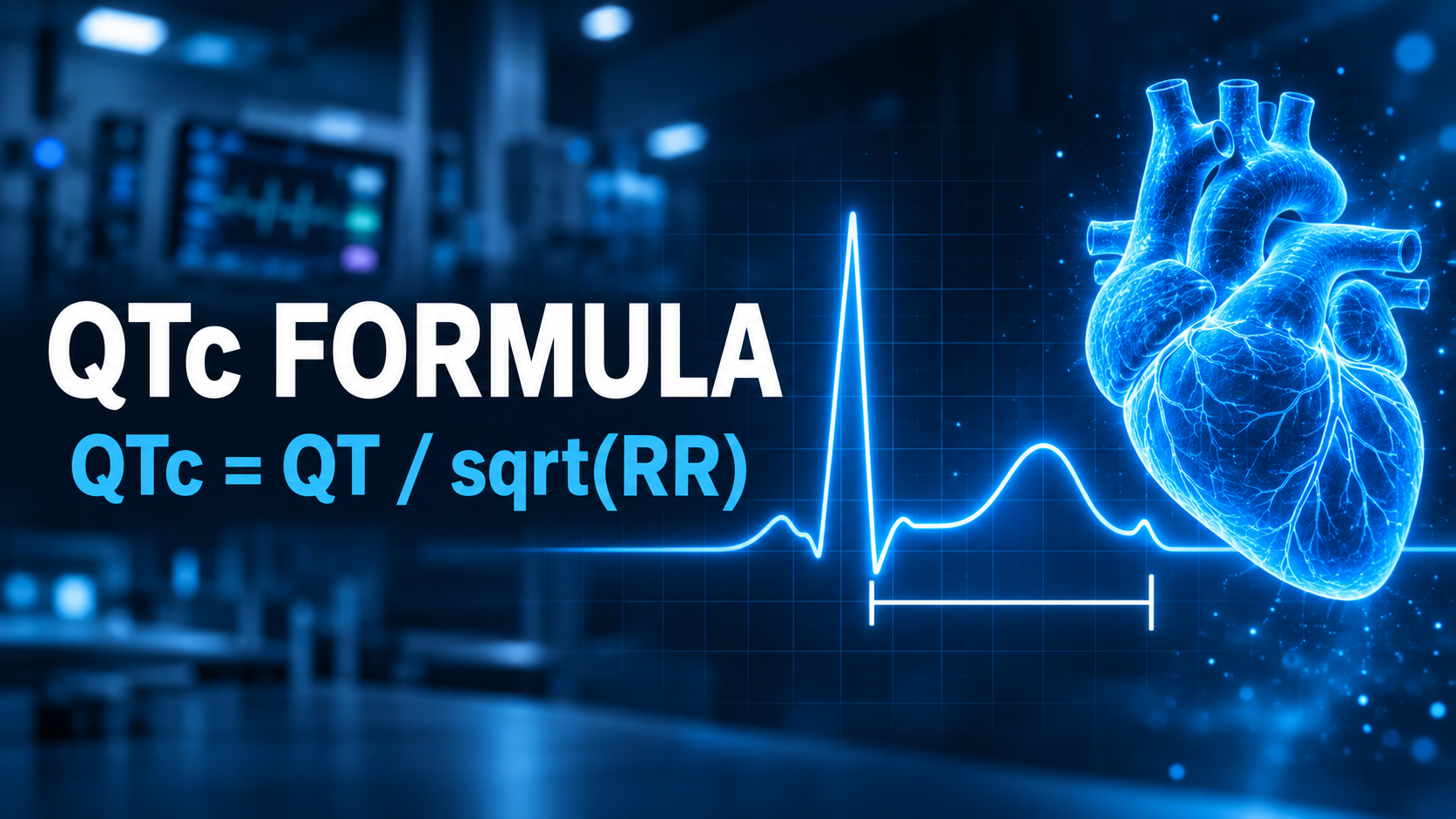
The QT interval on an ECG tells us how long the ventricles take to depolarise and repolarise. The problem is that this interval changes with heart rate, so a raw QT value of 380 ms means different things at 50 beats per minute and at 100. That is why clinicians use the corrected QT interval, or QTc. In this guide you will learn the QTc formula, how to calculate it step by step, normal and prolonged values, and when the common Bazett formula can mislead you.
What Is the QT Interval and Why Do We Correct It?
The QT interval is measured from the start of the QRS complex to the end of the T wave. A prolonged QT interval signals delayed ventricular repolarisation, which can create a vulnerable period for dangerous ventricular rhythms, especially torsades de pointes.
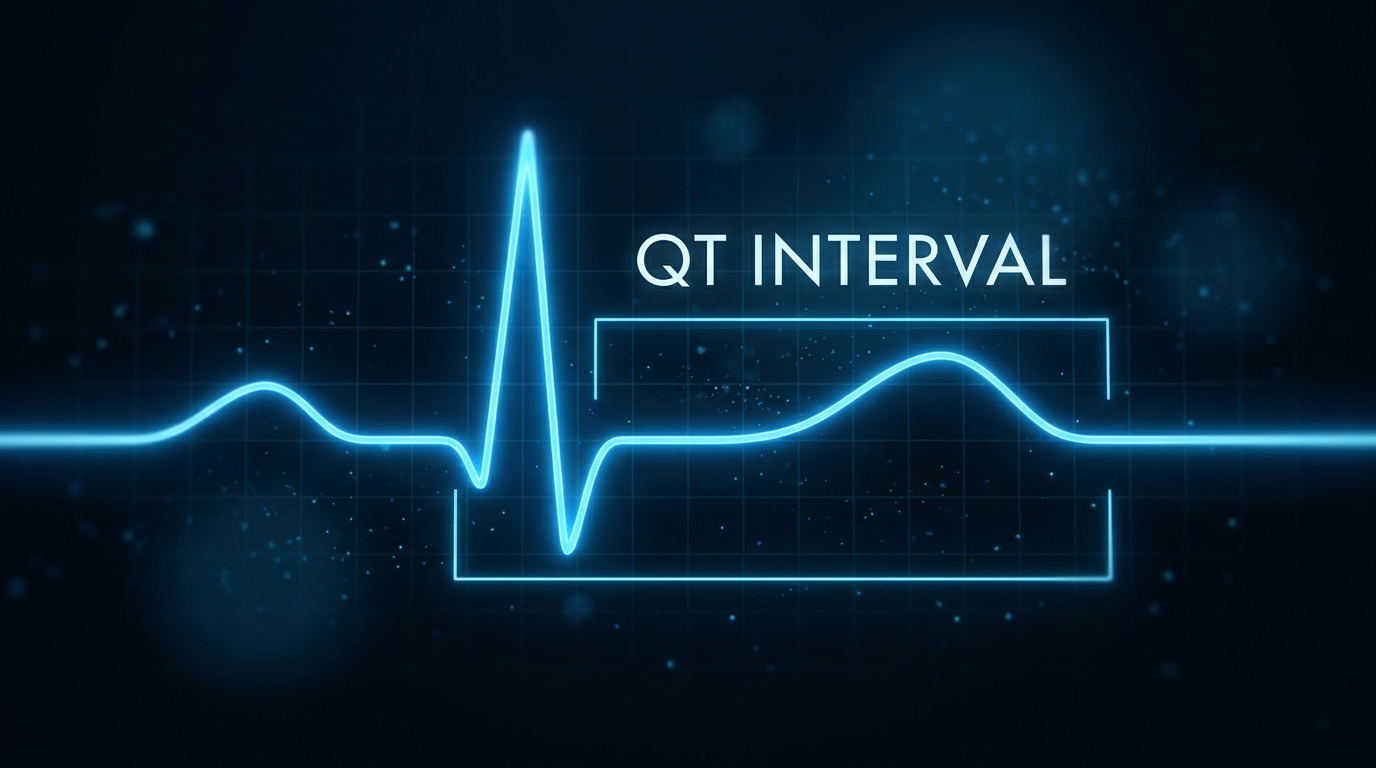
QT correction formulas were developed to account for the inverse relationship between QT interval and heart rate. At a fast rate the QT naturally shortens, and at a slow rate it lengthens, so the raw value alone can be misleading.
QTc Formula (Bazett’s Formula)
First, convert heart rate into the RR interval in seconds:
RR (seconds) = 60 ÷ Heart Rate
Then apply Bazett’s formula, the most widely taught method:
QTc = QT ÷ √RR
Here QT is in milliseconds and RR is in seconds. You can also check your result with an online QTc calculator.
Fridericia’s Formula
Fridericia published his method in the same year as Bazett (1920), but he used a cube root instead of a square root:
QTc = QT ÷ ∛RR
Many studies suggest Fridericia is more reliable across a wider range of heart rates, particularly when the heart rate is fast.
Other QTc Formulas
Several other correction methods exist, and the same review covers them: the Framingham, Hodges and Rautaharju formulas. They are less commonly used at the bedside, and Bazett remains the one most taught in medical schools.
| Formula | Equation |
|---|---|
| Bazett | QT ÷ √RR |
| Fridericia | QT ÷ ∛RR |
| Framingham | QT + 154 × (1 − RR) |
| Hodges | QT + 1.75 × (HR − 60) |
| Rautaharju | QT × (120 + HR) ÷ 180 |
How to Calculate QTc Step by Step
- Measure the QT interval from the ECG in milliseconds.
- Note the heart rate in beats per minute.
- Calculate RR = 60 ÷ heart rate.
- Take the square root (Bazett) or cube root (Fridericia) of RR.
- Divide the QT interval by that value.
Worked Examples
Example 1: Normal heart rate. QT = 380 ms, HR = 75 bpm. RR = 60 ÷ 75 = 0.8 s.
Bazett: 380 ÷ √0.8 = 380 ÷ 0.894 = about 425 ms.
Fridericia: 380 ÷ ∛0.8 = 380 ÷ 0.928 = about 409 ms.
Both values are within the normal range.
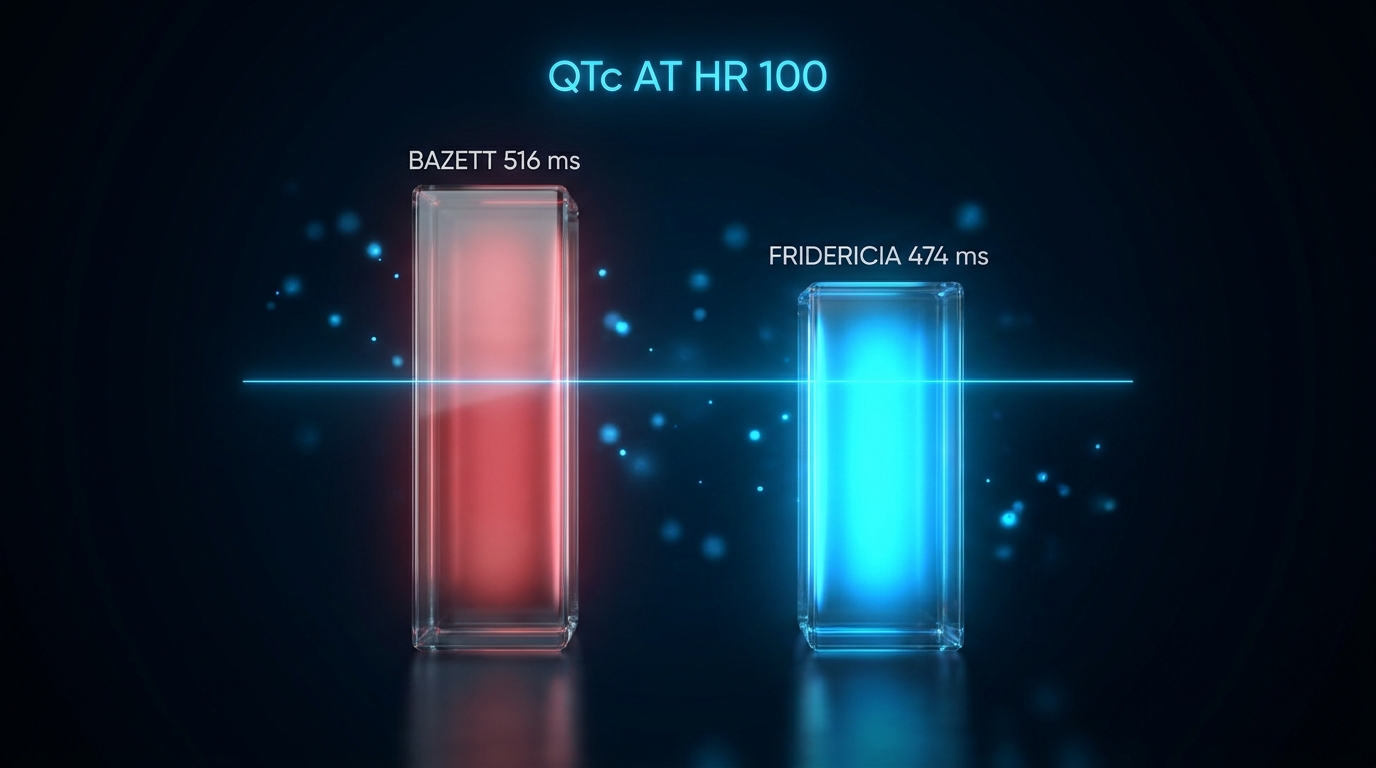
Example 2: Fast heart rate. QT = 400 ms, HR = 100 bpm. RR = 0.6 s.
Bazett: 400 ÷ 0.775 = about 516 ms.
Fridericia: 400 ÷ 0.843 = about 474 ms.
Notice the gap. Bazett suggests a dangerously long QTc above 500 ms, but Fridericia gives a much lower value. This is the classic problem of Bazett overcorrecting at high heart rates.
Example 3: Slow heart rate. QT = 440 ms, HR = 50 bpm. RR = 1.2 s.
Bazett: 440 ÷ 1.095 = about 402 ms.
Fridericia: 440 ÷ 1.063 = about 414 ms.
At slow rates Bazett gives the lower number.
Normal and Prolonged QTc Values
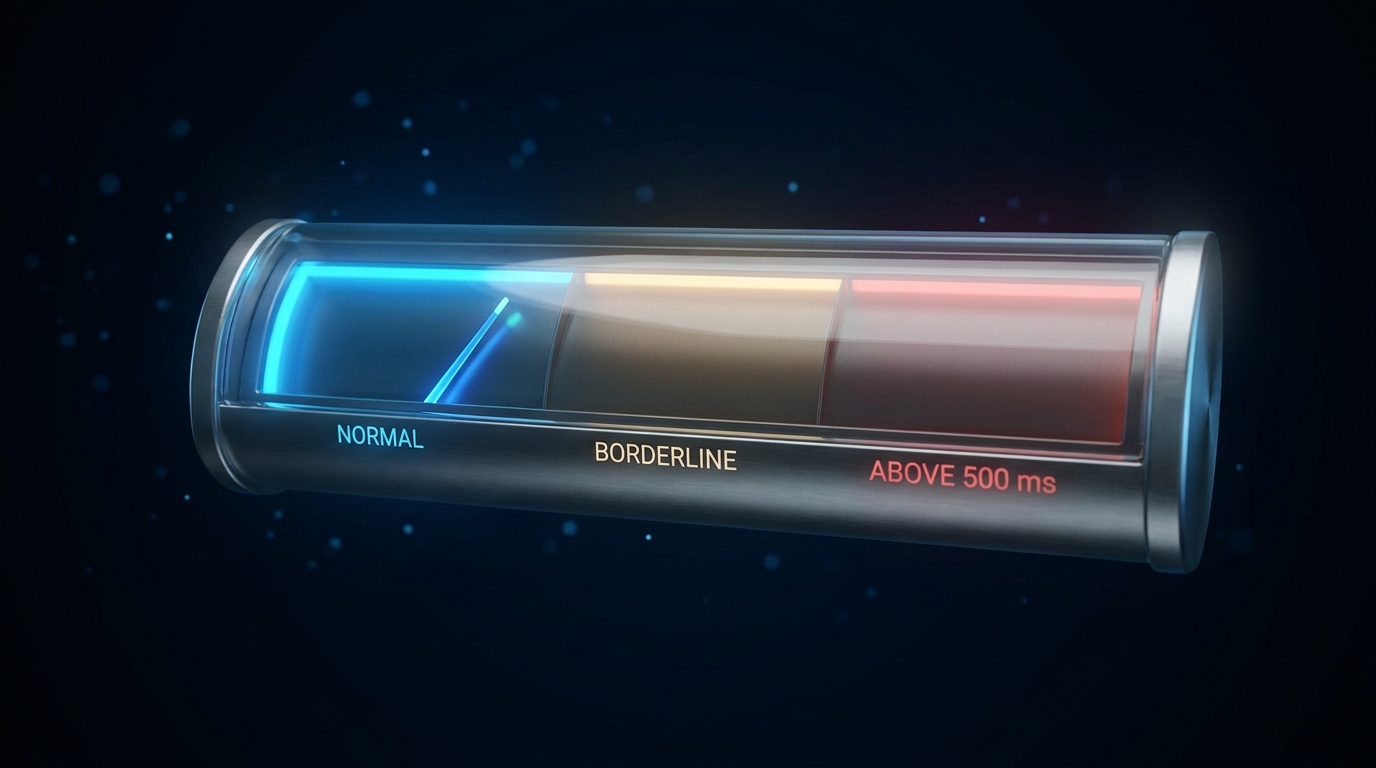
There is no single universal cut-off, and sources differ slightly. StatPearls states that a QTc is considered prolonged above 450 ms in men and 460 ms in women. A value above 500 ms has been linked with a two- to three-fold higher risk of torsades de pointes.
| QTc (ms) | Interpretation |
|---|---|
| Below 440 (men) / below 460 (women) | Normal |
| 440 to 500 | Borderline or prolonged, review drugs and electrolytes |
| Above 500 | Significantly prolonged, high risk of torsades de pointes |
These bands are a teaching guide. Local protocols and the clinical picture come first.
A Quick Bedside Rule of Thumb
A popular shortcut says: if the QT interval is less than half of the RR interval, the QTc is not prolonged. For example, at a heart rate of 75 the RR interval is 800 ms, so a QT below 400 ms is reassuring. This is useful for a quick look, but it does not replace calculating the QTc when the value is borderline.
Which Formula Should You Use: Bazett or Fridericia?
- Bazett is simple, widely taught and familiar, and it has been used to identify patients at risk of drug-induced torsades. However, it can produce falsely long QTc values at high heart rates.
- Fridericia is generally considered more robust at fast and slow rates. In atrial fibrillation, one comparison found that Bazett overestimated QTc while Fridericia was the most accurate.
In practice, many clinicians calculate both when the heart rate is not between 60 and 100 bpm, and they look at the trend rather than at a single number.
What Causes a Prolonged QTc?
According to StatPearls, QT prolongation can be congenital or acquired, and acquired prolongation is more common. Virtually all drugs that cause long QT block a potassium channel current called IKr.
Acquired causes:
- Medications, for example antiarrhythmic drugs such as amiodarone, sotalol and quinidine, and certain antiemetics
- Electrolyte problems: low potassium, low calcium and low magnesium
Congenital causes: inherited long QT syndromes, such as Romano-Ward syndrome and Jervell and Lange-Nielsen syndrome (which includes hearing loss).
StatPearls on torsades de pointes lists additional risk factors, including age over 65, female sex, bradycardia, structural heart disease and diuretic use.
Why Does a Long QTc Matter?
A long QTc raises the risk of torsades de pointes, a polymorphic ventricular tachycardia that can stop on its own or degenerate into ventricular fibrillation. Patients may have palpitations, fainting or cardiac arrest, although about half of those with torsades can be asymptomatic.
When a patient has a significantly prolonged QTc, the usual first steps are to repeat the ECG, review and stop QT-prolonging drugs where possible, and correct potassium, magnesium and calcium.
An unwell patient also needs a full set of vital signs, and heart rate matters in both QT correction and perfusion. See our guides on the shock index formula and the cardiac output formula (CO = HR × SV).
Limitations of the QTc Formula
- Heart rate extremes: all correction formulas become less accurate at very fast or very slow rates.
- Atrial fibrillation: irregular RR intervals make a single calculation unreliable, so averaging several beats is advised.
- Measurement errors: the end of the T wave can be hard to define, and different leads give different values.
- Wide QRS: bundle branch block or pacing lengthens the QT without true repolarisation delay.
- Not a diagnosis: QTc must be read with the clinical story, electrolytes and the medication list.
Key Takeaways
- QTc = QT ÷ √RR (Bazett), where RR = 60 ÷ heart rate.
- Fridericia uses the cube root and is often better at fast rates.
- Prolonged QTc is above about 450 ms (men) or 460 ms (women); above 500 ms is high risk.
- Bazett can overestimate QTc at high heart rates, as in Example 2.
- Check drugs and electrolytes first when QTc is prolonged.
Frequently Asked Questions
What is the QTc formula? QTc = QT ÷ √RR, where RR is 60 divided by the heart rate.
What is a normal QTc? Generally below 440 ms in men and below 460 ms in women, though sources vary.
What QTc is dangerous? A QTc above 500 ms is considered markedly prolonged and carries a higher risk of torsades de pointes.
Is Bazett or Fridericia better? Fridericia is often more accurate at fast heart rates, while Bazett is more familiar and widely used.
Can electrolytes change QTc? Yes. Low potassium, calcium and magnesium can prolong the QT interval.
Can I calculate QTc at home? You can, if you have a QT measurement and heart rate, but ECG interpretation should be done by a qualified clinician.
QTc (Corrected QT Interval) Knowledge Quiz
Available options: 1 to 20
Disclaimer: This article is for educational purposes only and is not a substitute for professional medical advice, diagnosis or treatment.