

A lab report says the calcium is 7.8 mg/dL. That looks low, and a quick glance might suggest treatment. But if the albumin on the same report is also low, the calcium that actually matters may be perfectly normal. The corrected calcium formula is the small piece of arithmetic that settles this. This guide explains why the correction exists, gives the formula in both common unit systems, includes a quick-reference table and eight worked examples, and shows when the formula should not be trusted.
Table of Contents
- Calcium basics: where it lives and what controls it
- Why albumin changes the total calcium
- The corrected calcium formula
- Quick-reference table
- Normal ranges
- A simple step-by-step routine
- Eight worked examples
- Common mistakes
- Low corrected calcium (hypocalcemia)
- High corrected calcium (hypercalcemia)
- How pH and other factors change the picture
- When the formula fails
- Corrected vs ionized vs total calcium
- Tips for students and nurses
- Frequently asked questions
- Key takeaways
1. Calcium Basics: Where It Lives and What Controls It
Almost all of the body’s calcium, about 99%, is stored in bones and teeth. The small amount left in the blood is what the lab measures, and it is tightly controlled because it drives muscle contraction, nerve signalling, blood clotting and the electrical activity of the heart.
Three main hormones and vitamins keep blood calcium steady:
| Controller | What it does |
|---|---|
| Parathyroid hormone (PTH) | Raises blood calcium by releasing it from bone, helping the kidneys hold on to it and activating vitamin D |
| Vitamin D | Increases calcium absorption from the gut |
| Calcitonin | Has a smaller effect and tends to lower calcium |
When any of these go wrong, or when the kidneys, gut or bones are affected, calcium levels shift.
2. Why Albumin Changes the Total Calcium
Calcium in the blood exists in three forms:
| Form | Approximate share | Active? |
|---|---|---|
| Bound to albumin | About 40% | No |
| Complexed with anions (phosphate, citrate, lactate) | About 15% | No |
| Free (ionized) calcium | About 45% | Yes |
The routine blood test measures total calcium, which adds all three together. Albumin is the carrier for the largest bound portion. So if albumin falls, which is common in liver disease, kidney disease (especially nephrotic syndrome), malnutrition, burns, malabsorption and severe infection, the total calcium falls too, while the active ionized calcium can stay normal. This is called pseudohypocalcemia (“false low calcium”).
The opposite also exists. If albumin is very high, for example from dehydration, the total can look higher than the active calcium really is.
The correction formula estimates what the total calcium would be if albumin were normal, so you can tell a lab artefact from a real problem.

3. The Corrected Calcium Formula
The standard version was described by Payne and colleagues in a 1973 BMJ paper that looked at how serum calcium behaves when serum proteins are abnormal. It is still the formula most people use today.
Conventional units (calcium in mg/dL, albumin in g/dL):
Corrected calcium = measured calcium + 0.8 × (4.0 − albumin)SI units (calcium in mmol/L, albumin in g/L):
Corrected calcium = measured calcium + 0.02 × (40 − albumin)How to remember it: for every 1 g/dL that albumin falls below 4.0, add 0.8 mg/dL to the measured calcium. In SI units, for every 10 g/L below 40, add 0.2 mmol/L.
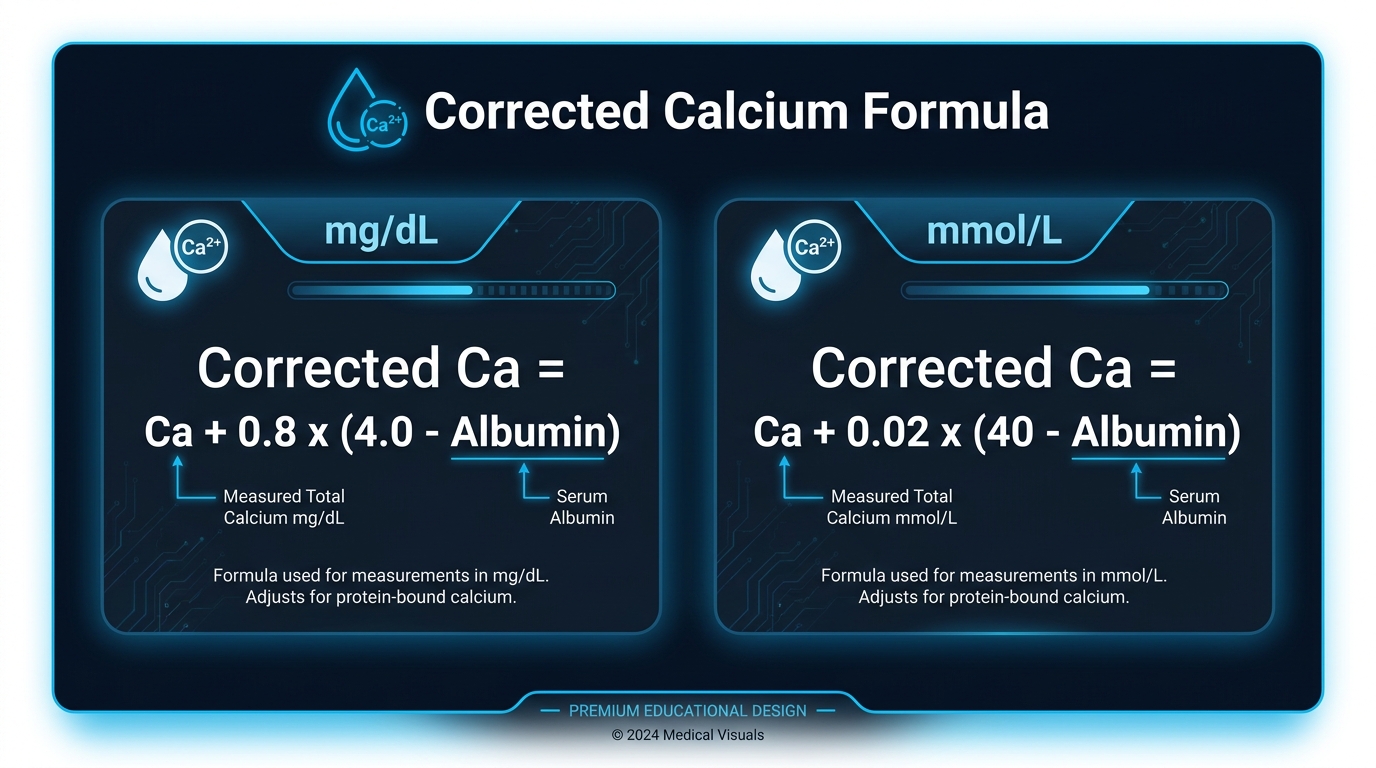
Both versions treat 4.0 g/dL (40 g/L) as the “normal” albumin. Some laboratories use a slightly different reference value, so follow your local lab if it publishes its own.
For more on the method, see this overview of calcium correction for hypoalbuminemia.
4. Quick-Reference Table
Instead of calculating every time, look up how much to add.
| Albumin (g/dL) | Albumin (g/L) | Add (mg/dL) | Add (mmol/L) |
|---|---|---|---|
| 4.0 | 40 | 0 | 0 |
| 3.5 | 35 | 0.4 | 0.10 |
| 3.0 | 30 | 0.8 | 0.20 |
| 2.5 | 25 | 1.2 | 0.30 |
| 2.0 | 20 | 1.6 | 0.40 |
| 1.5 | 15 | 2.0 | 0.50 |
Converting units: albumin g/dL × 10 = g/L, and calcium mg/dL ÷ 4 is approximately mmol/L.
5. Normal Ranges
| Measurement | Typical adult range |
|---|---|
| Total or corrected calcium | 8.5 to 10.5 mg/dL (about 2.1 to 2.6 mmol/L) |
| Ionized calcium | About 1.1 to 1.3 mmol/L |
| Albumin | About 3.5 to 5.0 g/dL (35 to 50 g/L) |
Laboratories differ slightly, so always compare against the range printed on your own report.
6. A Simple Step-by-Step Routine
- Check the albumin. If it is normal, you can usually read the measured calcium as it is.
- If albumin is low, pick the version that matches your units.
- Calculate the correction and add it to the measured calcium.
- Compare the answer with the reference range (8.5 to 10.5 mg/dL).
- Look at the patient. Cramps, tingling, confusion, an unusual ECG or a very sick patient all call for an ionized calcium test instead of relying on arithmetic.
If you like working through bedside numbers, our ideal body weight formula guide uses the same step-by-step approach, and you can explore more tools in our medical tools.
7. Eight Worked Examples
Example 1: Low calcium that is actually normal.
Calcium 7.8 mg/dL, albumin 2.5 g/dL.
Correction = 0.8 × (4.0 − 2.5) = 1.2. Corrected calcium = 7.8 + 1.2 = 9.0 mg/dL. Normal. The first result was a false alarm caused by low albumin.
Example 2: Borderline value, severe albumin loss.
Calcium 8.0 mg/dL, albumin 2.0 g/dL.
Correction = 0.8 × 2.0 = 1.6. Corrected calcium = 9.6 mg/dL. Normal.
Example 3: Hidden hypercalcemia.
Calcium 10.2 mg/dL (looks normal), albumin 2.0 g/dL.
Correction = 0.8 × 2.0 = 1.6. Corrected calcium = 11.8 mg/dL. This is high, and the problem would have been missed without the correction.
Example 4: Truly low calcium.
Calcium 7.0 mg/dL, albumin 3.0 g/dL.
Correction = 0.8 × 1.0 = 0.8. Corrected calcium = 7.8 mg/dL. Still below 8.5, so this patient has real hypocalcemia.
Example 5: Mild albumin drop.
Calcium 8.6 mg/dL, albumin 3.4 g/dL.
Correction = 0.8 × 0.6 = 0.48. Corrected calcium = 9.1 mg/dL. Normal, and the correction barely changed anything. When albumin is only slightly low, the adjustment is small.
Example 6: SI units, normal result.
Calcium 2.00 mmol/L, albumin 25 g/L.
Correction = 0.02 × (40 − 25) = 0.30. Corrected calcium = 2.30 mmol/L. Normal.
Example 7: SI units, high result.
Calcium 2.65 mmol/L, albumin 20 g/L.
Correction = 0.02 × 20 = 0.40. Corrected calcium = 3.05 mmol/L, which is about 12.2 mg/dL. This is clearly high and needs a work-up.
Example 8: High albumin (use caution).
Calcium 10.8 mg/dL, albumin 5.0 g/dL in a dehydrated patient.
Applying the formula literally gives 10.8 + 0.8 × (4.0 − 5.0) = 10.0 mg/dL, but this use is debated. Many clinicians do not correct for high albumin and request an ionized calcium instead.

8. Common Mistakes
- Mixing units. The mg/dL formula needs albumin in g/dL, and the mmol/L formula needs albumin in g/L. Mixing them gives nonsense.
- Correcting when albumin is normal. There is nothing to adjust, so the measured value stands.
- Trusting the corrected value in a very sick patient. Critical illness changes calcium binding.
- Forgetting the pH. Acidosis and alkalosis change how much calcium is free.
- Treating a number instead of the patient. Always check symptoms, the ECG and, if in doubt, ionized calcium.
- Using the wrong “normal albumin.” If your lab uses a different reference value, substitute it.
9. Low Corrected Calcium (Hypocalcemia)
Common causes:
| Group | Examples |
|---|---|
| Low PTH | Surgery on the thyroid or parathyroid glands, autoimmune hypoparathyroidism |
| Vitamin D problems | Poor intake, little sun, malabsorption, kidney disease |
| Kidney disease | Reduced activation of vitamin D, raised phosphate |
| Other | Low magnesium, acute pancreatitis, massive blood transfusion, sepsis, rhabdomyolysis, some medicines |
Features: tingling around the mouth and in the fingers, muscle cramps, tetany, seizures in severe cases, and a prolonged QT interval on the ECG. The bedside signs of Chvostek (facial twitch on tapping the facial nerve) and Trousseau (hand spasm when a blood pressure cuff is inflated) may appear. Chvostek’s sign is also positive in a fair number of healthy people, so it is not a reliable stand-alone test.
Treatment in outline: symptomatic or severe hypocalcemia is usually treated with intravenous calcium gluconate, low magnesium is corrected, and vitamin D is used for long-term management. Hospital protocols differ, so this is for understanding only. The StatPearls review on hypocalcemia covers causes and diagnosis in detail, and notes that total calcium should be corrected for albumin before hypocalcemia is diagnosed.
10. High Corrected Calcium (Hypercalcemia)
Common causes:
| Group | Examples |
|---|---|
| Overactive parathyroid glands | Primary hyperparathyroidism |
| Cancer | Tumours that release calcium-raising substances, or bone involvement |
| Vitamin D or calcium excess | Supplements, granulomatous disease such as sarcoidosis |
| Medicines | Thiazide diuretics, lithium |
| Other | Prolonged immobilization, dehydration |
Overactive parathyroid glands and cancer together account for the large majority of cases.
Features: the classic memory aid is stones, bones, groans and psychiatric overtones: kidney stones, bone pain, abdominal complaints (nausea, constipation) and mood or thinking changes. The QT interval tends to shorten.
Typical grading:
| Corrected calcium | Grade |
|---|---|
| Above 10.5 to about 12 mg/dL | Mild |
| About 12 to 14 mg/dL | Moderate |
| Above about 14 mg/dL | Severe |
Treatment in outline: intravenous fluids are the first step, with further treatment depending on the cause and severity.

11. How pH and Other Factors Change the Picture
| Situation | Effect on calcium binding | Effect on ionized calcium |
|---|---|---|
| Acidosis | Less binding to albumin | Ionized calcium goes up |
| Alkalosis (for example, hyperventilation) | More binding to albumin | Ionized calcium goes down, and symptoms can appear even with a normal total |
| Low magnesium | Stops PTH from working properly | Calcium is hard to correct until magnesium is replaced |
| Rapid blood transfusion | Citrate binds calcium | Ionized calcium can fall |
This is why a patient who is hyperventilating can get tingling and spasms even though the total calcium looks normal.
12. When the Formula Fails
The correction is an estimate, not a measurement. It can mislead when:
- Albumin is very low (below about 2 g/dL or 20 g/L), because the straight-line assumption breaks down.
- The patient is critically ill, because many factors are changing at once.
- The blood pH is abnormal.
- Abnormal proteins are present, for example in paraproteinemia.
- Albumin is high, where the formula is debated.
In all of these situations, a direct ionized calcium test is the gold standard.
13. Corrected vs Ionized vs Total Calcium
| Feature | Total calcium | Corrected calcium | Ionized calcium |
|---|---|---|---|
| What it is | Measured, all forms together | Calculated estimate | Measured, active form only |
| Affected by albumin | Yes | Adjusted for it | No |
| Affected by pH | Not directly | Not accounted for | Yes, but it reflects the true active level |
| Cost and availability | Cheap, routine | Free, instant | Needs a special sample and analyser |
| Best used | First-line screening | When albumin is abnormal | In sick patients or when results do not fit |
14. Tips for Students and Nurses
- Learn the formula as “0.8 for every 1 below 4” and the SI version as “0.2 for every 10 below 40.”
- Always write the units next to each number before you calculate.
- Check albumin first. If it is normal, skip the calculation.
- Remember that a normal total calcium with low albumin can hide hypercalcemia.
- In an unwell patient, ask whether an ionized calcium has been sent.
- Link the numbers to the patient: tingling and cramps for low calcium, “stones, bones, groans and moans” for high calcium.
- Report symptoms early, such as spasms, confusion or palpitations, rather than waiting for a repeat blood test.
15. Frequently Asked Questions
What is the corrected calcium formula?
Corrected calcium = measured calcium + 0.8 × (4.0 − albumin), with calcium in mg/dL and albumin in g/dL.
What is the corrected calcium formula in mmol/L?
Corrected calcium = measured calcium + 0.02 × (40 − albumin), with calcium in mmol/L and albumin in g/L.
Why do we correct calcium for albumin?
Because about 40% of blood calcium is bound to albumin. Low albumin lowers the total calcium without lowering the active ionized calcium.
What is a normal corrected calcium?
About 8.5 to 10.5 mg/dL, or roughly 2.1 to 2.6 mmol/L.
Do I need to correct calcium when albumin is normal?
Usually not. When albumin is normal, the corrected and measured values are essentially the same.
Is corrected calcium the same as ionized calcium?
No. Corrected calcium is a calculated estimate, while ionized calcium is a direct measurement and is more accurate.
Can corrected calcium be wrong?
Yes. It is less reliable in critical illness, severe low albumin and acid-base disturbances.
Why can calcium look low even when it is normal?
Because low albumin carries less calcium in the blood, which lowers the total even though the active calcium has not changed.
What does a high corrected calcium mean?
Often an overactive parathyroid gland or cancer. It needs a proper medical work-up.
What does a low corrected calcium mean?
Common causes include low PTH, vitamin D deficiency, kidney disease and low magnesium.
Do I use the same formula for children?
Reference ranges for children differ, so follow your hospital’s pediatric guidance.
Who uses the corrected calcium formula?
Doctors, nurses, pharmacists and students reviewing lab results, especially in hospital patients with liver, kidney or nutritional problems.
Corrected Calcium Knowledge Quiz
Available options: 1 to 20
16. Key Takeaways
- Total calcium falls when albumin falls, even if the active ionized calcium is normal.
- Correct it with: measured calcium + 0.8 × (4.0 − albumin), or the 0.02 × (40 − albumin) version for SI units.
- Add about 0.8 mg/dL for every 1 g/dL that albumin is below 4.0.
- A “low” calcium can turn out normal after correction, and a “normal” one can hide hypercalcemia.
- Acidosis, alkalosis, critical illness and very low albumin can make the estimate unreliable.
- Confirm with an ionized calcium test when the picture is unclear, and always treat the patient, not just the number.
Disclaimer: This article is for educational purposes only and is not a substitute for professional medical advice. Lab results should be interpreted by a qualified clinician in the context of the whole patient.
References
- Payne RB, et al. Interpretation of serum calcium in patients with abnormal serum proteins. BMJ. 1973.
- StatPearls: Hypocalcemia. NCBI Bookshelf.
- MDCalc: Calcium Correction for Hypoalbuminemia and Hyperalbuminemia.