


Acute appendicitis is one of the most common causes of emergency abdominal surgery, but diagnosing it is not always simple. Early appendicitis can look like gastroenteritis, and other conditions such as ovarian pathology or a kidney stone can look like appendicitis. Scoring systems were created to bring structure to this decision, and the Alvarado score is the most widely taught of them. This guide explains the score in detail: what it measures, how to calculate it, how to interpret it, how accurate it is and where it can mislead you.
Table of Contents
- What is the Alvarado score?
- Why do we need an appendicitis score?
- The MANTRELS mnemonic and scoring chart
- Understanding each component
- How to calculate the score, step by step
- Alvarado score interpretation and management
- Worked examples
- How accurate is the Alvarado score?
- Modified Alvarado score (MASS)
- Alvarado vs other appendicitis scores
- Limitations and pitfalls
- Practice MCQs
- Frequently asked questions
- Key takeaways
1. What Is the Alvarado Score?
The Alvarado score, also known as the MANTRELS score, is a 10-point clinical scoring system used to estimate the probability of acute appendicitis in a patient with right lower abdominal pain. Dr. Alfredo Alvarado introduced it in 1986 after reviewing which symptoms, signs and laboratory findings were most strongly linked to appendicitis confirmed on pathology.
The score uses eight items: three symptoms, three signs and two laboratory findings. It requires no imaging, only a history, an examination, a temperature reading and a blood count, which is why it remains popular in emergency departments and in medical exams.
2. Why Do We Need an Appendicitis Score?
To understand the score, it helps to know how appendicitis typically develops.
The appendix can become blocked, most often by a fecalith (a hard stool fragment) or by swollen lymphoid tissue. Once the lumen is blocked, mucus keeps being produced, pressure rises, blood flow suffers and bacteria multiply. The inflamed appendix first causes a dull, poorly localized pain around the umbilicus, because visceral pain from the midgut is felt in the central abdomen. As the inflammation reaches the parietal peritoneum, the pain shifts to the right iliac fossa and becomes sharper and easier to point to. This classic migration of pain is one of the most useful clues, and it is the first letter in MANTRELS.
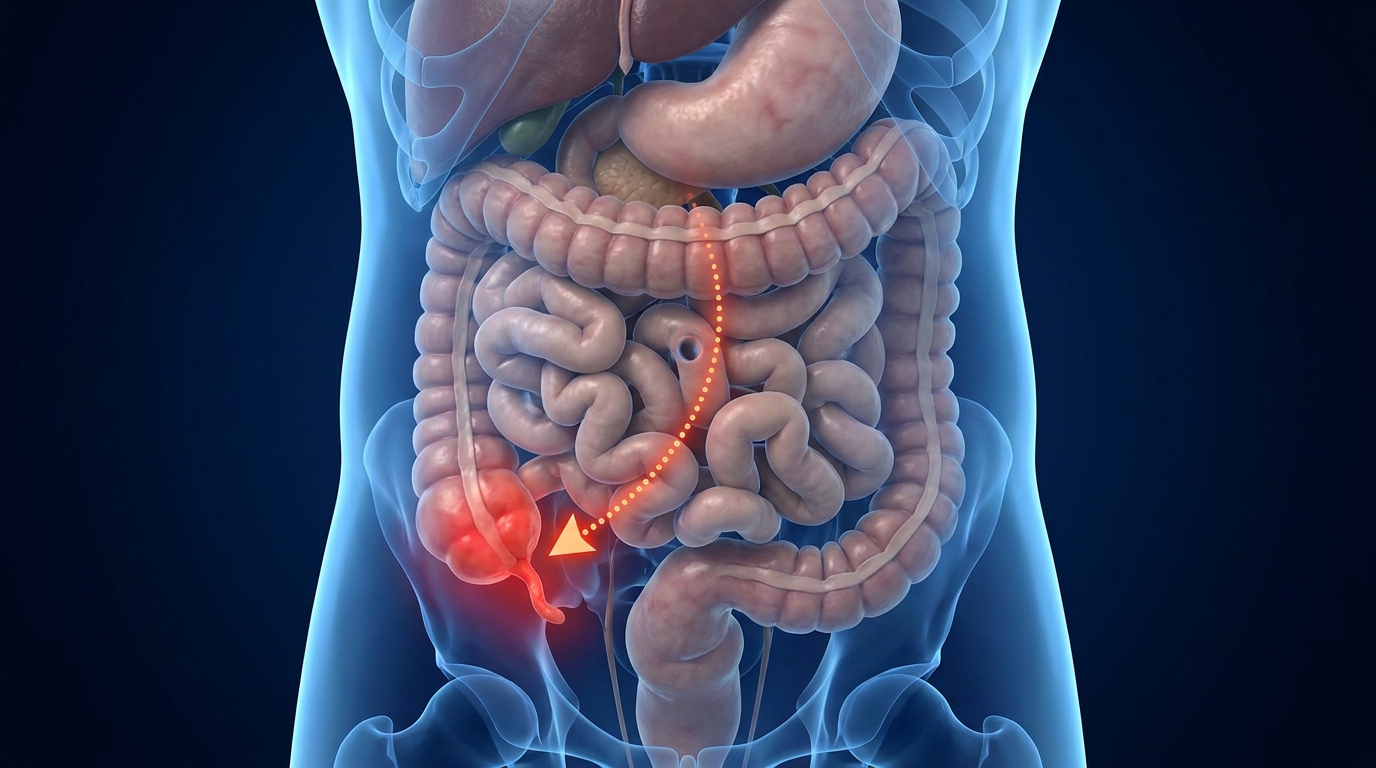
The problem is that not every patient follows this script. Children, older adults, pregnant women and people with a retrocecal appendix often present atypically. Missing appendicitis risks perforation and peritonitis, while operating on a normal appendix exposes a patient to unnecessary surgery. A scoring system helps the clinician decide who can safely go home, who needs observation or imaging, and who needs a surgeon.
3. The MANTRELS Mnemonic and Scoring Chart
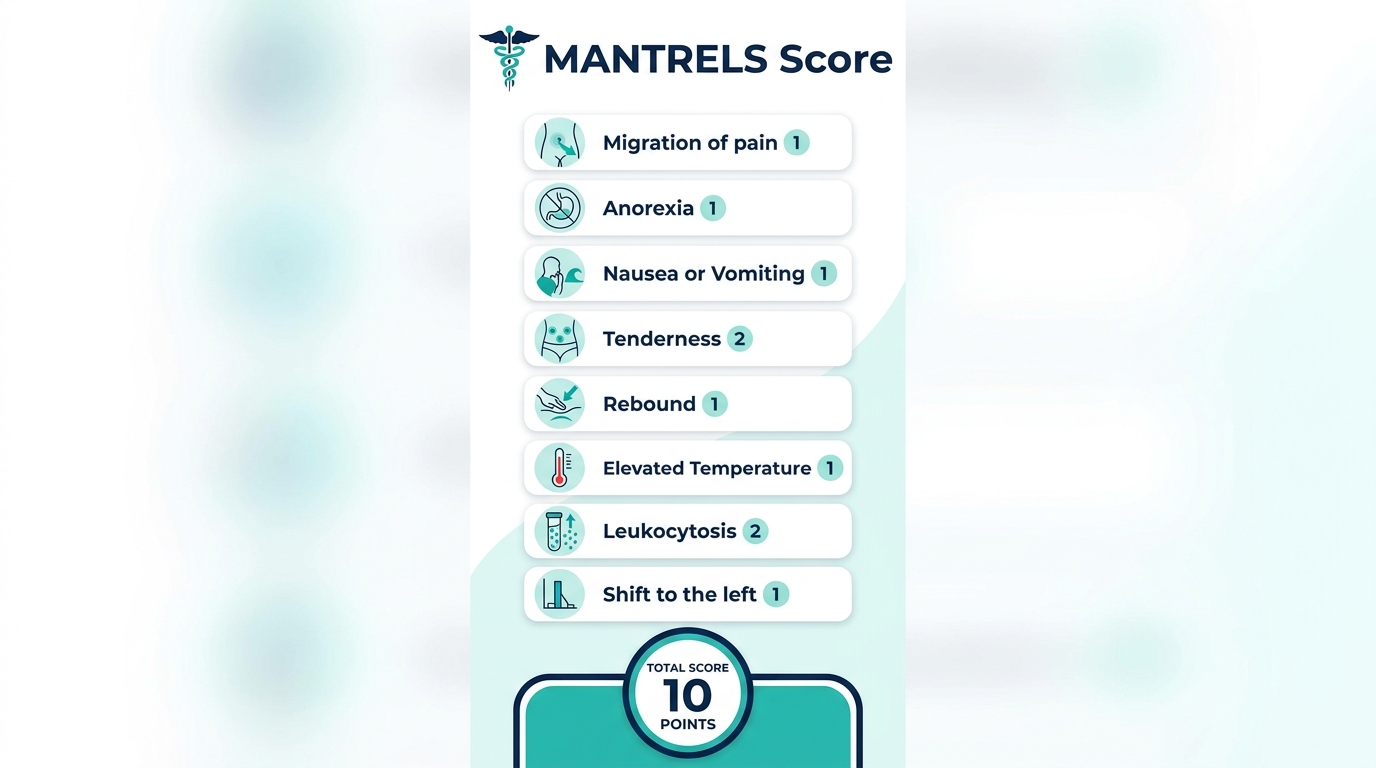
| Letter | Feature | Type | Points |
|---|---|---|---|
| M | Migration of pain to the right iliac fossa | Symptom | 1 |
| A | Anorexia (loss of appetite) | Symptom | 1 |
| N | Nausea or vomiting | Symptom | 1 |
| T | Tenderness in the right iliac fossa | Sign | 2 |
| R | Rebound tenderness | Sign | 1 |
| E | Elevated temperature (37.3 °C or above) | Sign | 1 |
| L | Leukocytosis (WBC above 10,000/µL) | Lab | 2 |
| S | Shift to the left (neutrophils above 75%) | Lab | 1 |
| Maximum total | 10 |
Memory trick: only two items score double, Tenderness and Leukocytosis. The other six score one point each. That gives 2 + 2 + 6 = 10.
4. Understanding Each Component
Migration of pain. Pain that begins near the belly button and moves to the lower right side is the classic story of appendicitis. Score 1 if the patient describes this movement.
Anorexia. Loss of appetite is very common. Many patients say they simply did not want to eat, and a person with abdominal pain who is still hungry makes appendicitis a little less likely.
Nausea or vomiting. Nausea usually follows the onset of pain. Vomiting that comes before the pain suggests gastroenteritis instead.
Tenderness in the right iliac fossa. Tenderness over McBurney’s point, roughly one-third of the way along the line from the anterior superior iliac spine to the umbilicus, is the most reliable sign. It carries two points.
Rebound tenderness. Pain that is worse when pressure is suddenly released suggests peritoneal irritation. Other signs such as Rovsing’s sign, the psoas sign and the obturator sign support the diagnosis but are not part of the score.
Elevated temperature. A low-grade fever of 37.3 °C or above scores a point. High fever early on may point toward another diagnosis or toward perforation.
Leukocytosis. A white cell count above 10,000 per microliter scores two points. Inflammation from appendicitis typically raises the count.
Shift to the left. A high proportion of neutrophils (above 75%) suggests an acute bacterial process.
5. How to Calculate the Score, Step by Step
- Take a focused history and record migration of pain, appetite and nausea or vomiting.
- Examine the abdomen for right iliac fossa tenderness and rebound tenderness.
- Record the temperature.
- Review the complete blood count for total white cells and neutrophil percentage.
- Add points using the chart and calculate the total out of 10.
- Combine the score with clinical judgment before deciding on the next step.
6. Alvarado Score Interpretation and Management
| Score | Likelihood of appendicitis | Suggested approach |
|---|---|---|
| 1–4 | Unlikely | Consider discharge with clear safety-net advice, or a short observation |
| 5–6 | Possible | Observe, repeat the examination, and consider imaging |
| 7–8 | Probable | Urgent surgical review |
| 9–10 | Very probable | Surgical review, and likely appendicectomy |
Some sources group the bands as low (below 5), intermediate (5 to 6) and high (7 or more). For example, one commonly cited study reported roughly 4% probability in the low group, about 45% in the intermediate group and about 87% in the high group in adults. The exact figures vary between populations, so always follow the protocol used in your hospital.
Role of imaging. For intermediate scores, imaging helps. Ultrasound is often the first choice in children and pregnant women because it avoids radiation, while CT or MRI may be used in other cases depending on availability and local practice.

Role of re-assessment. Appendicitis evolves over hours. A patient with a low score who is getting worse should be re-examined, not reassured by the first number.
7. Worked Examples
Example 1: High score. A 22-year-old man has pain that started around the umbilicus and moved to the right lower abdomen (1), no appetite (1), vomiting (1), right iliac fossa tenderness (2), rebound tenderness (1), temperature 37.8 °C (1), WBC 13,500 (2) and neutrophils 80% (1). Total = 10. Appendicitis is very probable and a surgical review is required.
Example 2: Intermediate score. A 30-year-old woman has right lower abdominal pain without clear migration (0), reduced appetite (1), nausea (1), right iliac fossa tenderness (2), no rebound (0), temperature 37.0 °C (0), WBC 11,200 (2) and neutrophils 70% (0). Total = 6. This is a “possible” case. Because gynecological causes are also likely, imaging (usually ultrasound first) and a pregnancy test are sensible next steps.
Example 3: Low score. A 19-year-old has generalized abdominal pain after eating outside, with loose stools (0 for migration), reduced appetite (1), vomiting (1), mild diffuse tenderness but not localized (0), no rebound (0), normal temperature (0), WBC 8,500 (0) and neutrophils 65% (0). Total = 2. Appendicitis is unlikely and gastroenteritis is more probable, though the patient should be told to return if the pain moves or worsens.
8. How Accurate Is the Alvarado Score?
Accuracy depends on the cut-off you choose and on the population being tested.
A large systematic review of 42 studies found that the score works best as a rule-out test at a cut-off of 5, with sensitivity of about 99% overall. In plain terms, very few people with appendicitis score below 5. At a cut-off of 7, the score performed poorly as a “rule-in” test, with overall specificity around 81%, and it was lowest in men at about 57%.
The same review found that the score was well calibrated in men, inconsistent in children, and tended to overestimate the probability of appendicitis in women. Individual hospital studies report varying sensitivities and specificities, which is expected because of differences in patients and in how the score is applied.
Practical message: a low Alvarado score is reassuring, but a high score is not proof. It should push you toward confirmation, not replace it.
9. Modified Alvarado Score (MASS)
The modified Alvarado score removes the “shift to the left” item. The maximum becomes 9, and the interpretation bands are adjusted. It is useful in places where differential white cell counts are not routinely available. Because published versions differ slightly, check which version your local protocol uses before comparing numbers.
10. Alvarado vs Other Appendicitis Scores
| Score | Key features |
|---|---|
| Alvarado (MANTRELS) | Symptoms, signs and WBC; widely taught and studied |
| Modified Alvarado | Drops neutrophil shift; simpler |
| Pediatric Appendicitis Score | Designed for children |
| AIR score | Adds CRP and graded findings; often better at ruling in appendicitis |
| RIPASA score | Developed in Asia; includes additional history and demographic items |
Many clinicians now combine a scoring system with imaging in a stepwise pathway instead of relying on a single score.
11. Limitations and Pitfalls
- Women of reproductive age: ovarian cysts, torsion, ectopic pregnancy and pelvic infection can mimic appendicitis, so the score may overestimate risk.
- Children: young children cannot describe migration or appetite reliably, so pediatric-specific tools are preferred.
- Older adults: they may have little fever or leukocytosis even with serious disease.
- Subjective findings: tenderness, rebound and appetite depend on the examiner and the patient.
- No imaging or CRP: modern pathways often add these for better accuracy.
- Atypical appendix position: a retrocecal or pelvic appendix may not cause classic signs.
- Early presentation: scores can be low in the first hours, then rise as the illness evolves.
Common differentials to keep in mind: mesenteric adenitis, gastroenteritis, ovarian torsion or cyst rupture, ectopic pregnancy, pelvic inflammatory disease, ureteric colic, Crohn’s disease and Meckel’s diverticulitis.
12. Practice MCQs
1. Which two Alvarado features score 2 points each?
A. Nausea and fever
B. Right iliac fossa tenderness and leukocytosis
C. Rebound tenderness and anorexia
D. Migration of pain and left shift
Answer: B
2. What is the maximum Alvarado score?
A. 8 B. 9 C. 10 D. 12
Answer: C
3. The Alvarado score is most useful for:
A. Ruling in appendicitis in women
B. Ruling out appendicitis at a low cut-off
C. Replacing ultrasound in children
D. Grading the severity of perforation
Answer: B
4. Which feature is removed in the modified Alvarado score?
A. Anorexia
B. Rebound tenderness
C. Shift to the left
D. Fever
Answer: C
5. A patient scores 6. What is the most appropriate next step?
A. Discharge without advice
B. Immediate laparotomy
C. Observation and consideration of imaging
D. Start chemotherapy
Answer: C
13. Frequently Asked Questions
What does MANTRELS stand for?
Migration of pain, Anorexia, Nausea or vomiting, Tenderness in the right iliac fossa, Rebound tenderness, Elevated temperature, Leukocytosis and Shift to the left.
What Alvarado score indicates surgery?
Scores of 7 or more usually prompt urgent surgical review, but the final decision depends on the whole clinical picture.
Can appendicitis occur with a low Alvarado score?
Yes. The score is a guide, and early or atypical cases can score low. Worsening symptoms need re-examination.
Is the Alvarado score accurate in women?
It tends to overestimate the probability of appendicitis in women, so imaging is often needed.
Is the Alvarado score used in children?
It is used, but its accuracy is inconsistent, and pediatric-specific scores are often preferred.
What is a normal Alvarado score?
Scores of 1 to 4 make appendicitis unlikely.
How is the modified Alvarado score different?
It leaves out the neutrophil shift, so the maximum is 9.
Can I calculate my own Alvarado score at home?
No. It needs a clinical examination and blood tests. If you have worsening right lower abdominal pain, seek medical care urgently.
Alvarado Score (MANTRELS) Knowledge Quiz
Available options: 1 to 20
14. Key Takeaways
- The Alvarado (MANTRELS) score is a 10-point tool for suspected appendicitis.
- Right iliac fossa tenderness and leukocytosis score 2 points each, and the other six items score 1 point each.
- A score of 1 to 4 makes appendicitis unlikely, 5 to 6 is intermediate, and 7 or more is high risk.
- It works best for ruling out appendicitis and is less reliable in women and children.
- It should always be combined with clinical judgment, repeat examination and imaging when needed.
Disclaimer: This article is for educational purposes only and is not a substitute for professional medical advice, diagnosis or treatment. If you suspect appendicitis, seek urgent medical care.
References (add at the bottom of your post):
- Alvarado A. A practical score for the early diagnosis of acute appendicitis. Ann Emerg Med, 1986.
- Ohle R, et al. The Alvarado score for predicting acute appendicitis: a systematic review. BMC Medicine, 2011.