


“How much should I weigh?” is one of the most common health questions, and doctors, pharmacists and dietitians have a quick way to estimate an answer: the ideal body weight (IBW) formula. These formulas use only your height and sex, so they are easy to calculate by hand. This guide explains the four main formulas, shows you how to use them with examples, and explains where they are useful and where they fall short.
Table of Contents
- What is ideal body weight?
- Where the formulas came from
- The four ideal body weight formulas
- How to calculate it step by step
- Worked examples
- Ideal body weight chart (Devine)
- Using centimetres instead of inches
- Adjusted body weight for drug dosing
- IBW vs BMI
- Limitations
- Frequently asked questions
- Key takeaways
1. What Is Ideal Body Weight?
Ideal body weight is an estimate of the weight that is expected to suit a healthy adult of a given height and sex. It is not a perfect target or a diagnosis. It is a reference point that clinicians use to judge whether someone is far above or below the expected range, and to calculate doses for certain medicines.
2. Where the Formulas Came From
Early ideal weight rules came from insurance height-weight tables, which linked certain weights with lower mortality. In 1974, Dr. Devine published a simple equation that converted an older rule of thumb into kilograms. It was first used to estimate drug metabolism and clearance, because many drugs behave more in line with ideal weight than with total body weight.
Other formulas followed: Hamwi in 1964, and Robinson and Miller in 1983. They look different, but they were built from similar height-weight data, so their answers are usually close to each other.
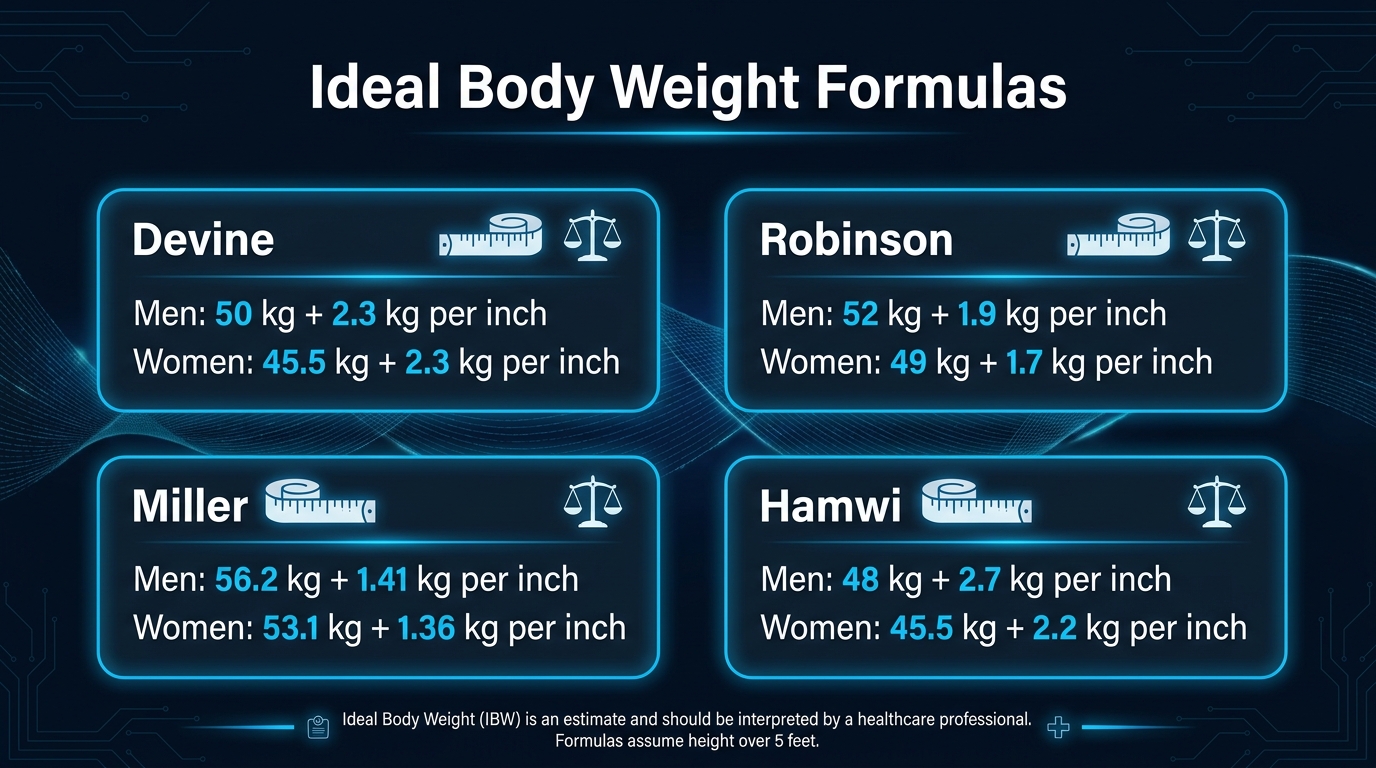
3. The Four Ideal Body Weight Formulas
All four use the number of inches over 5 feet (60 inches).
| Formula | Men | Women |
|---|---|---|
| Devine (1974) | 50 kg + 2.3 kg per inch | 45.5 kg + 2.3 kg per inch |
| Robinson (1983) | 52 kg + 1.9 kg per inch | 49 kg + 1.7 kg per inch |
| Miller (1983) | 56.2 kg + 1.41 kg per inch | 53.1 kg + 1.36 kg per inch |
| Hamwi (1964) | 48 kg + 2.7 kg per inch | 45.5 kg + 2.2 kg per inch |
Which one should you use? The Devine formula is the most widely used in clinical practice and for drug dosing. Robinson is slightly lower for tall people, Miller is the most generous, and Hamwi rises fastest as height increases.
4. How to Calculate Ideal Body Weight Step by Step
- Measure your height without shoes.
- Convert it to inches (1 foot = 12 inches).
- Subtract 60 inches (5 feet).
- Multiply the remainder by the per-inch value for your chosen formula and sex.
- Add the result to the base weight.
Prefer not to calculate by hand? Try the medical calculators on Clinic Side for quick health checks.
General form:
IBW (kg) = base weight + (per-inch value × (height in inches − 60))5. Worked Examples
Example 1: A man who is 5 ft 8 in tall (68 inches, 8 inches over 5 feet)
| Formula | Calculation | IBW |
|---|---|---|
| Devine | 50 + 2.3 × 8 | 68.4 kg |
| Robinson | 52 + 1.9 × 8 | 67.2 kg |
| Miller | 56.2 + 1.41 × 8 | 67.5 kg |
| Hamwi | 48 + 2.7 × 8 | 69.6 kg |
All four land between about 67 and 70 kg.
Example 2: A woman who is 5 ft 4 in tall (64 inches, 4 inches over 5 feet)
| Formula | Calculation | IBW |
|---|---|---|
| Devine | 45.5 + 2.3 × 4 | 54.7 kg |
| Robinson | 49 + 1.7 × 4 | 55.8 kg |
| Miller | 53.1 + 1.36 × 4 | 58.5 kg |
| Hamwi | 45.5 + 2.2 × 4 | 54.3 kg |
Here the results spread from about 54 to 58 kg, so a range is more honest than a single number.
6. Ideal Body Weight Chart (Devine Formula)
| Height | Men (kg) | Women (kg) |
|---|---|---|
| 5 ft 0 in | 50.0 | 45.5 |
| 5 ft 1 in | 52.3 | 47.8 |
| 5 ft 2 in | 54.6 | 50.1 |
| 5 ft 3 in | 56.9 | 52.4 |
| 5 ft 4 in | 59.2 | 54.7 |
| 5 ft 5 in | 61.5 | 57.0 |
| 5 ft 6 in | 63.8 | 59.3 |
| 5 ft 7 in | 66.1 | 61.6 |
| 5 ft 8 in | 68.4 | 63.9 |
| 5 ft 9 in | 70.7 | 66.2 |
| 5 ft 10 in | 73.0 | 68.5 |
| 5 ft 11 in | 75.3 | 70.8 |
| 6 ft 0 in | 77.6 | 73.1 |
| 6 ft 1 in | 79.9 | 75.4 |
| 6 ft 2 in | 82.2 | 77.7 |
7. Using Centimetres Instead of Inches
If you know your height in centimetres, convert the “inches over 60” part with this rule:
Inches over 60 = (height in cm − 152.4) / 2.54So the Devine formula in centimetres becomes roughly:
Men:   IBW (kg) = 50   + 0.906 × (height in cm − 152.4)
Women: IBW (kg) = 45.5 + 0.906 × (height in cm − 152.4)
Example: A woman who is 165 cm tall: 45.5 + 0.906 × (165 − 152.4) = 45.5 + 11.4 = 56.9 kg.
8. Adjusted Body Weight for Drug Dosing
Many medicines are dosed by weight. For patients who are overweight or obese, using actual body weight can lead to too high a dose for drugs that do not distribute well into fat. In these cases some protocols use an adjusted (dosing) body weight:
Dosing weight = IBW + 0.4 × (actual weight − IBW)If the patient’s actual weight is lower than the IBW, the actual weight is used.
Example: A man with an IBW of 68.4 kg and an actual weight of 100 kg:
68.4 + 0.4 × (100 − 68.4) = 68.4 + 12.6 = 81.0 kg.
Only use this for drugs where the guidance specifically recommends adjusted weight. Doses should always follow the drug’s own guidelines and a pharmacist’s or doctor’s advice.

9. Ideal Body Weight vs BMI
| Feature | Ideal body weight | BMI |
|---|---|---|
| Gives | A single target weight | A weight range (18.5 to 24.9 is the usual healthy band) |
| Uses | Height and sex | Height and weight |
| Main clinical use | Drug dosing, nutrition estimates | Screening for underweight, overweight and obesity |
For a 5 ft 8 in adult (about 172.7 cm), a BMI of 18.5 to 24.9 corresponds to roughly 55 to 74 kg. The IBW values from the formulas (about 67 to 70 kg for a man) fall inside that band. You can check your own BMI with the BMI calculator on this site.
10. Limitations of Ideal Body Weight Formulas
- They ignore body composition. A muscular athlete may weigh more than the formula suggests and still be very healthy.
- They ignore age, ethnicity and frame size. The formulas were built from specific populations.
- They do not apply to children, pregnant women or some medical conditions.
- They are less meaningful for very short or very tall people, because the formulas extend a straight line from the 5-foot mark.
- Different formulas give different numbers, so use the result as a range, not an exact target.
- They are not a measure of health. Waist size, blood pressure, blood sugar and fitness matter as well.

12. Frequently Asked Questions
What is the ideal body weight formula?
The most common is the Devine formula: 50 kg + 2.3 kg per inch over 5 feet for men, and 45.5 kg + 2.3 kg per inch over 5 feet for women.
Which ideal body weight formula is most accurate?
No formula is perfectly accurate. Devine is the most widely used clinically, and the others give similar results, so a range is better than one number.
What is the ideal body weight for a woman who is 5 ft 4 in?
About 54.7 kg using the Devine formula, and roughly 54 to 58 kg across the four formulas.
Is ideal body weight the same as healthy weight?
Not exactly. IBW gives a single estimate, while a healthy weight is usually described as a range, often based on BMI.
Why do doctors use ideal body weight?
Mainly to calculate drug doses and nutritional needs, because many medicines relate more closely to ideal weight than to total body weight.
What is the difference between ideal and lean body weight?
Ideal body weight comes from height-weight tables and formulas, while lean body weight refers to the weight of the body without fat.
Can ideal body weight be used for children?
No. These formulas are for adults, and children are assessed with growth charts.
Should I aim for my ideal body weight exactly?
Not necessarily. Use it as a rough reference and talk to a doctor or dietitian about a healthy goal for your body.
Ideal Body Weight Formula Knowledge Quiz
Available options: 1 to 20
13. Key Takeaways
- Ideal body weight is estimated from height and sex using formulas such as Devine, Robinson, Miller and Hamwi.
- Devine (50 kg for men or 45.5 kg for women, plus 2.3 kg per inch over 5 feet) is the most commonly used.
- The formulas give similar but not identical answers, so think in ranges.
- Adjusted body weight (IBW + 0.4 × excess weight) is sometimes used for dosing in overweight patients.
- IBW ignores muscle mass, age and health, so use it with BMI, waist size and a doctor’s advice.
Disclaimer: This article is for educational purposes only and is not a substitute for professional medical advice. Consult a doctor, pharmacist or dietitian for personal health or dosing decisions.
References
- Pai MP, Paloucek FP. The origin of the “ideal” body weight equations. Ann Pharmacother. 2000;34(9):1066-9.
- Devine BJ. Gentamicin therapy. Drug Intell Clin Pharm. 1974.
- Robinson JD, et al. Am J Hosp Pharm. 1983;40(6):1016-9.