


When a baby is born and the mother’s dates are uncertain, doctors still need to know how mature the baby is. A baby born at 30 weeks needs very different care from one born at 40 weeks. The Ballard score is a bedside tool that estimates gestational age by examining the newborn’s body and muscle tone. This guide covers the full chart, the formula, how the exam is done, worked examples and the limitations you should know.
Table of Contents
- What is the Ballard score?
- History: from Dubowitz to the New Ballard score
- Why gestational age matters
- Structure of the score
- Neuromuscular maturity chart
- Physical maturity chart
- Ballard score to gestational age table and formula
- How to perform the exam, step by step
- Worked examples
- Classification of the newborn
- Limitations of the Ballard score
- Ballard vs other methods
- Tips for students and nurses
- Practice MCQs
- Frequently asked questions
- Key takeaways
1. What Is the Ballard Score?
The Ballard score, also called the Ballard maturational assessment, estimates a newborn’s gestational age from 12 physical and neuromuscular signs. A baby’s muscle tone and body features change in a predictable way as pregnancy advances, so adding up these signs gives a number that can be converted to weeks.
It is mainly used when the last menstrual period is unknown or unreliable and no early ultrasound dating is available, which is common in busy hospitals and in places where antenatal care is limited.
2. History: From Dubowitz to the New Ballard Score
Before Ballard, the Dubowitz score was the standard method for assessing newborn maturity. It was accurate but long, with many items to assess. Dr. Jeanne Ballard and colleagues adapted it into a shorter system built on 6 physical and 6 neuromuscular criteria, which became the original Ballard score and covered babies from about 26 to 44 weeks.
As survival of very premature babies improved, doctors needed a tool for babies below 26 weeks. In 1991 the New Ballard Score was published, adding negative scores so the scale could extend down to 20 weeks. This expanded version is the one used today.
3. Why Gestational Age Matters
Gestational age is one of the strongest predictors of a newborn’s outcome. Knowing it helps the team:
- Decide whether the baby is preterm, term or post-term.
- Plan breathing support, since premature lungs lack surfactant.
- Plan feeding, because sucking and swallowing coordination develops late.
- Plan temperature control, since preterm babies lose heat quickly.
- Judge whether the baby’s weight is small, appropriate or large for age.
- Anticipate problems such as jaundice, hypoglycemia and infection.
- Counsel parents honestly about risks.

4. Structure of the Score
The exam has two sections, each with six criteria, and each section contributes up to 25 points.
| Section | Number of criteria | Maximum points |
|---|---|---|
| Neuromuscular maturity | 6 | 25 |
| Physical maturity | 6 | 25 |
| Total | 12 | 50 |
Scores can also be negative, which is why the total ranges from −10 to 50.
5. Neuromuscular Maturity Chart
Muscle tone develops from the inside out and from the bottom up. Preterm babies lie floppy and extended, while term babies rest in a flexed posture and resist stretching.

Posture (baby lying quietly on the back)
| Score | Finding |
|---|---|
| 0 | Arms and legs extended |
| 1 | Beginning flexion of hips and knees, arms extended |
| 2 | Stronger flexion of legs, arms extended |
| 3 | Arms slightly flexed, legs flexed and abducted |
| 4 | Full flexion of arms and legs |
Square window (wrist): flex the hand toward the forearm and measure the angle.
| Score | Angle |
|---|---|
| −1 | More than 90° |
| 0 | 90° |
| 1 | 60° |
| 2 | 45° |
| 3 | 30° |
| 4 | 0° |
Arm recoil: flex the forearms for 5 seconds, extend them, then release.
| Score | Finding |
|---|---|
| 0 | Arms stay extended (180°), no recoil |
| 1 | Minimal recoil (140° to 180°) |
| 2 | Slow recoil (110° to 140°) |
| 3 | Moderate recoil (90° to 110°) |
| 4 | Brisk return to flexion (less than 90°) |
Popliteal angle: with the thigh flexed on the abdomen, extend the leg and measure the angle behind the knee.
| Score | Angle |
|---|---|
| −1 | 180° |
| 0 | 160° |
| 1 | 140° |
| 2 | 120° |
| 3 | 100° |
| 4 | 90° |
| 5 | Less than 90° |
Scarf sign: pull the baby’s hand across the neck toward the opposite shoulder and see how far the elbow moves.
| Score | Finding |
|---|---|
| −1 | Elbow passes the opposite axillary line easily |
| 0 | Elbow reaches the opposite anterior axillary line |
| 1 to 3 | Elbow moves progressively less far |
| 4 | Elbow does not reach the midline |
Heel to ear: bring the foot toward the ear on the same side.
| Score | Finding |
|---|---|
| −1 | Heel touches the ear easily |
| 0 to 3 | Progressively more resistance |
| 4 | Foot cannot approach the ear |
6. Physical Maturity Chart
Physical signs change as the skin thickens, fat is laid down, cartilage firms up and lanugo disappears.
Skin
| Score | Finding |
|---|---|
| −1 | Sticky, friable, transparent |
| 0 | Gelatinous, red, translucent |
| 1 | Smooth, pink, visible veins |
| 2 | Superficial peeling or rash, few veins |
| 3 | Cracking, pale areas, rare veins |
| 4 | Parchment-like, deep cracking, no visible vessels |
| 5 | Leathery, cracked, wrinkled |
Lanugo
| Score | Finding |
|---|---|
| −1 | None |
| 0 | Sparse |
| 1 | Abundant |
| 2 | Thinning |
| 3 | Bald areas |
| 4 | Mostly bald |
Plantar surface
| Score | Finding |
|---|---|
| −2 | Heel-to-toe distance under 40 mm |
| −1 | Heel-to-toe distance 40 to 50 mm |
| 0 | Over 50 mm, no creases |
| 1 | Faint red marks |
| 2 | Anterior transverse crease only |
| 3 | Creases over anterior two-thirds |
| 4 | Creases over the entire sole |
Breast
| Score | Finding |
|---|---|
| −1 | Imperceptible |
| 0 | Barely perceptible |
| 1 | Flat areola, no bud |
| 2 | Stippled areola, 1 to 2 mm bud |
| 3 | Raised areola, 3 to 4 mm bud |
| 4 | Full areola, 5 to 10 mm bud |
Eye and ear
| Score | Finding |
|---|---|
| −2 | Eyelids fused tightly |
| −1 | Eyelids fused loosely |
| 0 | Lids open, pinna flat, stays folded |
| 1 | Slightly curved pinna, soft, slow recoil |
| 2 | Well-curved pinna, soft but ready recoil |
| 3 | Formed and firm, instant recoil |
| 4 | Thick cartilage, ear stiff |
Genitals (male)
| Score | Finding |
|---|---|
| −1 | Scrotum flat and smooth |
| 0 | Scrotum empty, faint rugae |
| 1 | Testes in upper canal, rare rugae |
| 2 | Testes descending, few rugae |
| 3 | Testes down, good rugae |
| 4 | Testes pendulous, deep rugae |
Genitals (female)
| Score | Finding |
|---|---|
| −1 | Clitoris prominent, labia flat |
| 0 | Prominent clitoris, small labia minora |
| 1 | Prominent clitoris, enlarging labia minora |
| 2 | Majora and minora equally prominent |
| 3 | Majora large, minora small |
| 4 | Majora cover the clitoris and minora |
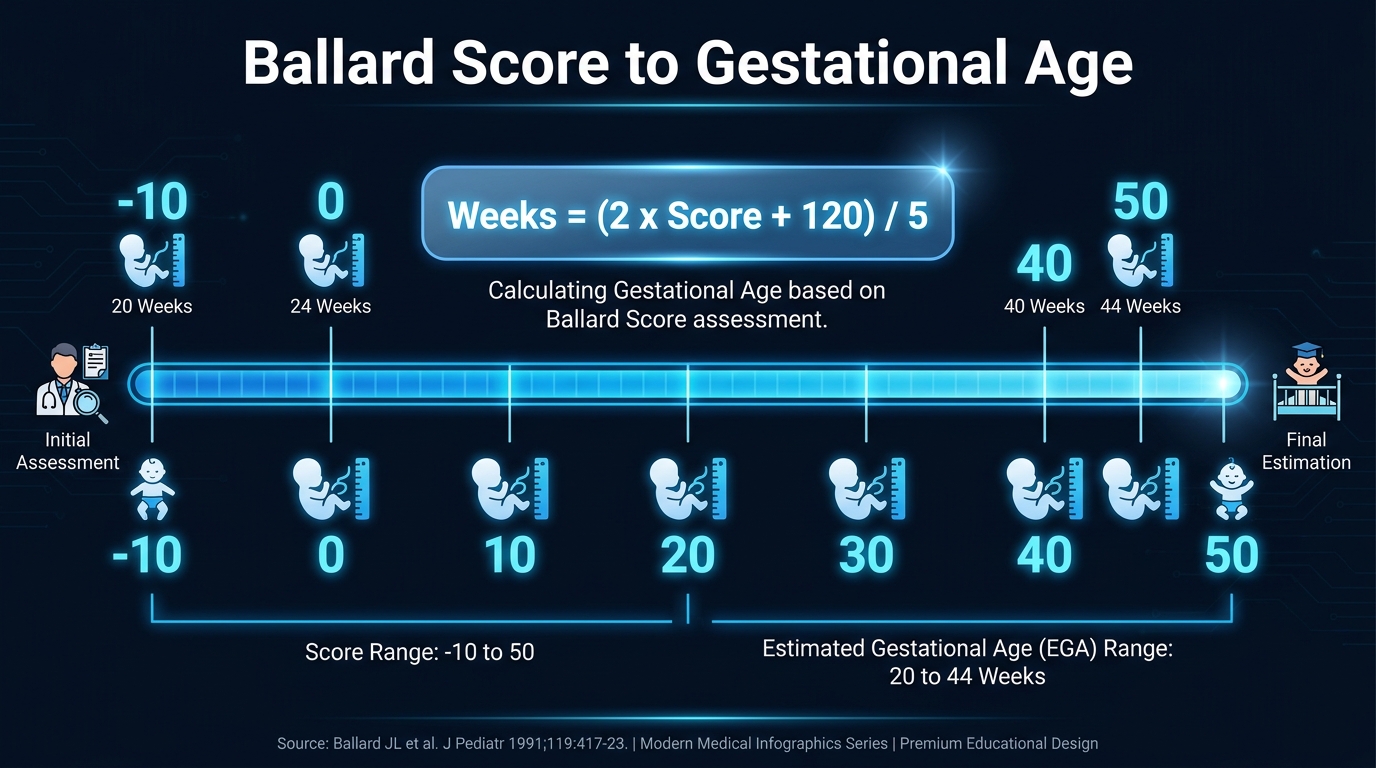
7. Ballard Score to Gestational Age
| Total score | Gestational age (weeks) |
|---|---|
| −10 | 20 |
| −5 | 22 |
| 0 | 24 |
| 5 | 26 |
| 10 | 28 |
| 15 | 30 |
| 20 | 32 |
| 25 | 34 |
| 30 | 36 |
| 35 | 38 |
| 40 | 40 |
| 45 | 42 |
| 50 | 44 |
Formula:
Gestational age (weeks) = (2 × total score + 120) / 5Every 5-point increase in the score adds 2 weeks, so you can also interpolate between rows of the table.
8. How to Perform the Exam, Step by Step
Preparation
- Wash your hands, warm them and keep the room warm.
- Make sure the baby is clinically stable and able to tolerate handling.
- Place the baby on a flat, warm surface and keep monitoring if the baby is on support.
Examination
4. Score posture first, while the baby is lying undisturbed.
5. Examine the remaining neuromuscular signs gently, never forcing a joint past resistance.
6. Examine the physical signs, looking at skin, lanugo, soles, breast, eyes and ears, and genitals.
7. Score each of the 12 criteria and write the values in the chart.
Calculation
8. Add the neuromuscular and physical scores.
9. Convert the total to weeks using the chart or the formula.
10. Document the result with the time of examination and the baby’s age in hours.
Timing: The exam is most accurate in the first hours of life. Extremely preterm babies are best examined within about 12 hours. In more mature babies, the score stays fairly reliable for a few days, but neuromuscular signs can change as the baby gets older or becomes ill, so earlier is better.
9. Worked Examples
Example 1: Term baby.
Neuromuscular score = 18 and physical score = 18. Total = 36.
Gestational age = (2 × 36 + 120) / 5 = 192 / 5 = 38.4 weeks, so about 38 weeks, which is term.
Example 2: Very preterm baby.
Neuromuscular score = 5 and physical score = 7. Total = 12.
Gestational age = (2 × 12 + 120) / 5 = 144 / 5 = 28.8 weeks, so about 29 weeks. The baby is very preterm and will need neonatal intensive care.
Example 3: Late term baby.
Neuromuscular score = 22 and physical score = 21. Total = 43.
Gestational age = (2 × 43 + 120) / 5 = 206 / 5 = 41.2 weeks, so about 41 weeks. The baby is term, near the upper end.

10. Classification of the Newborn
By gestational age
| Gestational age | Category |
|---|---|
| Below 28 weeks | Extremely preterm |
| 28 to under 32 weeks | Very preterm |
| 32 to under 37 weeks | Moderate to late preterm |
| 37 to 41 weeks and 6 days | Term |
| 42 weeks or more | Post-term |
By weight for gestational age
Once gestational age is known, the birth weight is plotted on a growth chart.
| Category | Meaning |
|---|---|
| Small for gestational age (SGA) | Weight below the 10th percentile |
| Appropriate for gestational age (AGA) | Weight between the 10th and 90th percentile |
| Large for gestational age (LGA) | Weight above the 90th percentile |
A baby can be preterm and AGA, or term and SGA, and the care needed for each is different.
11. Limitations of the Ballard Score
- It is subjective. Different examiners can score the same baby differently, especially for tone-based signs.
- Sick babies are harder to assess. Sedation, birth asphyxia, infection, hypotonia and neurological problems can reduce muscle tone and make the baby look less mature.
- It can differ from other dating methods. In some babies the Ballard estimate is a few weeks higher than gestational age by dates, and it may overestimate gestational age in very preterm infants.
- Early ultrasound is better. When a reliable first-trimester ultrasound is available, it is usually preferred for dating.
- Accuracy drops with age. Results are less reliable if the exam is delayed or the baby is already unwell.
- Extremes of age are less validated. Scores at the very top and bottom of the scale correspond to ages that are not fully validated.
12. Ballard vs Other Methods
| Method | Key points |
|---|---|
| Ballard / New Ballard | 12 criteria, covers 20 to 44 weeks, widely used |
| Dubowitz | Older, more detailed, takes longer |
| Capurro | Simpler, uses fewer signs |
| Early ultrasound | Most reliable when done early in pregnancy |
| LMP dating | Depends on accurate recall of dates |
In practice, clinicians combine the best available information, and the Ballard score fills the gap when dates are uncertain.
13. Tips for Students and Nurses
- Learn the neuromuscular signs as “flexion increases with maturity” and the physical signs as “skin thickens, lanugo disappears, creases and cartilage appear”.
- Remember that the square window and popliteal angle are the two measurements that need a protractor-like estimate, so practice them on a model.
- Always record the baby’s age in hours at the time of the exam.
- If the baby is sedated or sick, interpret the neuromuscular score with caution.
- Mention the method used (Ballard, New Ballard or Dubowitz) when documenting.
15. Frequently Asked Questions
What is the Ballard score used for?
It estimates a newborn’s gestational age from physical and neuromuscular signs when pregnancy dates are unknown or unreliable.
What is a normal Ballard score for a term baby?
A total of about 35 to 45 corresponds to roughly 38 to 42 weeks, which is term.
What is the formula for the Ballard score?
Gestational age in weeks equals (2 × total score + 120) divided by 5.
What is the difference between the Ballard score and the New Ballard score?
The New Ballard score added negative values so it can assess extremely premature babies from 20 weeks, while the original started at about 26 weeks.
Is the Ballard score accurate?
It is a useful bedside estimate, but it is less accurate than early ultrasound dating and can vary between examiners and in sick babies.
When should the Ballard exam be done?
As soon as the baby is stable, ideally in the first hours of life, and within about 12 hours in extremely preterm babies.
Who performs the Ballard score?
Trained pediatricians, neonatologists and nurses.
How long does the exam take?
A trained examiner can usually complete it in a few minutes.
Can the Ballard score be done on a premature baby on a ventilator?
Yes, if the baby is stable enough to tolerate handling, but findings must be interpreted carefully because illness and sedation affect tone.
Can parents calculate the Ballard score?
No. It needs a trained examiner and a proper bedside assessment.
Ballard Score Knowledge Quiz
Available options: 1 to 20
16. Key Takeaways
- The Ballard score estimates gestational age from 6 neuromuscular and 6 physical signs.
- The New Ballard score ranges from −10 to 50 and covers 20 to 44 weeks.
- Every 5 points equals 2 weeks, and the formula is (2 × score + 120) / 5.
- Neuromuscular signs show increasing flexion, and physical signs show thicker skin, less lanugo and firmer cartilage with maturity.
- It is subjective and less reliable in sick babies or when the exam is delayed.
- Early ultrasound remains the preferred method for dating when available.
Disclaimer: This article is for educational purposes only and does not replace professional medical advice. Newborn assessment should be performed by a trained clinician.
References
- Ballard JL, Khoury JC, Wedig K, et al. New Ballard Score, expanded to include extremely premature infants. J Pediatr, 1991.
- StatPearls: Ballard and Dubowitz Neonatal Assessments for Gestational Age Determination.